
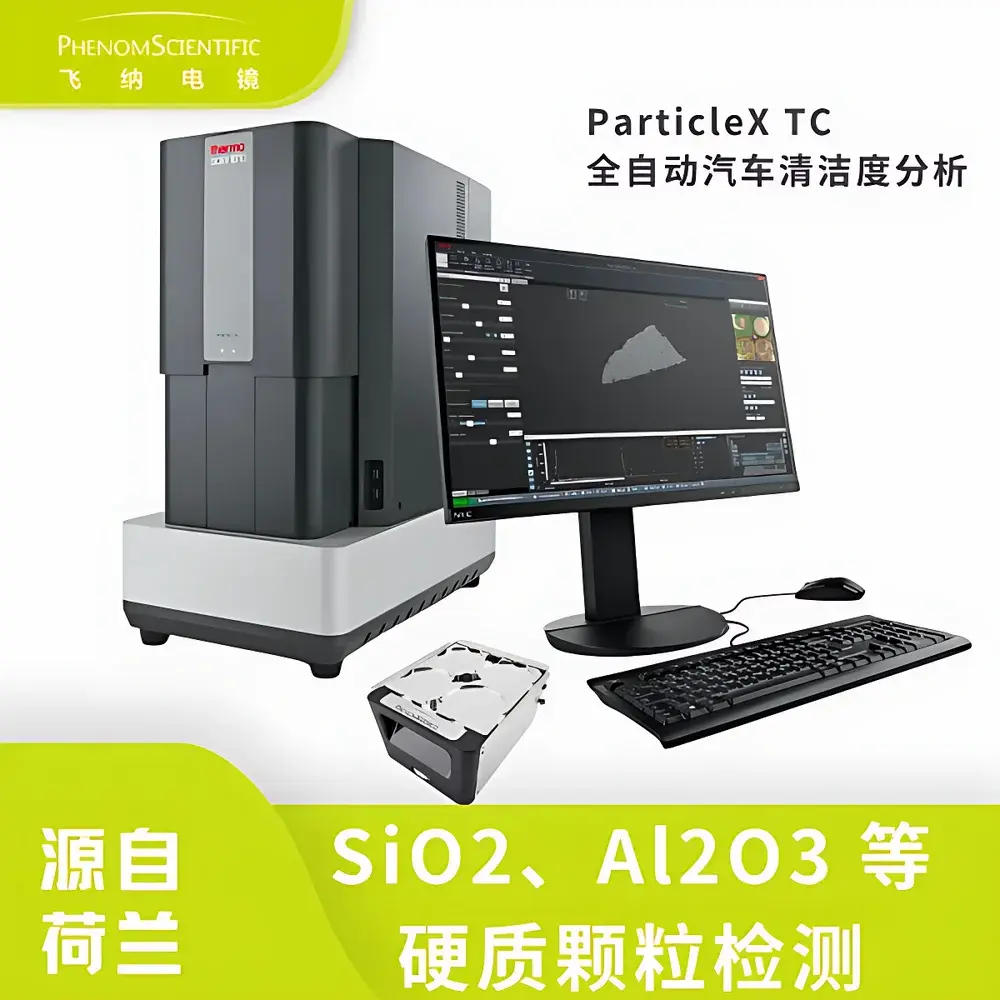
Phenom ParticleX TC Automotive Cleanliness Analysis System – Hard Particle Identification, Composition & Hardness Analysis
| Brand | Phenom |
|---|---|
| Origin | Netherlands |
| Manufacturer | Thermo Fisher Scientific (Phenom brand) |
| Import Category | Imported Instrument |
| Model | ParticleX TC Automotive Cleanliness |
| Instrument Type | Benchtop Scanning Electron Microscope (SEM) |
| Electron Source | Cerium Hexaboride (CeB₆) |
| Secondary Electron (SE) Resolution | 8 nm |
| Maximum Magnification | 200,000× |
| Accelerating Voltage Range | Standard Modes: 2 kV, 5 kV, 10 kV, 15 kV, 20 kV |
| Advanced Mode | Continuously Adjustable from 4.8 kV to 20.5 kV |
| Backscattered Electron (BSE) Resolution | 8 nm |
| Max Sample Capacity | Up to four 47 mm diameter filter membranes simultaneously |
| Standard Detectors | BSE Detector, Energy-Dispersive X-ray Spectrometer (EDS) |
| Optional Detector | Secondary Electron Detector (SED) |
Overview
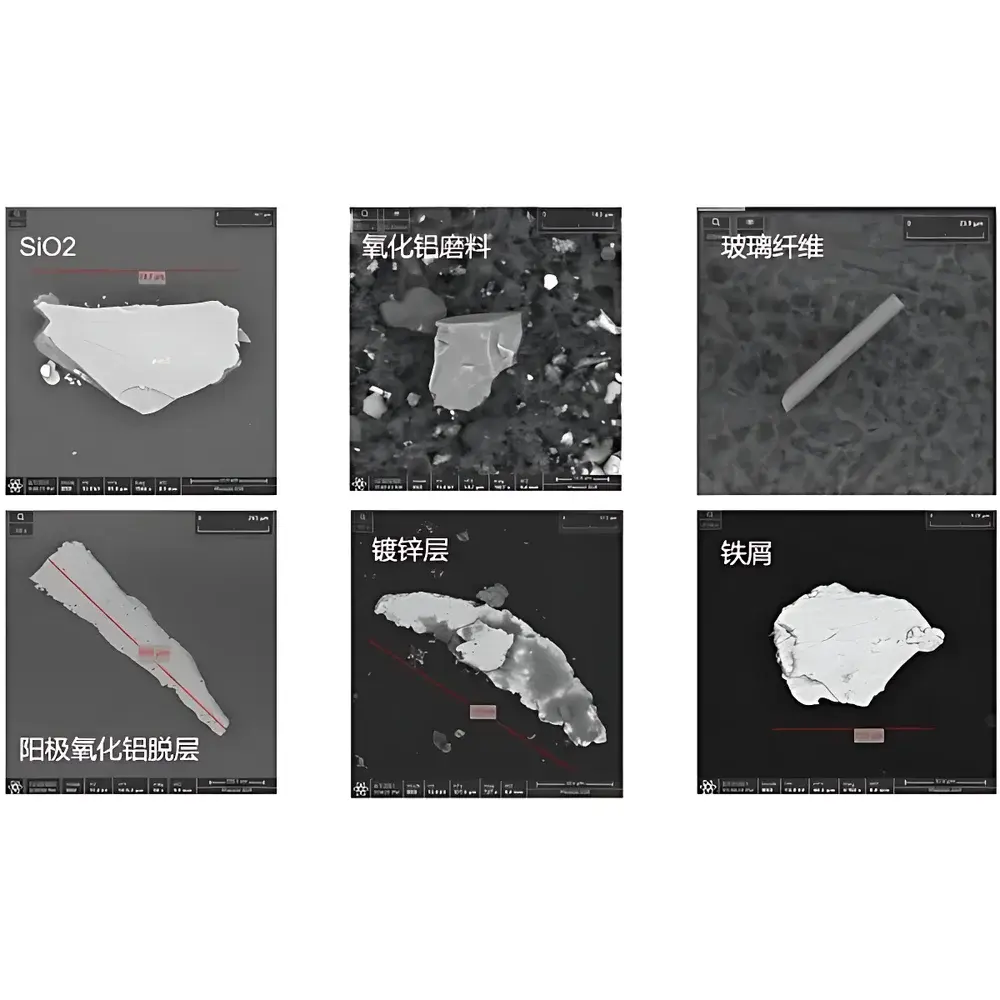
The Phenom ParticleX TC Automotive Cleanliness Analysis System is a fully automated benchtop scanning electron microscope (SEM) integrated with energy-dispersive X-ray spectroscopy (EDS), engineered specifically for quantitative particulate contamination analysis in automotive component manufacturing and quality assurance. Unlike conventional gravimetric or optical microscopy methods—limited to bulk mass estimation or morphological description—the ParticleX TC employs high-resolution SEM imaging combined with elemental microanalysis to identify, classify, and geochemically characterize individual particles ≥0.5 µm on filtration membranes. Its core measurement principle relies on electron–sample interaction: incident electrons generate secondary electrons (for topographic contrast), backscattered electrons (for atomic number contrast), and characteristic X-rays (for elemental composition). This tri-modal detection enables unambiguous differentiation between metallic wear debris, ceramic abrasives, polymer fragments, and environmental contaminants—directly supporting root-cause analysis of process-induced contamination.
Key Features
- Benchtop architecture with CeB₆ thermionic electron source, delivering stable beam current and extended source lifetime without ultra-high vacuum requirements.
- Automated multi-membrane workflow: simultaneous loading and sequential analysis of up to four 47 mm filter membranes under consistent imaging and acquisition parameters.
- Integrated EDS detector with real-time spectrum acquisition, enabling rapid qualitative and semi-quantitative elemental identification (Z ≥ 5) at each particle location.
- Intelligent particle recognition engine using morphology, grayscale thresholding, and compositional clustering algorithms compliant with ISO 16232-10 and VDA 19-2015 Annex A.
- Variable accelerating voltage control (4.8–20.5 kV continuous) optimized for low-voltage surface-sensitive imaging of insulating particles and high-kV penetration for bulk-phase analysis.
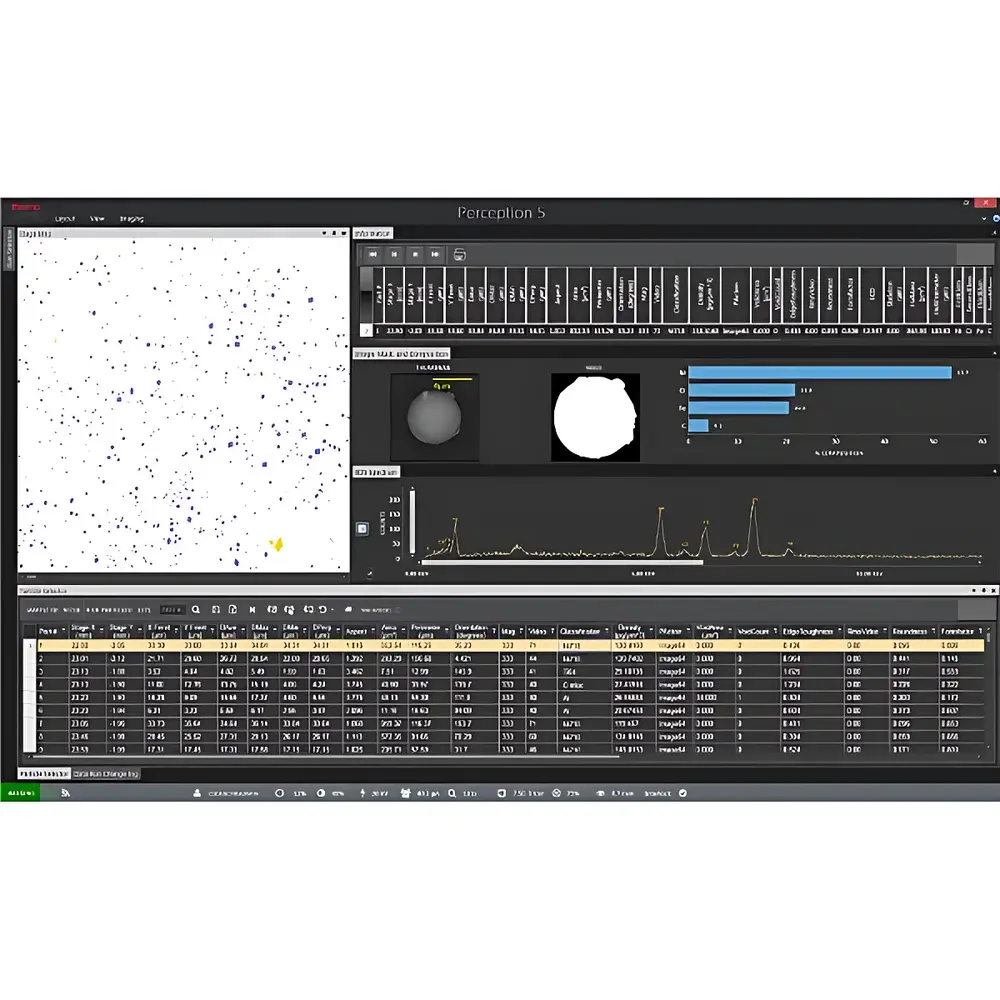
- Zero-touch operation: automated stage navigation, focus/stigmation correction, particle detection, EDS point analysis, and report generation—all initiated via single-button interface.
Sample Compatibility & Compliance
The system accepts standard 47 mm diameter polycarbonate, mixed cellulose ester (MCE), or polyvinylidene fluoride (PVDF) filter membranes used in automotive fluid and component rinsing protocols. It supports both dry and conductive-coated samples; optional low-vacuum mode accommodates non-conductive or hydrated residues without sputter coating. All analytical workflows adhere strictly to ISO 16232 (Road vehicles — Cleanliness of components of fluid circuits) Parts 1–12, particularly Part 10 (Particle characterization by SEM/EDS), and VDA 19.1 (Contamination analysis in the automotive industry). Audit-ready metadata—including acquisition time stamps, instrument settings, detector calibrations, and user authentication logs—is embedded into every dataset, satisfying GLP/GMP documentation requirements and facilitating FDA 21 CFR Part 11-compliant electronic records when deployed with validated software configurations.
Software & Data Management
The ParticleX TC operates on Phenom’s proprietary Cleanliness Analysis Software Suite (v5.3+), which provides a validated, locked-down environment for method-driven analysis. The software enforces standardized particle classification rules (e.g., ISO 16232-defined size bins: >5 µm, >15 µm, >25 µm, >50 µm, >100 µm) and composition-based categories (e.g., Fe-rich, Al-Si, Ca-P, SiO₂). Each report includes traceable raw data files (.emf, .eds, .csv), annotated SEM montages, particle count histograms, elemental distribution maps, and compliance summary tables. Data export supports ASTM E1508–22 format for inter-laboratory comparison and integrates with LIMS platforms via secure FTP or OPC UA interfaces. All software updates undergo internal IQ/OQ validation, and full audit trails—including user actions, parameter changes, and report revisions—are retained for ≥15 years per internal retention policy.
Applications
- Root-cause investigation of wear debris in engine oil filters, fuel injectors, and transmission valve bodies.
- Validation of machining coolant filtration efficiency and identification of grinding wheel residue (e.g., Al₂O₃, SiC).
- Verification of cleaning process efficacy for brake calipers, ABS sensors, and EV battery cooling plates.
- Supplier qualification testing per OEM-specific cleanliness specifications (e.g., VW 60330, GMW16002, Ford WSS-M99P1111-A).
- Failure analysis of hydraulic actuators and steering rack assemblies contaminated with casting sand or core binder residues.
- Monitoring of cleanroom assembly environments for airborne particulate shedding from gaskets, seals, or adhesives.
FAQ
Does the ParticleX TC require liquid nitrogen or high-maintenance cryo-cooling for the EDS detector?
No—the system uses a Peltier-cooled silicon drift detector (SDD) with <135 eV Mn-Kα resolution at 0°C, eliminating dependency on cryogens.
Can the software distinguish between overlapping particles on the same filter?
Yes—advanced deconvolution algorithms apply edge detection, intensity gradient segmentation, and shadow masking to resolve partially superimposed particles down to 0.8 µm separation distance.
Is remote monitoring and diagnostic support available?
Yes—Thermo Fisher’s SecureConnect™ remote service portal enables encrypted real-time diagnostics, firmware updates, and collaborative troubleshooting with certified Field Application Scientists.
What sample preparation steps are required prior to analysis?
Filters must be dried under inert atmosphere or desiccated; no sputter coating is needed for most metallic or ceramic particles. Optional carbon coating may be applied for high-resolution imaging of low-Z organics.
How is measurement uncertainty quantified for particle size and composition?
Size uncertainty is ±0.15 µm (at 10,000× magnification, calibrated with NIST-traceable grating standards); EDS quantification uncertainty is ±5% relative for major elements (>10 wt%) under optimal counting statistics (≥10,000 net counts).




