
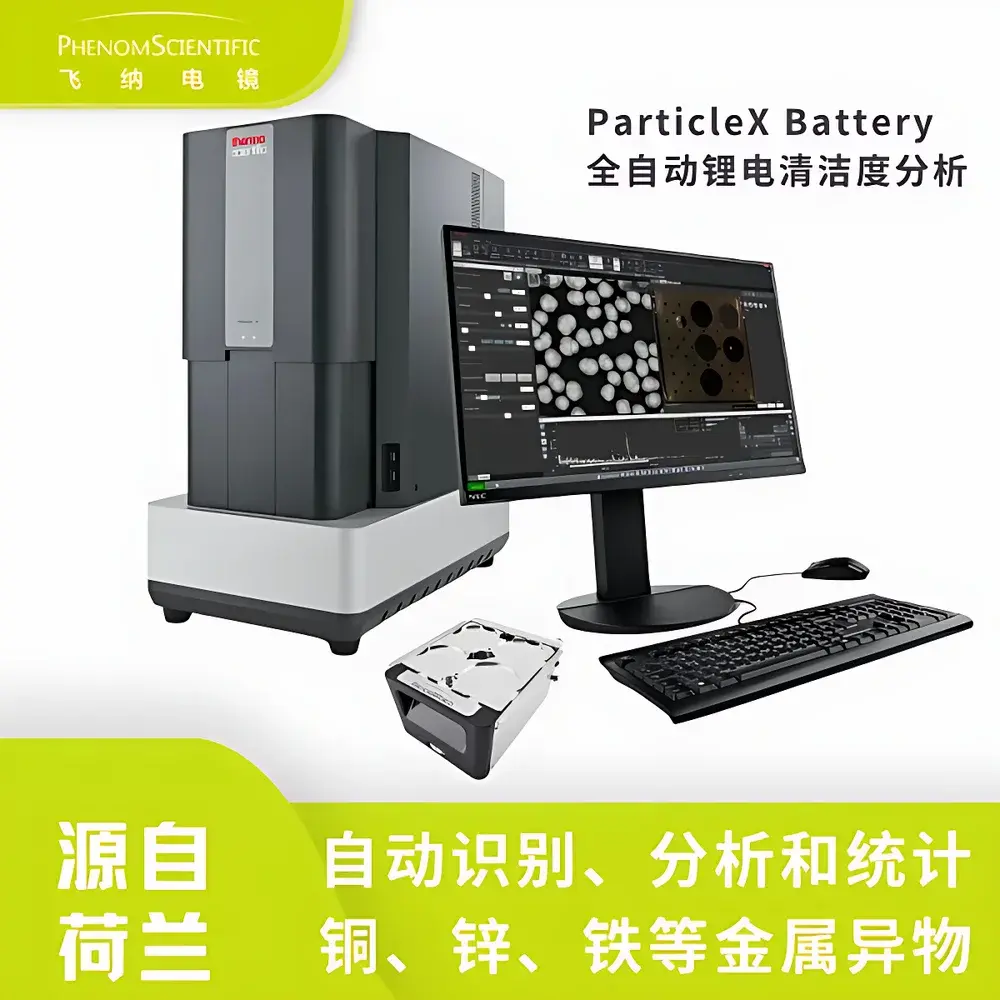
Phenom ParticleX Battery Automated Cleanliness Analysis System for Lithium-ion Battery Materials
| Brand | Phenom |
|---|---|
| Origin | Netherlands |
| Manufacturer | Phenom-World B.V. |
| Import Status | Imported |
| Model | ParticleX Battery |
| Instrument Type | Benchtop Scanning Electron Microscope (SEM) |
| Electron Source | Cerium Hexaboride (CeB6) |
| Secondary Electron Resolution | 8 nm |
| Maximum Magnification | 200,000× |
| Acceleration Voltage Range | Standard Modes: 2, 5, 10, 15, 20 kV |
| Advanced Mode | Continuously Adjustable from 4.8 kV to 20.5 kV |
| Backscattered Electron Resolution | 8 nm |
| Maximum Sample Capacity | Up to four 47 mm diameter filter membranes simultaneously |
| Standard Detectors | Backscattered Electron Detector (BSE), Energy-Dispersive X-ray Spectrometer (EDS) |
| Optional Detector | Secondary Electron Detector (SED) |
Overview
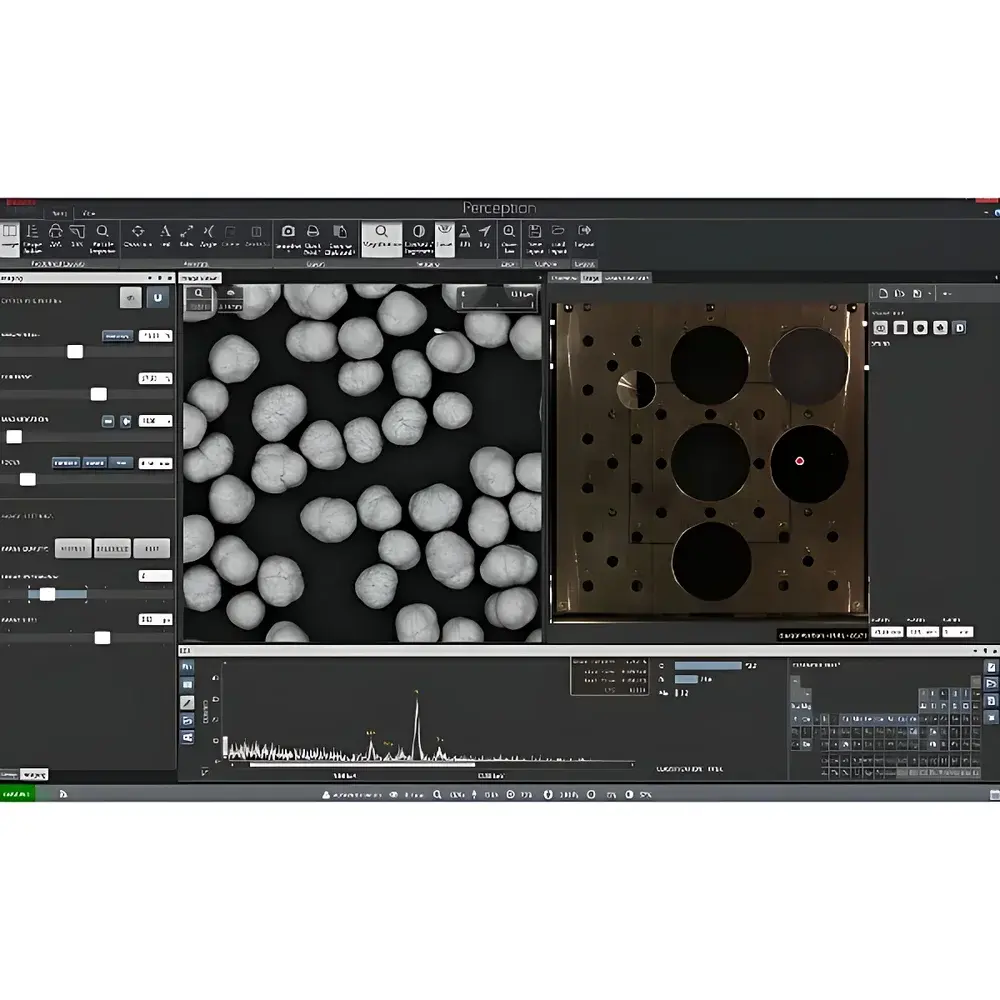
The Phenom ParticleX Battery is a purpose-built, benchtop scanning electron microscope (SEM) integrated with automated particle analysis and energy-dispersive X-ray spectroscopy (EDS) for quantitative cleanliness assessment of lithium-ion battery electrode materials. It operates on the principle of high-resolution electron beam–sample interaction, generating secondary and backscattered electron signals for topographic and compositional contrast, respectively. Coupled with real-time EDS elemental mapping and spectral identification, the system enables unambiguous detection, classification, and quantification of metallic contaminants—including Fe, Cu, Cr, Ni, Zn, and Ag—at sub-micron scales. This capability addresses a critical quality control requirement in battery manufacturing: trace metal impurities—especially ferromagnetic particles—can migrate during cycling, deposit on the anode, and mechanically pierce the separator, triggering internal short circuits, accelerated self-discharge, thermal runaway, and safety failures. The ParticleX Battery delivers metrologically traceable, GLP-aligned data to support root-cause analysis across cathode slurry preparation, coating, calendering, drying, and handling processes.
Key Features
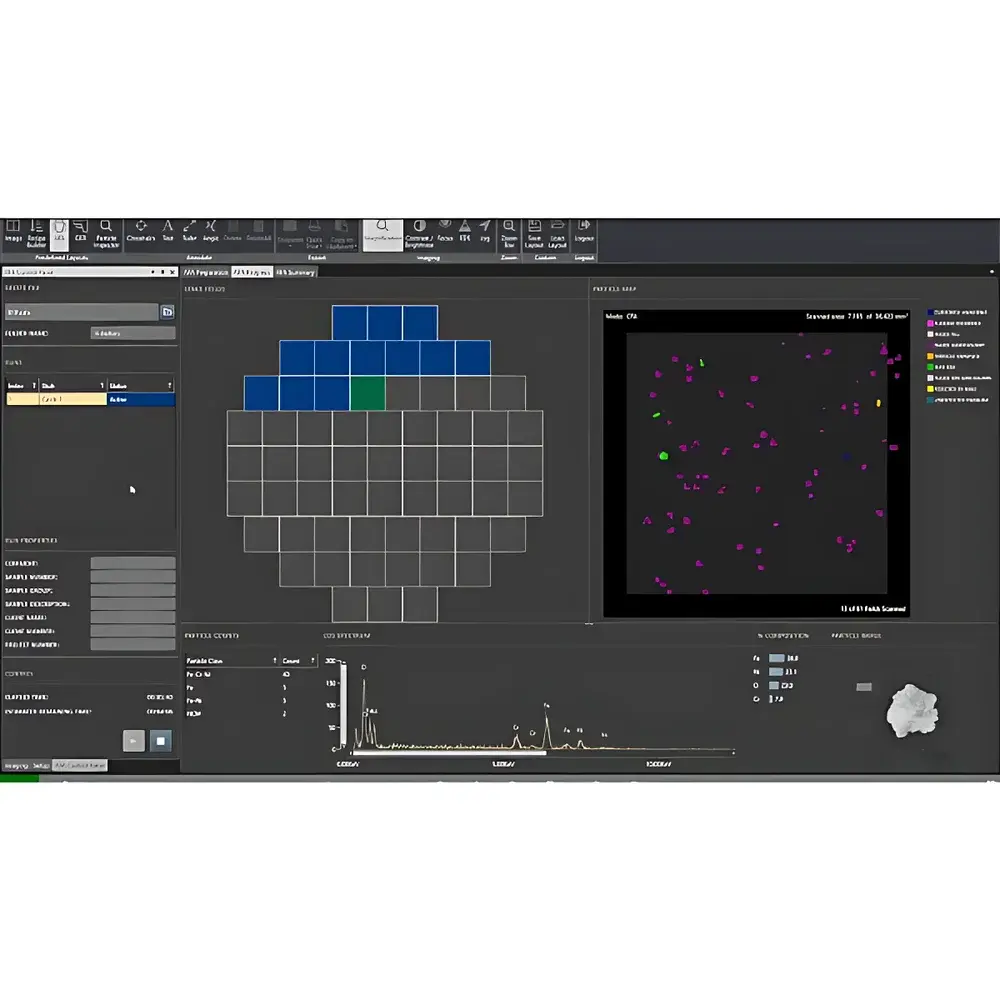
- Automated End-to-End Workflow: Fully autonomous acquisition, particle detection, EDS-based elemental classification, morphological parameterization (area, aspect ratio, Feret diameter), and statistical reporting—no manual intervention required from sample loading to final PDF export.
- Customizable Analysis Logic: Unlike generic SEM-EDS software modules, ParticleX Battery employs a dedicated, scriptable analysis engine. Users define custom particle classification rules (e.g., “Fe-rich >90 wt%”, “Cu/Al ratio >5”, “irregular shape + Zn signal”), thresholding strategies, region-of-interest (ROI) logic, and report templates—ensuring alignment with internal QC protocols and regulatory expectations (e.g., ISO 16232, USP <788> particulate matter guidance).
- CeB6 Electron Source: A thermionic cerium hexaboride (CeB6) cathode provides stable, high-brightness emission over ≥3,000 hours (manufacturer warranty), eliminating abrupt filament failure common with tungsten sources. This ensures uninterrupted overnight or multi-day batch analyses essential for production-line throughput validation.
- High-Throughput Hardware Architecture: Features a 100 × 100 mm motorized stage enabling sequential analysis of up to four 47 mm filter membranes without venting; tri-chamber vacuum design achieves base pressure in <60 seconds; and fixed working distance between SEM optics and EDS detector eliminates recalibration during mode switching.
- Integrated SEM-EDS Co-Design: Hardware and software are co-engineered—detector geometry, beam current management, dwell time optimization, and spectrum processing pipelines are synchronized at firmware level—reducing spectral artifacts, improving peak-to-background ratios, and ensuring reproducible quantification per ASTM E1508 and ISO 14705 standards.
Sample Compatibility & Compliance
The system accepts standard 47 mm membrane filters (mixed cellulose ester, polyvinylidene fluoride, or polycarbonate) used in battery slurry and electrolyte filtration testing. Sample mounting requires no conductive coating for most metallic contaminants due to the low-kV imaging capability (down to 2 kV) and high-efficiency BSE detection. All analytical workflows support audit trails compliant with FDA 21 CFR Part 11 requirements—including user authentication, electronic signatures, change logs, and immutable data archiving. Data output formats include CSV (for LIMS integration), .emsa (for spectral reprocessing), and PDF reports with embedded metadata (instrument ID, operator, date/time, calibration status, EDS acquisition parameters).
Software & Data Management
ParticleX Battery runs on Phenom’s proprietary Cleanliness Analysis Suite (CAS), a Windows-based application with role-based access control (RBAC). CAS supports method locking for SOP enforcement, version-controlled analysis protocols, and configurable pass/fail criteria per contaminant class. Raw EDS spectra and maps are stored in standardized .eds and .tiff formats, compatible with third-party quantification tools (e.g., Thermo Fisher Pathfinder, Oxford AZtec). Data integrity is ensured via SHA-256 hashing of all acquired datasets, and optional network-attached storage (NAS) integration enables centralized backup aligned with ISO/IEC 27001 information security policies.
Applications
- Quantitative ferrous and non-ferrous particle counting in cathode active materials (NMC, LFP, NCA) and anode slurries (graphite, silicon composites)
- Source attribution of metallic debris in dry rooms, mixing vessels, and coating lines via morphology–chemistry correlation
- Validation of cleaning efficacy for roller mills, sieves, and slurry transfer hoses
- Supporting IATF 16949 and VDA 6.3 process audits through statistically robust contamination trend analysis
- Generating evidence for ISO 26262 functional safety assessments related to battery cell-level hazard analysis
FAQ
What regulatory standards does the ParticleX Battery support for battery cleanliness verification?
It supports methodology alignment with ISO 16232 (road vehicles – cleanliness of components), USP <788> (particulate matter in injectables—adapted for slurry filtration), and internal OEM specifications such as GM W317652 and Ford CETP 00.00-L-467.
Can the system distinguish between airborne dust and process-introduced metal fragments?
Yes—via combined morphological analysis (angularity, edge sharpness, surface texture) and elemental fingerprinting (e.g., Fe-Cr-Ni alloy vs. pure Fe oxide), enabling differentiation between wear debris and environmental contamination.
Is remote monitoring and troubleshooting supported?
Yes—via secure TLS-encrypted web interface; engineers can diagnose vacuum status, detector health, stage calibration, and software state without physical access, reducing mean time to repair (MTTR) under service agreements.
How is measurement uncertainty managed in automated EDS quantification?
Uncertainty propagation follows ISO 14705 guidelines: certified reference materials (e.g., NIST SRM 2136) are measured daily; matrix corrections use ZAF or φ(ρz) algorithms; and repeatability is verified via 10-replicate analyses of homogenous standards, with CV ≤3.5% reported in calibration certificates.
Does the system comply with GMP/GLP documentation requirements?
Yes—full electronic lab notebook (ELN) functionality includes timestamped audit trails, instrument calibration records, user training logs, and 21 CFR Part 11–compliant electronic signatures for release of QC reports.




