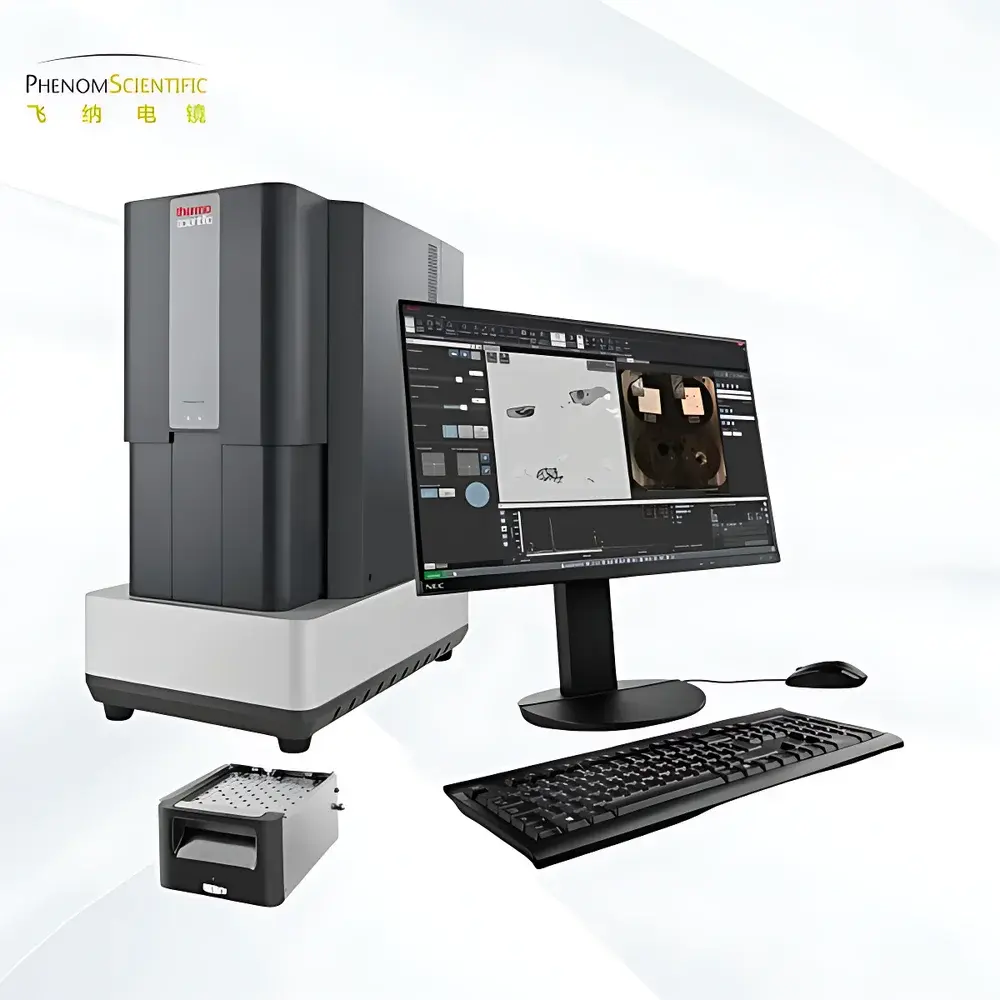
Phenom ParticleX Steel Automated Steel Inclusion Analysis System
| Brand | Phenom |
|---|---|
| Origin | Netherlands |
| Manufacturer Type | Original Equipment Manufacturer (OEM) |
| Import Status | Imported |
| Model | ParticleX Steel |
| Instrument Type | Benchtop Scanning Electron Microscope |
| Electron Source | Cerium Hexaboride (CeB6) |
| Secondary Electron Resolution | 8 nm |
| Maximum Magnification | 200,000× |
| Accelerating Voltage Range | Standard Modes: 2 kV, 5 kV, 10 kV, 15 kV, 20 kV |
| Advanced Mode | Continuously Adjustable from 4.8 kV to 20.5 kV |
| Backscattered Electron Resolution | 8 nm |
| Standard Detectors | Backscattered Electron Detector (BSE), Energy-Dispersive X-ray Spectrometer (EDS) |
| Optional Detector | Secondary Electron Detector (SED) |
Overview
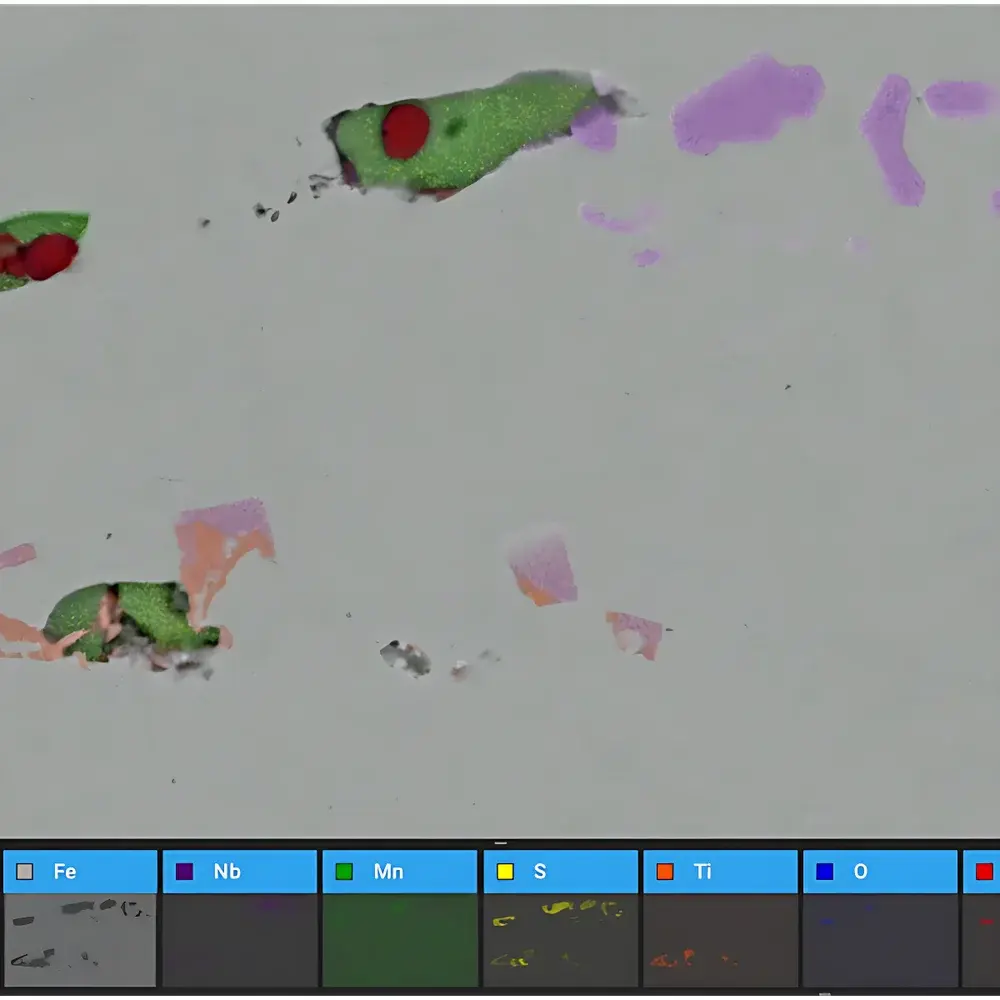
The Phenom ParticleX Steel Automated Steel Inclusion Analysis System is a purpose-built benchtop scanning electron microscope (SEM) integrated with high-performance energy-dispersive X-ray spectroscopy (EDS) for standardized, statistically robust characterization of non-metallic inclusions in ferrous metallurgical samples. Engineered specifically for steel quality assurance and process development laboratories, the system implements automated scanning electron microscopy coupled with real-time EDS spectral acquisition to deliver quantitative morphological, spatial, and compositional data on oxide, sulfide, nitride, and silicate inclusions. Unlike conventional metallographic or wet-chemical methods—which are inherently low-throughput, operator-dependent, and lack statistical representativeness—the ParticleX Steel platform applies deterministic stage navigation, adaptive focus routines, and rule-based particle classification algorithms to achieve reproducible, ISO/ASTM-aligned inclusion analysis across full cross-sections of polished steel mounts. Its CeB6 thermionic electron source ensures stable beam current over extended acquisition sequences (>1,000 hours lifetime), while the tri-chamber vacuum architecture enables sub-30-second pump-down times—critical for high-volume QC throughput.
Key Features
- Benchtop SEM architecture with integrated EDS detector—no external cryo-cooling or high-voltage infrastructure required
- CeB6 electron gun delivering superior brightness and signal-to-noise ratio compared to tungsten filament sources, enabling reliable low-kV imaging (down to 2 kV) for surface-sensitive inclusion contrast
- Motorized precision stage with <100 nm positional repeatability and automated drift compensation during long-duration mapping
- Dual-mode operation: fully automated inclusion survey mode + manual SEM/EDS investigation mode for root-cause failure analysis
- Intelligent auto-focus and stigmation routines calibrated per magnification and accelerating voltage, minimizing user intervention
- Real-time EDS spectrum acquisition synchronized with image capture—each inclusion receives a full elemental spectrum (Z ≥ 5)
- Configurable analysis templates compliant with ASTM E2792, ISO 4967, and GB/T 10561 standards for inclusion rating and classification
Sample Compatibility & Compliance
The ParticleX Steel supports standard 25 mm or 32 mm diameter metallographic mounts prepared via grinding, polishing, and optional etching (e.g., nital or Murakami reagents). Samples must be electrically conductive; carbon coating (≤5 nm) is recommended for non-conductive phases or heavily oxidized surfaces. The system complies with IEC 61000-6-3 (EMC) and IEC 61010-1 (safety) standards. All analytical workflows—including acquisition parameters, spectral libraries, classification rules, and report generation—support audit-ready documentation aligned with GLP and GMP requirements. Full electronic records—including raw spectra, annotated maps, and metadata timestamps—are stored in vendor-neutral formats (e.g., .emsa, .tiff, .csv) for FDA 21 CFR Part 11–compliant data integrity.
Software & Data Management
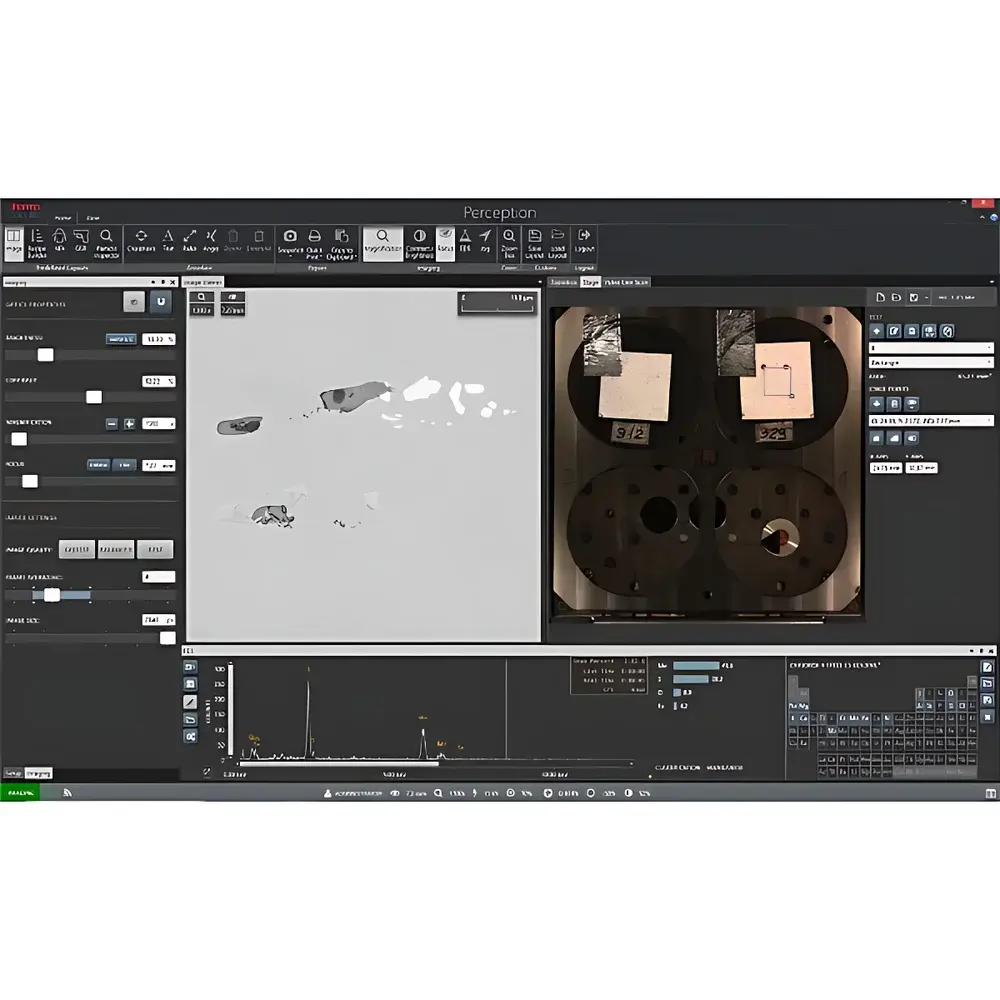
The ParticleX Steel runs on Phenom’s proprietary ProSuite software, featuring a modular workflow engine supporting customizable analysis protocols. Users define inclusion detection thresholds (size, circularity, contrast), elemental filters (e.g., “Al-O-Si > 80 wt%”), and classification trees based on phase chemistry (e.g., MnS vs. Al₂O₃ vs. CaO-Al₂O₃-SiO₂). All operations generate traceable logs with digital signatures, session timestamps, and version-controlled method files. Data export supports direct integration with LIMS platforms via ODBC or REST API. Batch reporting includes ASTM E45-type charts, inclusion size distribution histograms, cluster density heatmaps, and statistical summaries (mean, median, max/min size, aspect ratio, nearest-neighbor distance). Raw EDS spectra are exportable in standard formats for third-party quantification (e.g., DTSA-II, AZtec).
Applications
- Statistical evaluation of inclusion populations in clean steel grades (e.g., bearing steels, pipeline steels, automotive AHSS)
- Correlation of inclusion type/distribution with rolling mill defects (e.g., edge cracking, fatigue initiation sites)
- Process validation for ladle refining, calcium treatment, and tundish flux optimization
- Root-cause analysis of unexpected service failures via inclusion phase mapping and stoichiometric verification
- Development of inclusion control specifications in supplier technical agreements (STAs)
- Training and certification of metallurgical QA personnel using standardized reference materials (e.g., NIST SRM 2135a)
FAQ
What sample preparation is required prior to analysis?
Standard metallographic polishing to 0.05 µm colloidal silica finish is required. Carbon or chromium coating (3–5 nm) is recommended for charge dissipation.
Can the system differentiate between Type A (sulfides), Type B (aluminates), and Type C (silicates) per ASTM E45?
Yes—classification is performed automatically using EDS-derived elemental ratios and morphology criteria embedded in user-defined rule sets.
Is remote operation supported for multi-site labs?
Yes—ProSuite supports secure remote desktop access and scheduled unattended runs with email/SMS alerts upon completion.
How does the tri-chamber vacuum design improve uptime?
Independent chamber isolation allows continuous loading/unloading without breaking main column vacuum, reducing instrument idle time by >60% versus single-chamber systems.
Does the system support custom spectral library creation for proprietary steel chemistries?
Yes—users may build and validate custom EDS libraries using certified reference materials and apply them across all automated analyses.