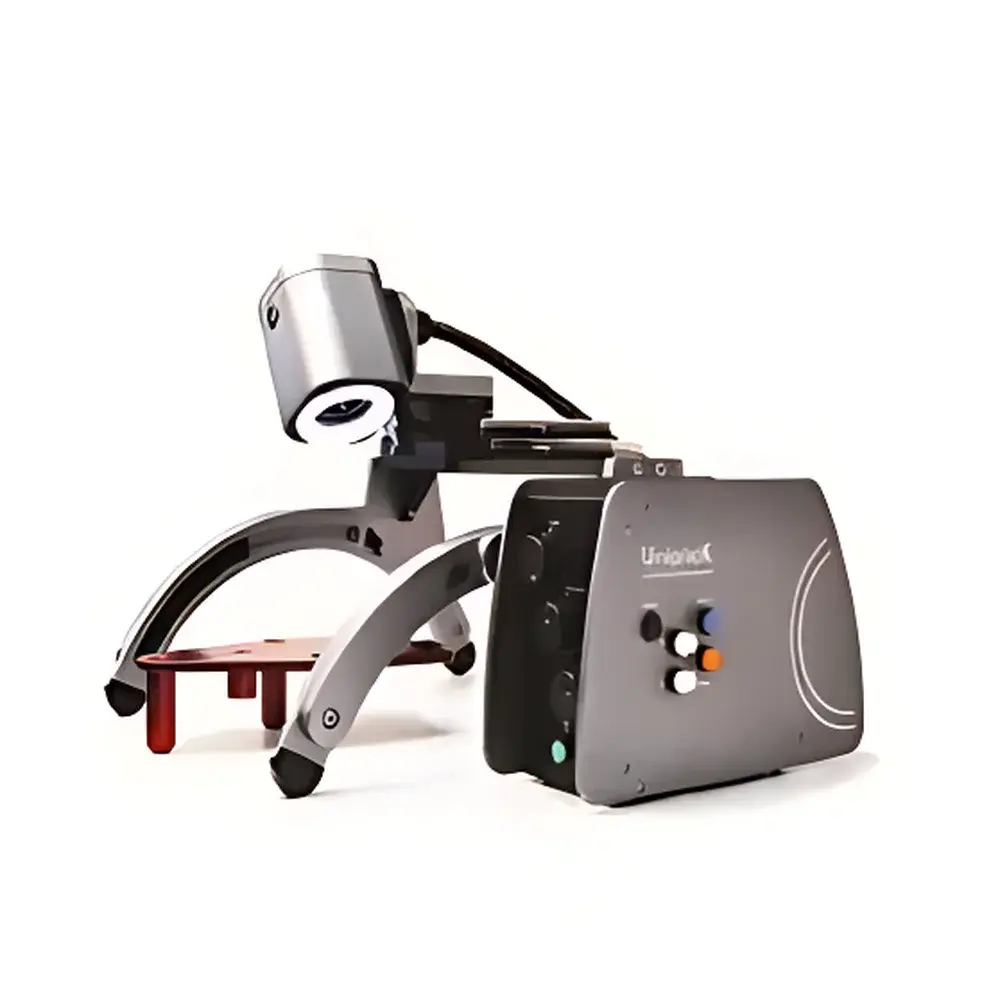
NeuroIndx Unipick Single-Cell Isolation and Microdissection System
| Origin | USA |
|---|---|
| Manufacturer Type | Authorized Distributor |
| Origin Category | Imported |
| Model | Unipick |
| Pricing | Available Upon Request |
Overview
The NeuroIndx Unipick Single-Cell Isolation and Microdissection System is a precision-engineered, vacuum-driven micro-manipulation platform designed to upgrade standard inverted microscopes into fully functional single-cell sorting, live-cell capture, and cryosection-compatible tissue microdissection workstations. Unlike laser-based microdissection (LCM) or fluidic sorting platforms, the Unipick operates on a contact-free, low-shear capillary aspiration principle—leveraging controlled negative pressure through calibrated glass micropipettes to isolate intact, viable single cells or morphologically defined tissue regions under direct visual guidance. Its core architecture integrates a high-resolution linear motor stage (±0.0015 mm step resolution), programmable vacuum pulse control (0–1 s duration, 0–588.8 mmHg range), and an adjustable capillary positioning system compatible with standard inverted microscopy optical paths. The system is explicitly engineered for applications requiring molecular-grade integrity—enabling downstream extraction of high-yield, high-integrity RNA, DNA, and proteins from captured material without chemical fixation, thermal stress, or photodamage.
Key Features
- Vacuum-assisted, non-contact cell/tissue isolation using borosilicate glass capillaries (ID: 15–100 µm) with minimal mechanical perturbation—preserving cell viability and nucleic acid integrity.
- Universal microscope adapter kit enables seamless integration with virtually all inverted microscopes (e.g., Olympus CKX31/CKX41, Labomed TCM400, Nikon Eclipse Ti, Zeiss Axio Observer), eliminating the need for dedicated instrument purchase.
- Extended working range (8.9 mm travel, 0.35 mm/s max speed) and retractable pipette function (Retract Function) optimized for multiwell plates, Petri dishes, and T-flasks—supporting scalable single-cell screening across heterogeneous cultures.
- LED ring illumination (144 LEDs, 10,000 hr lifetime) provides uniform, shadow-free contrast for phase-contrast, fluorescence, or DIC imaging during real-time targeting.
- No pre-fixation, cryoprotection, or dehydration required: compatible with fresh-frozen, sucrose-perfused, and live unfixed tissue sections (5–300 µm thickness) and all major culture formats (adherent, suspension, 3D organoids).
- Low operational and maintenance cost relative to laser capture microdissection (LCM) systems—no consumable lasers, optics alignment, or specialized facility requirements.
Sample Compatibility & Compliance
The Unipick supports biologically diverse sample types while maintaining compliance with foundational biospecimen handling standards. It is routinely validated for use in GLP-aligned workflows where traceability and sample integrity are critical—including ISO 20387 (biobanking), ASTM E2916 (nucleic acid quality assessment), and USP sterility considerations for live-cell recovery. Capillary-based collection avoids enzymatic, thermal, or photochemical artifacts, making it suitable for RNA-seq library preparation (RIN >9.0 typical), methylation-sensitive PCR, and functional re-culture assays. While not FDA-cleared as an IVD device, its output meets analytical requirements for research-use-only (RUO) applications in neurobiology, oncology, stem cell biology, and developmental epigenetics per CLIA-recognized laboratory protocols.
Software & Data Management
The Unipick operates via a dedicated Windows-based control interface that supports manual point-and-click operation and semi-automated batch acquisition. The software logs timestamped metadata for each capture event—including vacuum pressure, pulse duration, XYZ coordinates, capillary ID, and user-defined annotation tags. Audit trails comply with 21 CFR Part 11 requirements when deployed with validated IT infrastructure (electronic signatures, role-based access, immutable log archiving). Raw coordinate data exports in CSV and XML formats for integration with LIMS, image analysis pipelines (e.g., Fiji/ImageJ macros), or single-cell metadata frameworks (e.g., SCEA, HCA standards). No proprietary database or cloud dependency is required—data remains locally stored and fully exportable.
Applications
- Single-cell isolation from heterogeneous primary cultures (e.g., dissociated neurons, tumor-infiltrating lymphocytes, iPSC-derived cardiomyocytes) for clonal expansion and functional phenotyping.
- Region-specific microdissection of fresh-frozen brain sections—hippocampal subfields, cortical laminae, or lesion margins—for spatial transcriptomics and proteomic profiling.
- Live-cell retrieval from 3D spheroids and organoids without enzymatic dissociation—preserving native extracellular matrix interactions and signaling gradients.
- Targeted isolation of rare circulating tumor cells (CTCs) or endothelial progenitor cells from suspension cultures prior to whole-genome amplification.
- Preparation of high-fidelity reference standards for NGS assay validation, including spike-in controls and allelic dropout assessment panels.
FAQ
What microscope models are compatible with the Unipick system?
The Unipick includes a universal adapter bracket compatible with most inverted microscopes featuring standard nosepiece threading (e.g., Olympus CKX series, Nikon Eclipse Ti, Zeiss Axio Observer, Leica DMi8). Custom mounting solutions are available upon request for non-standard configurations.
Can the Unipick isolate cells from stiff or fibrous tissues like muscle or skin?
The system is optimized for soft, compliant tissues such as brain, liver, or embryonic tissue. Dense connective tissues require pre-treatment (e.g., limited collagenase digestion) to enable effective capillary penetration and aspiration without compromising cellular integrity.
Is the system capable of long-term cell re-culture after isolation?
Yes—live-cell viability post-isolation exceeds 95% (measured by trypan blue exclusion and metabolic activity assays), and isolated adherent cells routinely re-attach and proliferate within 24–48 hours under standard culture conditions.
Does the Unipick include integrated imaging or analysis software?
No—the system is designed as a hardware add-on; users leverage their existing microscope imaging software (e.g., CellSens, NIS-Elements, ZEN) for visualization and documentation. Unipick control software manages only motion, vacuum, and metadata logging.
What regulatory documentation is provided for audit readiness?
A comprehensive Device Master Record (DMR)-aligned technical file, calibration certificate for linear stage and vacuum sensor, and SOP templates for installation qualification (IQ), operational qualification (OQ), and routine performance verification are supplied with each system.