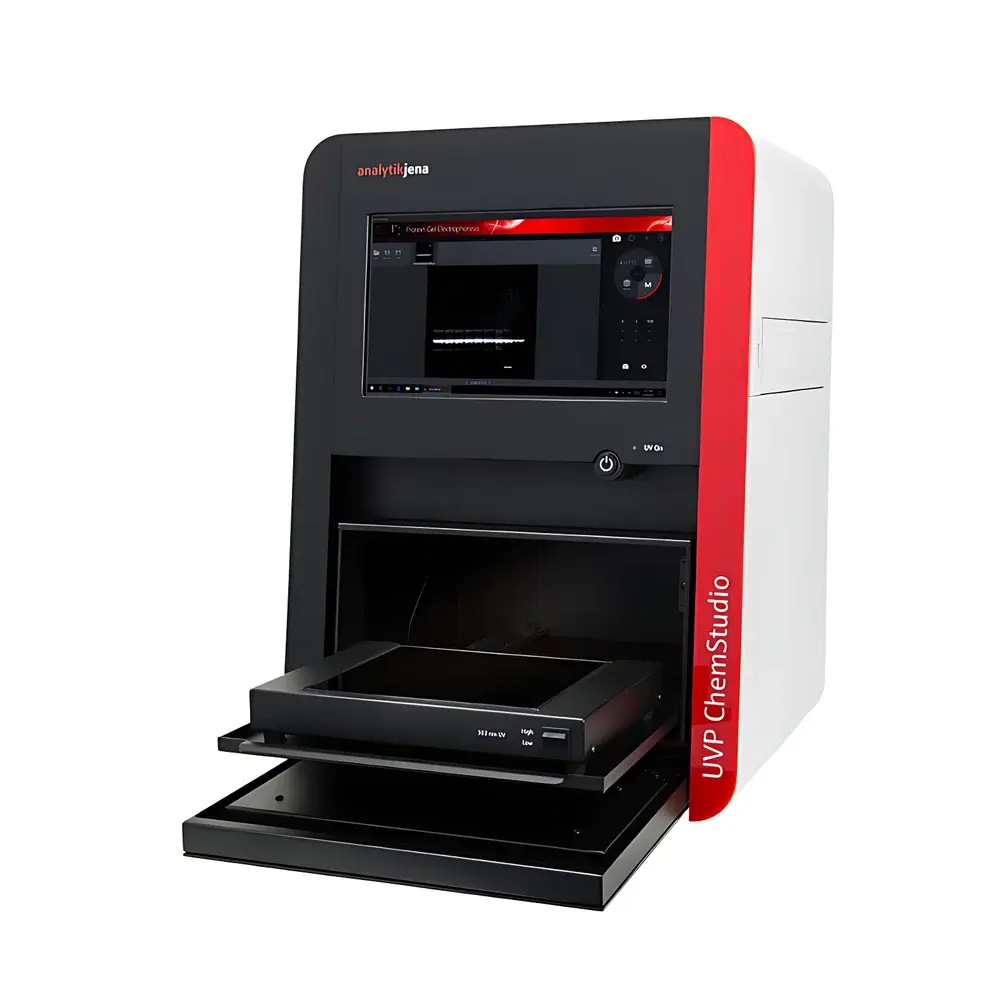
Analytik Jena UVP ChemStudio Touch Multimodal Gel Imaging System
| Brand | Analytik Jena |
|---|---|
| Origin | USA |
| Manufacturer | Analytik Jena GmbH |
| Model | UVP ChemStudio Touch |
| CCD Resolution | 8.1 MP (3296 × 2472) |
| CCD Cooling | −57 °C |
| Touchscreen | 15.6″ Full-Color Capacitive Display |
| Light Sources | LED, Xenon Broadband Lamp, Dual-NIR Lasers (700/800 nm) |
| Filter Capacity | 21 Position Motorized Filter Wheel |
| Binning Options | 1×1 to 8×8 |
| Max Effective Resolution | 16.2 MP |
| Supported Imaging Modes | UV Transillumination, Fluorescence (RGB & NIR), Chemiluminescence, 2D DIGE, In Vivo Plant & Animal Imaging |
| Image Formats | JPG, BMP, TIFF, GIF, TGA, PNG, AVI |
| UV Transilluminator | Long-Life Cold-Cathode Fluorescent Lamp (20-Year Lifetime) |
Overview
The Analytik Jena UVP ChemStudio Touch is a high-performance multimodal gel imaging system engineered for quantitative molecular detection across life science research and quality control laboratories. Built upon the legacy of UVP—the pioneer of commercial gel documentation—and enhanced by Analytik Jena’s expertise in optical engineering and low-noise detection, this platform integrates three distinct excitation modalities—LED, broadband xenon, and dual-wavelength near-infrared lasers—within a single, unified optical architecture. Its core measurement principle relies on high-sensitivity, thermoelectrically cooled CCD detection (−57 °C) coupled with precisely synchronized illumination and spectral filtering to enable quantitative capture of emitted photons across UV, visible, and NIR spectral bands (254–850 nm). Designed for reproducible, low-background imaging, it supports compliance-critical workflows including chemiluminescent Western blot quantification, multiplex fluorescent protein/nucleic acid detection, 2D-DIGE analysis, and non-invasive in vivo plant and small-animal imaging—all without external computing hardware.
Key Features
- Tri-modal excitation architecture: Independently optimized LED arrays (for standard fluorophores), a full-spectrum xenon lamp (for broad-band RGB fluorescence and colorimetric assays), and dual solid-state NIR lasers (700 nm and 800 nm) for deep-tissue and low-autofluorescence applications.
- 21-position motorized filter wheel with precision spectral bandpass selection, enabling rigorous separation of emission signals in multicolor experiments—essential for accurate ratiometric analysis and spectral unmixing.
- −57 °C Peltier-cooled 8.1 MP CCD sensor with 16-bit digitization and programmable binning (1×1 to 8×8), delivering sub-femtogram chemiluminescent detection limits and high dynamic range (>4.5 OD) for linear quantification across wide signal intensities.
- Integrated 15.6″ capacitive touchscreen display with embedded Linux-based imaging OS—eliminating dependency on external PCs and reducing footprint while maintaining full local data processing capability.
- eLite transilluminator module: The only commercially available source capable of both top-down and bottom-up excitation, enabling simultaneous transmission-based DIGE labeling (e.g., Cy2/Cy3/Cy5) and reflection-mode fluorescence—critical for high-fidelity 2D electrophoresis quantification.
- Wireless image export via secure Wi-Fi (WPA2-Enterprise compatible), supporting direct transfer to networked workstations without physical media; audit-trail–enabled metadata embedding ensures traceability per GLP/GMP requirements.
Sample Compatibility & Compliance
The ChemStudio Touch accommodates standard electrophoretic formats—including mini and midi gels (up to 20 × 20 cm), blots (PVDF, nitrocellulose), microplates (6–384-well), tissue sections, whole-mount plant organs, and live anesthetized rodents (up to 35 g). Its optical design meets ISO 17025 calibration traceability standards for intensity linearity and spatial uniformity. For regulated environments, the system supports 21 CFR Part 11–compliant user authentication, electronic signatures, and immutable audit logs when paired with optional UVP ImageLab Suite software. It is routinely validated for ASTM E2557 (chemiluminescence assay reproducibility) and ISO 15195 (clinical laboratory equipment verification).
Software & Data Management
UVP ImageLab Suite (v6.2+) provides a fully open, modular architecture—supporting import of TIFF, PNG, JPEG, BMP, GIF, TGA, and AVI files from third-party instruments. Quantitative modules include background subtraction (rolling ball, morphological), band/spot volume integration, molecular weight estimation, % area normalization, cluster analysis (hierarchical and k-means), colony counting (with adaptive thresholding), and plant phenotyping (leaf area, vein density, chlorophyll index). All analyses generate CSV- and PDF-exportable reports with embedded raw pixel data and acquisition metadata. Software licensing permits installation on unlimited lab workstations, and API access enables integration with LIMS or ELN platforms via RESTful endpoints.
Applications
- Quantitative Western blotting using HRP- or AP-conjugated secondary antibodies under chemiluminescent conditions.
- Multiplex nucleic acid detection (e.g., SYBR Gold, Ethidium Bromide, GelRed) and protein staining (Coomassie, Silver, Deep Purple) under UV and visible illumination.
- RGB and NIR fluorescence multiplexing for co-localization studies (e.g., GFP/mCherry + IRDye 800CW), including spectral unmixing for cross-talk correction.
- 2D-DIGE workflows utilizing CyDye labeling, leveraging eLite’s dual-path excitation and FirstLight™ low-noise acquisition for <0.05% spot-to-spot CVs.
- In vivo imaging of reporter gene expression (e.g., luciferase, tdTomato) and nanoparticle biodistribution in murine models, with adjustable exposure times (1 ms–60 min) and auto-exposure algorithms.
- Plant phenotyping: chlorophyll fluorescence (Fv/Fm), stress-induced anthocyanin accumulation, root architecture analysis, and time-lapse growth monitoring.
FAQ
Does the ChemStudio Touch support FDA 21 CFR Part 11 compliance?
Yes—when deployed with UVP ImageLab Suite in audit mode, it provides role-based access control, electronic signatures, and immutable audit trails for all acquisition and analysis events.
Can I use third-party filters or light sources with this system?
No—optical alignment and spectral calibration are factory-validated for the integrated 21-filter wheel and proprietary light engines; substitution voids performance specifications and regulatory validation.
What is the expected lifetime of the cold-cathode UV transilluminator?
Rated for 20 years (>175,000 hours) at nominal output, with <5% intensity drift over its service life under continuous operation.
Is remote instrument control possible outside the local network?
Remote desktop access is restricted to authenticated VLANs; cloud-based control is not supported to maintain data sovereignty and cybersecurity compliance.
How does the system handle sample heating during long exposures?
All light sources operate in pulsed mode with active thermal management; the −57 °C CCD stage and ambient-temperature sample chamber ensure minimal thermal load on temperature-sensitive specimens such as live plants or primary tissues.
Related Products