
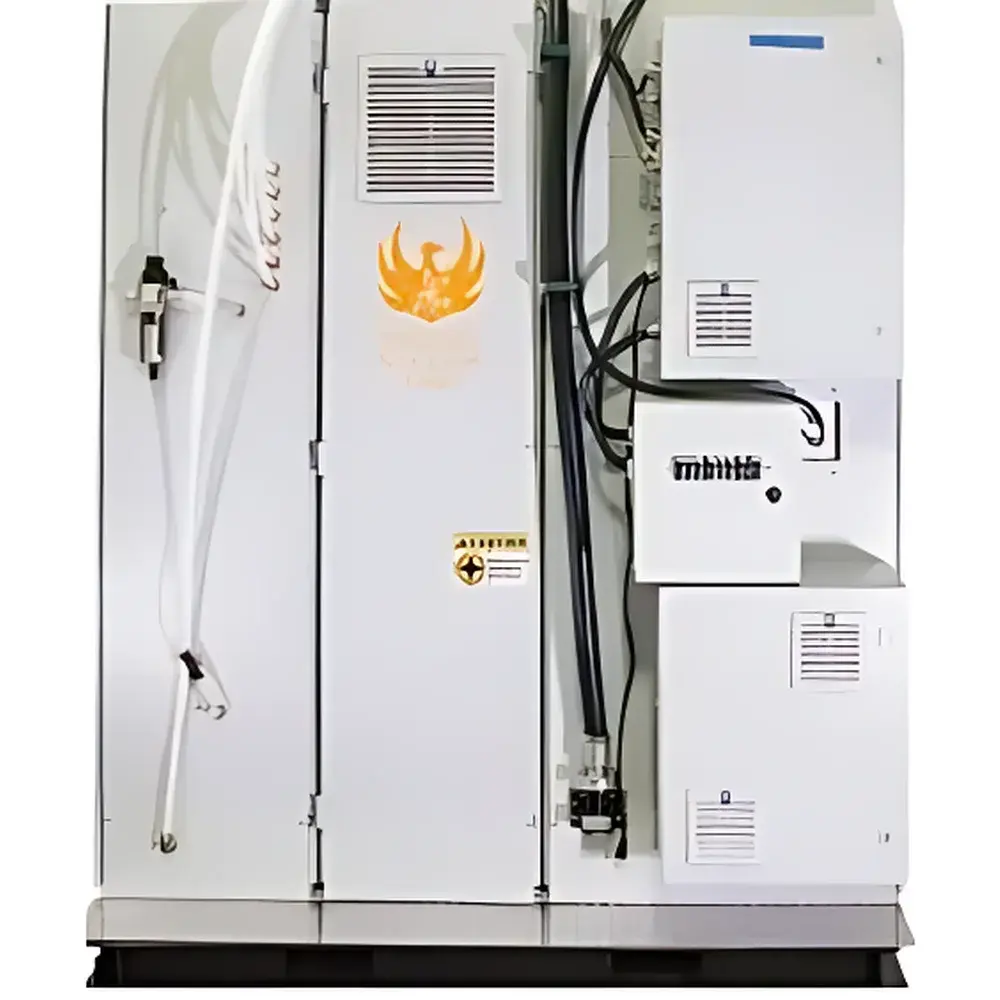
Phoenix PNL Compact High-Yield Neutron Generator
| Origin | USA |
|---|---|
| Manufacturer Type | Authorized Distributor |
| Origin Category | Imported |
| Model | PNL |
| Pricing | Available Upon Request |
Overview
The Phoenix PNL Compact High-Yield Neutron Generator is an engineered neutron source designed for laboratory, industrial, and national security applications requiring reliable, on-demand neutron production without reliance on nuclear reactors or radioactive isotopes. Based on the principle of deuterium-tritium (D-T) or deuterium-deuterium (D-D) fusion reactions, the system employs a microwave-driven ion source to generate tritium (or deuterium) ions, which are electrostatically accelerated to energies up to 150 keV and directed onto a solid metal hydride target—typically titanium or erbium loaded with deuterium or tritium. Upon impact, nuclear fusion occurs, producing monoenergetic neutrons at 14.1 MeV (D-T) or 2.5 MeV (D-D). The PNL architecture integrates high-vacuum pumping, active thermal management, and pulse-modulated beam control to ensure stable operation, low maintenance, and extended service life—rated for ≥10 years under typical duty cycles.
Key Features
- Compact, self-shielded design optimized for installation in controlled-access laboratories and mobile detection platforms
- Microwave electron cyclotron resonance (ECR) ion source delivering high-current, low-emittance tritium/deuterium ion beams with excellent long-term stability
- Modular high-voltage acceleration column with precision electrode alignment and integrated beam diagnostics (Faraday cup, beam profile monitor)
- Replaceable solid-target assembly with rapid exchange capability; compatible with both D- and T-loaded targets for flexible neutron energy selection
- Pulse-mode operation (1–100 Hz repetition rate, adjustable pulse width from 1 µs to 10 ms) enabling time-of-flight (TOF) measurements and background suppression
- Integrated radiation monitoring interface compliant with IEC 61513 and ANSI N43.17 safety standards
Sample Compatibility & Compliance
The PNL neutron generator operates independently of sample form—supporting irradiation of solids, powders, liquids, and sealed containers. Its neutron output is suitable for activation analysis of elemental composition (e.g., nitrogen, chlorine, hydrogen), neutron radiography of dense objects (e.g., explosives, composite materials, spent nuclear fuel assemblies), and neutron-based assay of special nuclear materials (SNM) such as 235U and 239Pu. The system meets electromagnetic compatibility (EMC) requirements per FCC Part 15 Class A and is designed to support GLP-compliant workflows. Full documentation—including traceable calibration certificates for neutron yield (measured via manganese bath or proton recoil spectrometry), vacuum integrity reports, and electrical safety test records—is provided with each unit. Optional integration with neutron moderation assemblies (polyethylene + cadmium/boron layers) enables thermalized neutron fields required for boron neutron capture therapy (BNCT) research and neutron imaging with high spatial resolution.
Software & Data Management
Control and monitoring are executed via Phoenix ControlSuite™, a Windows-based application supporting real-time beam current/voltage logging, pulse synchronization with external detectors (e.g., scintillation arrays, He-3 tubes), and automated yield normalization against reference foils. All operational parameters—including ion source gas flow, acceleration voltage, target temperature, and interlock status—are timestamped and stored in SQLite databases compliant with FDA 21 CFR Part 11 for audit trail generation. Export formats include CSV, HDF5, and NEXUS for interoperability with MCNP, GEANT4, and ImageJ-based neutron radiography reconstruction pipelines. Remote access is available via TLS-secured SSH tunneling, enabling off-site system health monitoring and scheduled maintenance alerts.
Applications
- Medical Isotope Production: On-site generation of short-lived isotopes (e.g., 13N, 15O, 18F precursors) via neutron capture or spallation pathways in shielded hot cells
- Neutron Radiography & Tomography: High-contrast imaging of hydrogenous materials (e.g., lubricants in turbine blades, water ingress in composites, organic explosives in luggage)
- SNM Detection & Verification: Active interrogation of shielded cargo using delayed neutron counting and fission signature analysis per IAEA Nuclear Security Series No. 11-T
- Radiation Effects Testing: Single-event effect (SEE) qualification of aerospace electronics, displacement damage studies in semiconductor devices, and total ionizing dose (TID) benchmarking
- Neutron Cross-Section Validation: Reference neutron field generation for calibrating neutron dosimeters and validating nuclear data libraries (ENDF/B-VIII.0, JEFF-4.0)
FAQ
What is the typical neutron yield range for the PNL system?
Standard configuration delivers 1 × 10⁸ n/s (D-T mode, continuous operation); higher-output variants up to 5 × 10⁸ n/s are available upon request and subject to regulatory licensing.
Is tritium handling certification required for end users?
Yes—tritium target operation requires authorization under national nuclear regulatory frameworks (e.g., NRC 10 CFR Part 30 in the U.S., ONR regulations in the UK); Phoenix provides full technical documentation to support license applications.
Can the PNL be integrated with existing neutron detection infrastructure?
All analog and digital I/O ports conform to IEEE 1159 and NIM standards; trigger, gate, and veto signals are TTL-compatible and configurable for synchronization with neutron counters, gamma spectrometers, and data acquisition systems.
What maintenance intervals are recommended?
Ion source cleaning and target replacement are scheduled every 2,000 operating hours or annually—whichever occurs first—based on beam current decay trending and vacuum integrity verification.
Does the system support remote diagnostics and firmware updates?
Yes—embedded diagnostics log subsystem health metrics continuously; secure over-the-air (OTA) firmware updates are supported via authenticated HTTPS endpoints and require dual-factor approval.






