
CAST T-Series Airport Traffic Simulation & Capacity Assessment System
| Key | Origin: Germany |
|---|---|
| Manufacturer Type | Authorized Distributor |
| Origin Category | Imported |
| Model | T |
| Pricing | Available Upon Request |
Overview
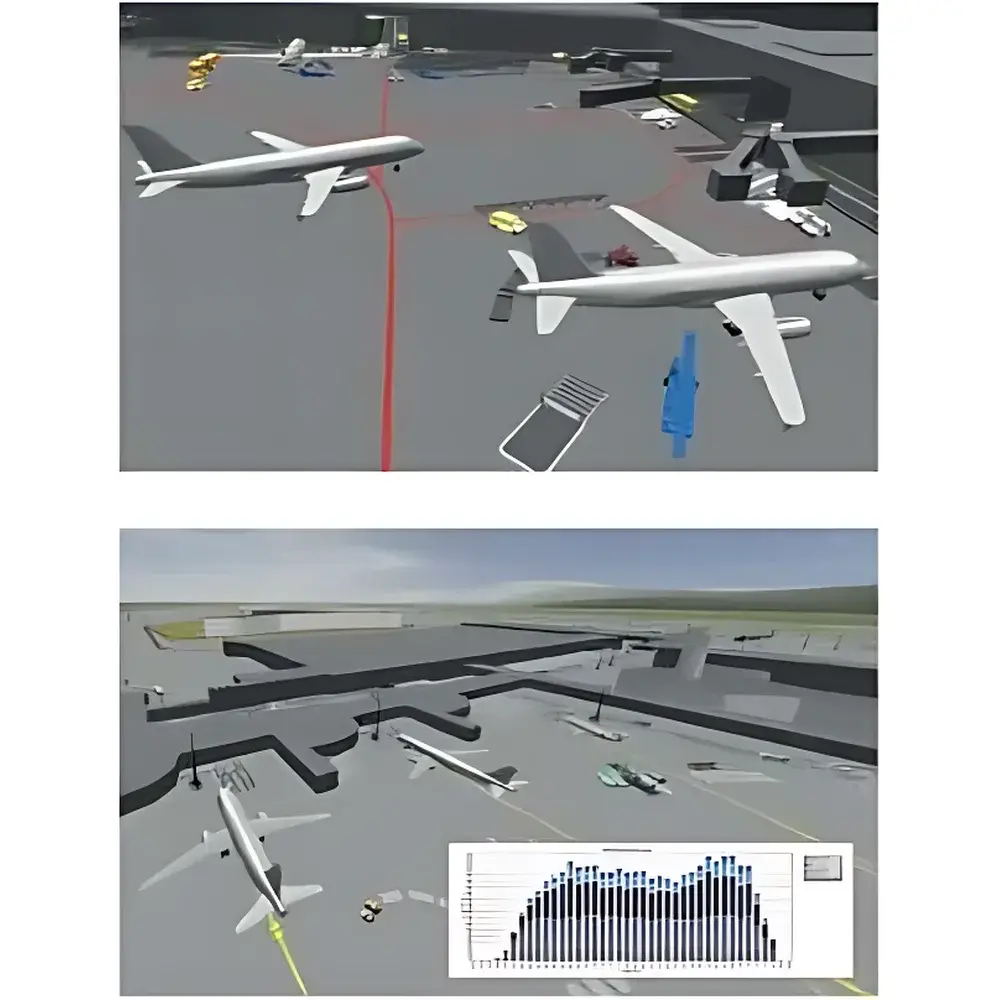
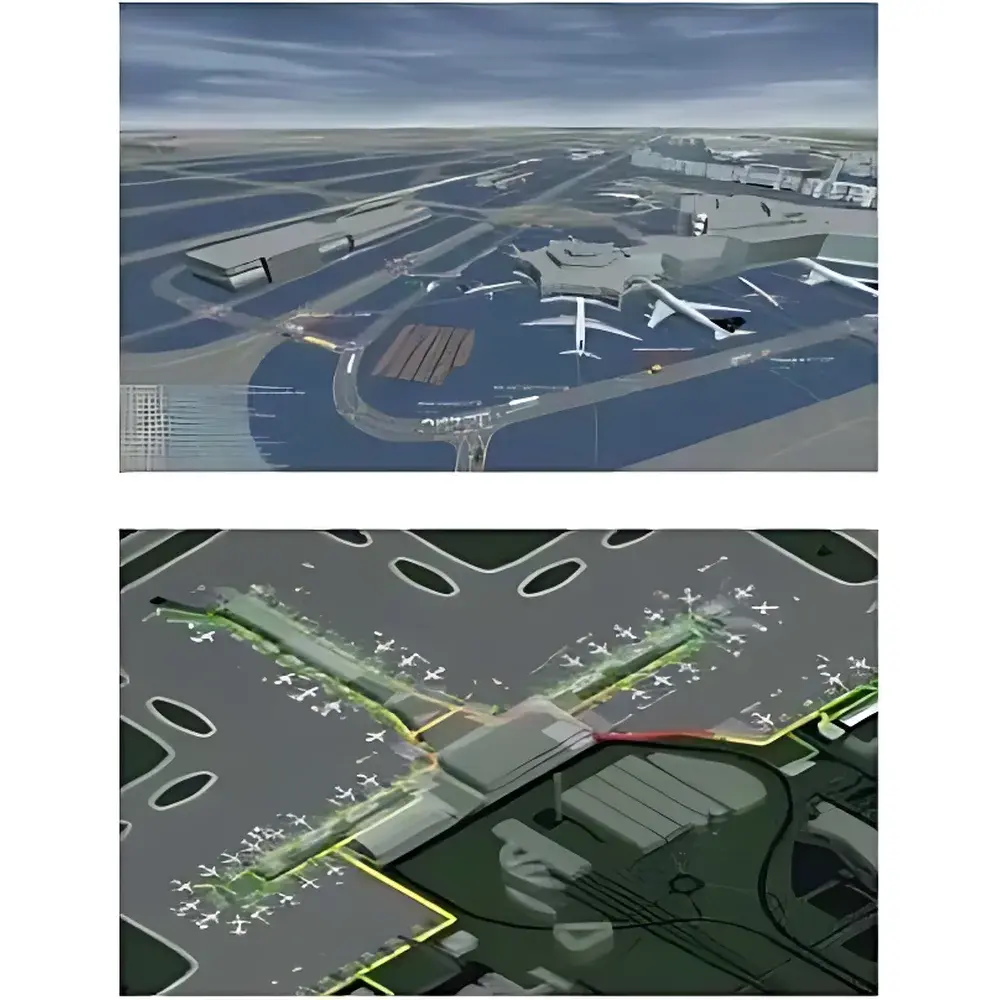
The CAST T-Series Airport Traffic Simulation & Capacity Assessment System is a high-fidelity, agent-based modeling (ABM) platform engineered for strategic and tactical analysis of integrated airport surface and airside operations. Built on a physics-informed, event-driven simulation architecture, CAST models the dynamic interactions among heterogeneous agents—including aircraft, ground service equipment (GSE), passenger flows, air traffic control (ATC) instructions, and gate/stand allocation logic—within a georeferenced 3D environment. Unlike static capacity estimation tools, CAST implements a directed, multi-airport network model that explicitly captures inter-airport dependencies (e.g., connecting flights, shared airspace sectors, and coordinated arrival/departure schedules) and intra-airport coupling constraints (e.g., runway occupancy time, taxiway conflict resolution, apron congestion thresholds). The core optimization objective minimizes total system-wide flight delay under joint capacity constraints—encompassing runway throughput, stand availability, gate turnaround windows, and ATC sector saturation—while respecting real-world operational rules defined per ICAO Annex 14, FAA AC 150/5060-5, and EASA AMC 20-23.
Key Features
- Agent-Based Architecture: Each entity—aircraft, pushback tractor, baggage cart, or passenger group—is instantiated as an autonomous agent with configurable behavioral rules, state variables (e.g., fuel level, maintenance status, crew duty time), and decision logic governed by priority hierarchies and stochastic response functions.
- Multi-Layer 3D Visualization Engine: Real-time rendering of synchronized surface movement, terminal passenger flow, and en-route trajectory data in a GIS-aligned 3D scene; supports LOD (Level of Detail) scaling, time-warp playback (0.1x–10x), and overlay of performance KPIs (e.g., average gate dwell time, taxi delay distribution, stand utilization heatmap).
- Open Multi-Airport Network Modeling: Supports topology definition across interconnected airports sharing common airspace, slot coordination mechanisms, and interline passenger transfer logic; enables scenario testing of hub-and-spoke resilience, contingency rerouting, and collaborative decision-making (CDM) protocols.
- Constraint-Driven Optimization Framework: Integrates linear and mixed-integer programming solvers to allocate arrival/departure slots, optimize gate assignments, and resequence traffic under simultaneous constraints: runway capacity (per ICAO Doc 9883), apron maneuvering envelope, ATC staffing limits, and regulatory separation minima.
- Scenario Management & Sensitivity Analysis: Version-controlled scenario library with parameter sweep capability (e.g., ±15% demand growth, 20% GSE fleet reduction, 30-min ATC outage); automated generation of tornado charts and Monte Carlo confidence intervals for delay metrics.
Sample Compatibility & Compliance
CAST T-Series accepts input datasets compliant with AIXM 5.1, FIXM 4.2, and IATA’s PADIS schema for flight schedules, airport layout (ADAPT/ARINC 444), and NOTAM-derived restrictions. Output reports conform to ICAO Annex 16 Vol II (environmental reporting), EUROCONTROL’s EATCHIP guidelines, and FAA Order 8010.4B for safety risk assessment documentation. The system architecture adheres to ISO/IEC 27001 for data handling and supports audit-ready logging required under EASA Regulation (EU) No 376/2014 for occurrence reporting traceability.
Software & Data Management
CAST operates on a client-server architecture with PostgreSQL-backed spatial database and RESTful API integration for bidirectional exchange with existing A-CDM platforms (e.g., SITA WorldTracer, AMHS, and Lido/Flight Explorer). All simulation runs generate timestamped, digitally signed JSON-LD artifacts containing full provenance metadata (input parameters, random seed, solver configuration). Audit trails comply with ISO/IEC 17025 clause 7.10 for result integrity and support GLP-compliant validation protocols. Role-based access control (RBAC) enforces separation of duties between modelers, validators, and operational users.
Applications
- Airport master planning and infrastructure investment prioritization (e.g., new runway feasibility, terminal expansion ROI)
- Regulatory capacity certification submissions to national aviation authorities (NAA) and EASA
- Pre-implementation validation of A-CDM initiatives and collaborative arrival management (C-AMAN) procedures
- Disruption response rehearsal (e.g., weather-induced ground stops, ATC system failures, pandemic recovery ramp-up)
- Joint industry–regulator workshops for harmonizing capacity targets across multi-airport regions (e.g., London Airspace Strategy, German Upper Airspace Concept)
FAQ
Does CAST T-Series support real-time integration with live airport operational databases?
Yes—via certified middleware adapters for AODB, ATFM, and CMS systems using FIXM, AIXM, and custom XML schemas.
Can CAST simulate non-ICAO-compliant airports or military airfields?
Yes—custom geometry import (DXF, CityGML, or OpenStreetMap derivatives) and rule-set authoring enable modeling of non-standard layouts and procedural controls.
What validation methodologies are supported for CAST model accreditation?
CAST includes built-in statistical verification tools (Kolmogorov–Smirnov tests, chi-square goodness-of-fit) and supports third-party validation against historical ADS-B traces, radar logs, and AODB delay records per EUROCONTROL Validation Handbook v3.2.
Is cloud deployment available?
Deployment options include on-premise virtualized environments (VMware/Hyper-V), private cloud (AWS GovCloud, Azure Government), and hybrid configurations meeting NIST SP 800-53 Rev. 5 security controls.






