
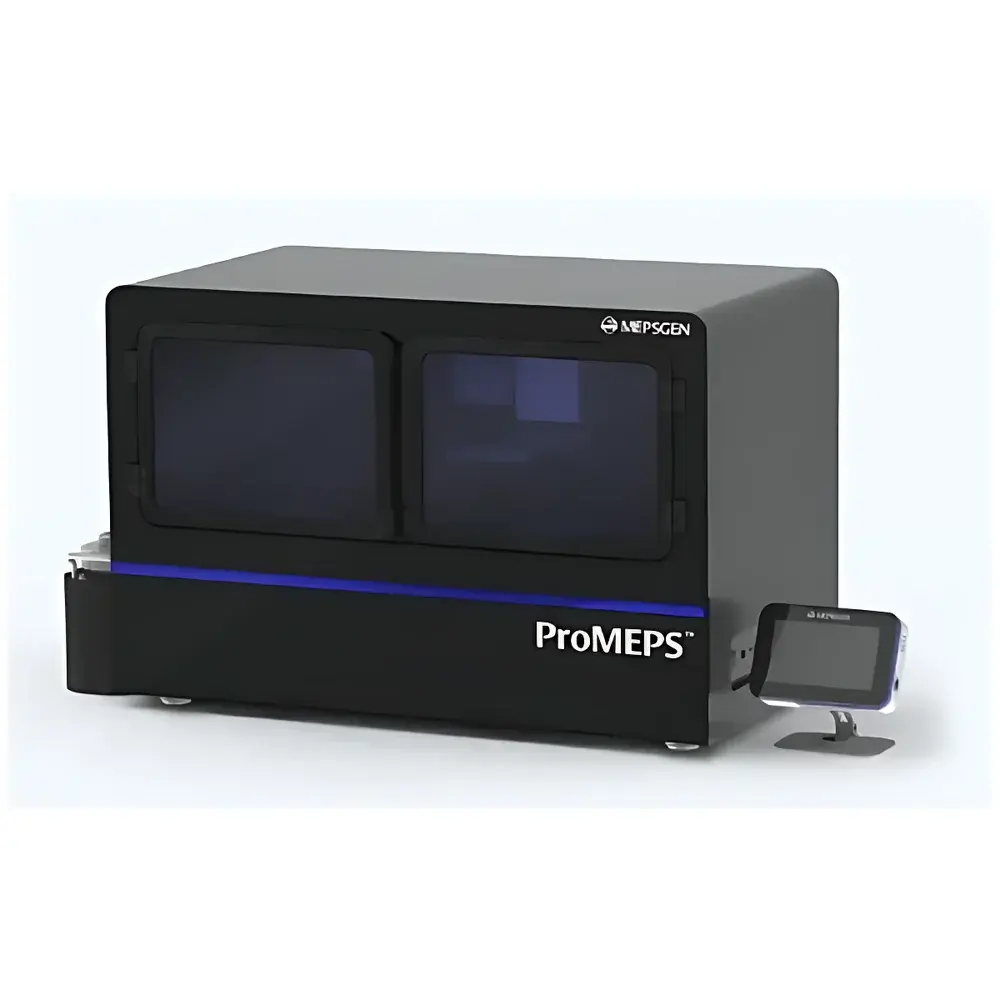
MEPSGEN ProMEPS Automated Organoid Workstation
| Brand | MEPSGEN |
|---|---|
| Model | ProMEPS |
| Origin | South Korea |
| Category | Imported |
| Weight | ~50 kg |
| Power Consumption | ~2000 W |
| Input Voltage | 100–130 VAC / 200–240 VAC, 60 Hz |
| CO₂ Supply | 100% CO₂ at 1.2 bar |
| Gas Flow Rate (Media) | 200 mL/min |
| Temperature Control Range | Ambient to 45 °C |
| Humidity Control Range | 30–80 % RH (Operating), 30–90 % RH (Storage) |
| Impedance Channels | 32 |
| Impedance Measurement Range | 0–100 kΩ |
| Display | 800 × 480 px capacitive touchscreen |
| Connectivity | Ethernet & USB |
| Operating Temperature | 20–30 °C |
| Storage Temperature | 0–60 °C |
Overview
The MEPSGEN ProMEPS Automated Organoid Workstation is an integrated robotic platform engineered for standardized, reproducible, and longitudinal culture of human-derived organoids and microphysiological systems (MPS). It operates on a modular microfluidic architecture combined with real-time bioimpedance monitoring and environmental control—enabling physiologically relevant in vitro modeling of epithelial and endothelial barriers. Unlike conventional static or manually operated 3D culture systems, ProMEPS employs continuous shear flow under parallel uniform perfusion to maintain tissue polarity, barrier integrity, and metabolic homeostasis—critical for modeling functional organ-level responses. Designed specifically for translational research laboratories and preclinical drug development units, the system supports compliant operation within GLP-aligned workflows and facilitates seamless integration into existing laboratory information management systems (LIMS).
Key Features
- Integrated Microfluidic Perfusion Architecture: Delivers laminar, low-shear flow across multi-well organoid chambers to sustain physiological shear stress profiles and prevent hypoxic core formation in 3D constructs.
- Real-Time TEER Monitoring: 32-channel bioimpedance measurement module enables non-invasive, label-free quantification of trans-epithelial/endothelial electrical resistance (TEER) with sub-minute temporal resolution—supporting dynamic assessment of barrier function during compound exposure.
- Automated Cell & Hydrogel Handling: High-precision robotic arm with calibrated dispensing accuracy (< ±1 µL) for sequential loading of primary cells, iPSC-derived progenitors, and tunable extracellular matrix hydrogels (e.g., Matrigel®, collagen I, synthetic PEG-based matrices).
- Environmental Control Suite: Independent regulation of CO₂ (1–20% range), temperature (ambient to 45 °C, ±0.3 °C stability), and relative humidity (30–80 % RH) within the culture chamber—validated per ISO 13485 environmental monitoring requirements.
- Modular Organ-Specific Protocols: Pre-validated, editable protocol libraries for brain, liver, kidney, lung, vascular, and skin organoid differentiation—compatible with both adherent and suspension-based maturation strategies.
- Touchscreen HMI & Remote Operation: 800 × 480 px capacitive display with intuitive GUI; full remote access via Ethernet-enabled secure SSH or HTTPS interface for audit-trail-compliant operation.
Sample Compatibility & Compliance
ProMEPS accommodates primary human cells, patient-derived organoids, iPSC-derived lineages, and co-cultures (e.g., epithelial-immune-stromal tri-cultures) across standard 24- and 96-well microfluidic formats. All fluidic pathways are constructed from USP Class VI-certified cyclic olefin copolymer (COC) and medical-grade silicone tubing—ensuring low protein adsorption and leachables compliance. The system meets ISO 14644-1 Class 5 cleanroom compatibility when installed with optional HEPA-integrated enclosure. For regulatory submissions, raw impedance data, environmental logs, and robotic action timestamps are exportable in CSV/JSON format with embedded metadata—supporting alignment with FDA 21 CFR Part 11 electronic record requirements and ICH M10 bioanalytical method validation guidelines.
Software & Data Management
The ProMEPS Control Suite (v4.x) provides role-based user authentication, configurable audit trails, and version-controlled protocol storage. All impedance measurements are time-synchronized with environmental sensor outputs (CO₂, T, RH) and robotic event logs. Data export includes native .mat files for MATLAB® analysis and standardized .csv exports compatible with GraphPad Prism®, Python pandas, and commercial LIMS platforms. Optional API integration enables bidirectional communication with ELN systems (e.g., LabArchives, Benchling) and automated report generation for internal review boards or IND-enabling studies.
Applications
- High-throughput toxicity screening of small molecules, biologics, and nanotherapeutics using organ-specific barrier integrity endpoints.
- Longitudinal modeling of disease progression (e.g., fibrosis, inflammation, metastatic invasion) in patient-derived organoid biobanks.
- Pharmacokinetic-pharmacodynamic (PK-PD) correlation studies integrating real-time TEER decay kinetics with LC-MS/MS compound quantification.
- Immuno-oncology assays evaluating T-cell infiltration, checkpoint inhibitor response, and cytokine-mediated barrier disruption.
- Regulatory safety assessment per OECD TG 497 (in vitro skin corrosion) and draft EMA CHMP reflection paper on MPS-based nonclinical data packages.
FAQ
Does ProMEPS support sterile, closed-system operation for GMP-adjacent workflows?
Yes—when configured with ISO 5 laminar flow hood integration and validated autoclavable fluidic cartridges, the system supports aseptic passaging and long-term maintenance of sterility over 21-day culture cycles.
Can impedance data be correlated with immunofluorescence or RNA-seq endpoints?
Absolutely—the system timestamps all impedance acquisitions to the second; users can align functional TEER trends with endpoint molecular assays using shared sample IDs and LIMS-synced metadata.
Is remote troubleshooting supported by MEPSGEN engineering teams?
Yes—via encrypted VNC session initiation through the onboard Ethernet port; firmware updates and calibration verification logs are remotely auditable under signed digital certificates.
What validation documentation is provided with system delivery?
Each unit ships with Factory Acceptance Test (FAT) reports, IQ/OQ protocols aligned with ASTM E2500-13, and a Certificate of Conformance traceable to NIST-calibrated reference standards.
Are consumables supplied under long-term supply agreements?
MEPSGEN offers multi-year consumables contracts—including pre-sterilized microfluidic chips, certified hydrogels, and CO₂ sensor modules—with guaranteed lot-to-lot consistency and CoA documentation.
Related Products



