
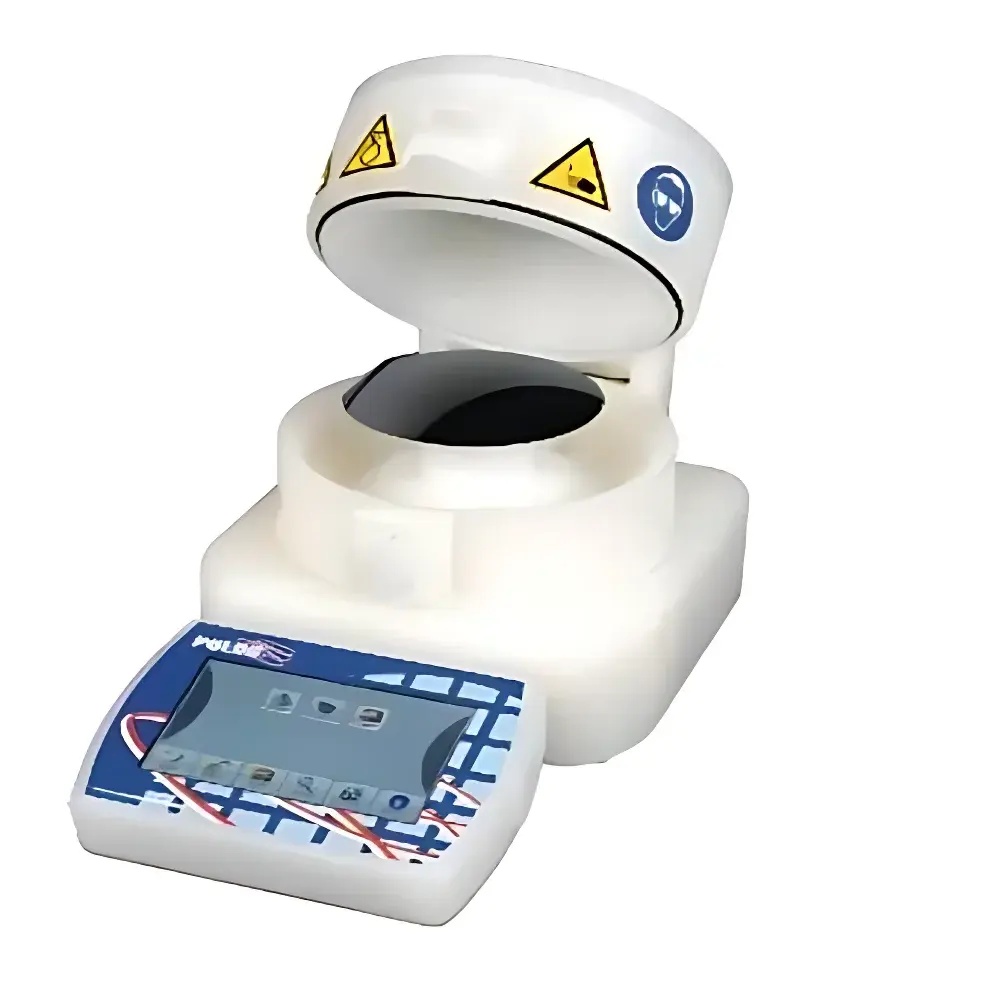
POLOS SPIN150i Spin Coater
| Brand | POLOS |
|---|---|
| Origin | Germany |
| Model | SPIN150i |
| Maximum Substrate Diameter | 150 mm (round) / 150×150 mm (square) |
| Rotation Speed Range | 0–12,000 rpm (±0.1 rpm accuracy) |
| Acceleration/Deceleration | 1–30,000 rpm/sec (adjustable in steps) |
| Rotation Modes | Programmable CW, CCW, and oscillatory stirring |
| Safety | Sensor-interlocked automatic lid lock |
| Standard Chuck | Vacuum chuck A-V36 + fragment adapter D-V10 |
| Housing Material | NPP (standard), optional PTFE version |
| Control Interface | Removable full-color touchscreen with intuitive recipe programming and storage |
| Optional Modules | Multi-nozzle dispensing (up to 6 independently programmable nozzles), ultrasonic cleaning, sequential/parallel chemical delivery |
Overview
The POLOS SPIN150i Spin Coater is an engineered precision instrument designed for reproducible thin-film deposition via rotational coating—principally governed by centrifugal force-driven fluid dynamics and solvent evaporation kinetics. It operates on the principle of spin casting: a liquid precursor (e.g., photoresist, sol-gel, polymer solution, or functional ink) is dispensed onto a stationary substrate, which is then accelerated to high angular velocity, inducing radial outward flow and controlled thinning of the film. Final thickness is determined by rheological properties of the coating material, spin speed profile (ramp-up, dwell, ramp-down), ambient temperature/humidity, and solvent volatility—parameters all precisely controllable and repeatable on the SPIN150i. Targeted at R&D laboratories and pilot-line manufacturing environments, it supports critical process steps including substrate cleaning, rinse/dry cycles, uniform coating, development, and etch-compatible pre-treatment across microelectronics, MEMS, photovoltaics, microfluidics, and advanced materials research.
Key Features
- Programmable bidirectional rotation (CW/CCW) and oscillatory stirring mode for enhanced edge uniformity and particle dispersion control
- High-resolution speed control: 0–12,000 rpm with ±0.1 rpm repeatability, enabling sub-nanometer film thickness resolution under calibrated conditions
- Ultra-fast acceleration/deceleration profiles (1–30,000 rpm/sec), fully configurable per step—essential for multi-stage spin protocols such as soft-bake–spin–hard-bake sequences
- Sensor-actuated safety interlock system ensures automatic lid locking during operation and immediate motor shutdown upon lid opening, compliant with IEC 61000-6-2/6-4 EMC and EN 60204-1 machinery safety standards
- Modular dispensing architecture: supports up to six independently addressable nozzles; each nozzle may be assigned unique timing, volume, flow rate, and retraction logic within a single recipe
- Integrated ultrasonic cleaning module option (20–40 kHz) for in-situ wafer surface activation and residue removal prior to coating
- NPP polymer construction (standard) provides chemical resistance to common solvents (acetone, PGMEA, IPA, DI water, dilute acids/bases); PTFE variant available for aggressive chemistries (HF, piranha, concentrated HNO₃)
Sample Compatibility & Compliance
The SPIN150i accommodates substrates ranging from 2.5 mm micro-dies to full 150 mm wafers (or 150 × 150 mm square plates), with optional adapters supporting fragments as small as 10 × 10 mm. Vacuum chucks (A-V36 standard) ensure stable clamping across silicon, glass, quartz, sapphire, metal foils, and flexible polymer substrates—including low-adhesion surfaces like PDMS and PET. All wet-processing modules comply with ISO 14644-1 Class 5 cleanroom compatibility when operated inside laminar flow hoods. The system meets GLP documentation requirements through audit-trail-enabled recipe logging (timestamped operator ID, parameter set, execution status), and supports 21 CFR Part 11 readiness when paired with validated third-party LIMS integration.
Software & Data Management
Operation is managed via a detachable industrial-grade color touchscreen running embedded Linux-based firmware. The GUI supports drag-and-drop recipe building, nested subroutines (e.g., “Clean → Dry → Prime → Coat → Soft-Bake”), and password-protected user roles (Operator, Engineer, Administrator). All executed runs are logged with metadata: date/time, operator ID, recipe name, actual vs. target RPM/time profiles, dispensing event timestamps, and error codes. Export formats include CSV and XML for traceability in quality management systems. Firmware updates are performed via USB or Ethernet, with SHA-256 signature verification. Optional API access (RESTful HTTP) enables integration into factory automation frameworks (SECS/GEM, OPC UA).
Applications
- Photolithography: Uniform photoresist (e.g., AZ, SU-8, PMMA) films for mask alignment and UV exposure
- MEMS packaging: Polyimide passivation layers, BCB adhesive spin-on films, and sacrificial layer deposition
- Perovskite & organic PV: Sequential spin-casting of HTL/ETL/active layers with inert-atmosphere compatibility
- Microfluidic device fabrication: PDMS precursor spinning, hydrogel patterning, and surface functionalization coatings
- Nanomaterials: Graphene oxide, MXene, or quantum dot ink deposition with controlled aggregation morphology
- Quality assurance: In-house validation of coating viscosity–thickness correlation per ASTM D1212 and ISO 2360
FAQ
What substrate sizes does the SPIN150i support?
Standard configuration handles round substrates up to Ø150 mm and square substrates up to 150 × 150 mm. Fragment adapters (D-V10) enable secure processing of pieces as small as 2.5 mm diameter or 10 × 10 mm squares.
Is vacuum chucking compatible with non-silicon substrates?
Yes—the A-V36 vacuum chuck includes adjustable suction zones and optional porous ceramic inserts for low-porosity or warped substrates (e.g., glass slides, metal foils, flexible circuits).
Can the system be integrated into a Class 100 cleanroom environment?
All electrical components are rated IP54; optional HEPA-filtered exhaust ducting and static-dissipative housing upgrades satisfy ISO 14644-1 Class 5 requirements.
Does the SPIN150i support GMP/GLP-compliant recordkeeping?
Yes—full electronic batch records (EBR) with digital signatures, change history, and exportable audit logs are available when configured with validated software mode and external time-server synchronization.
Are custom dispensing nozzles available for high-viscosity pastes?
Yes—stainless-steel or ceramic nozzles with orifice diameters from 50 µm to 500 µm, pressure-regulated syringe pumps (0.1–50 mL/min), and heated lines (up to 80 °C) are supported as factory-installed options.




