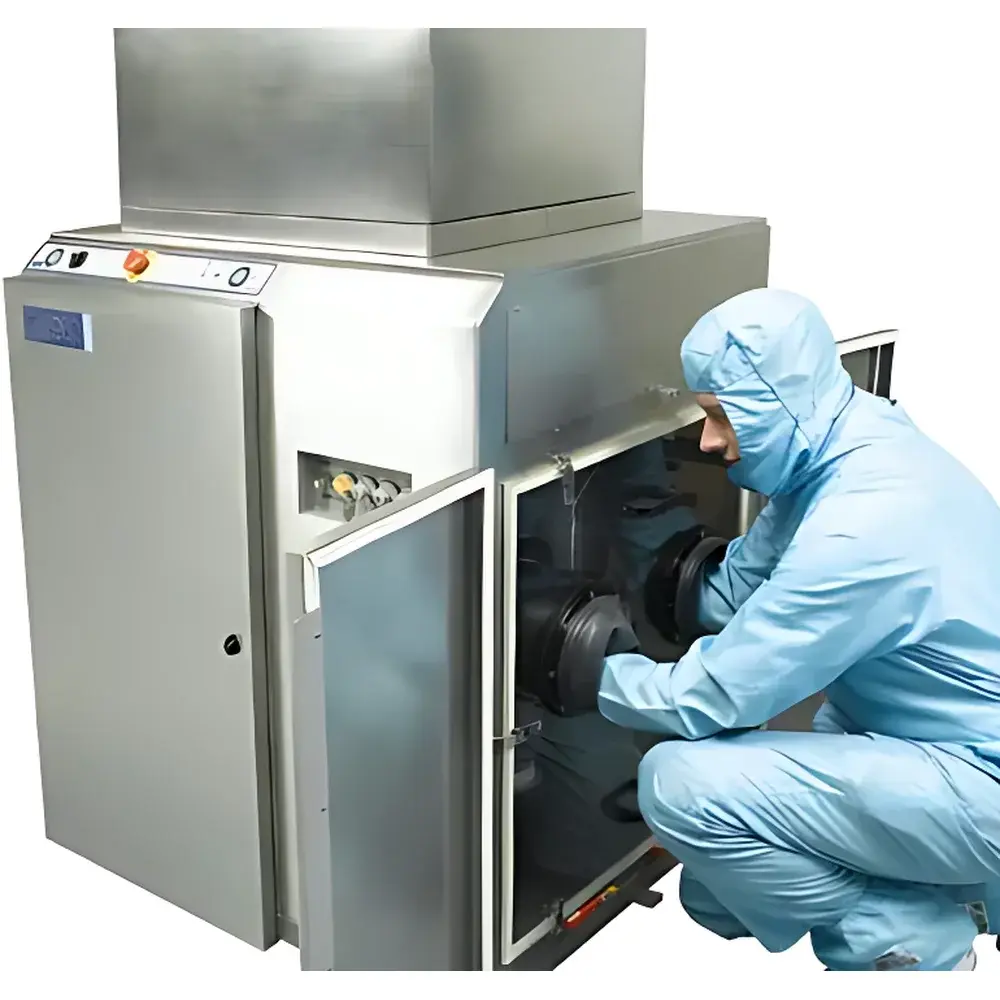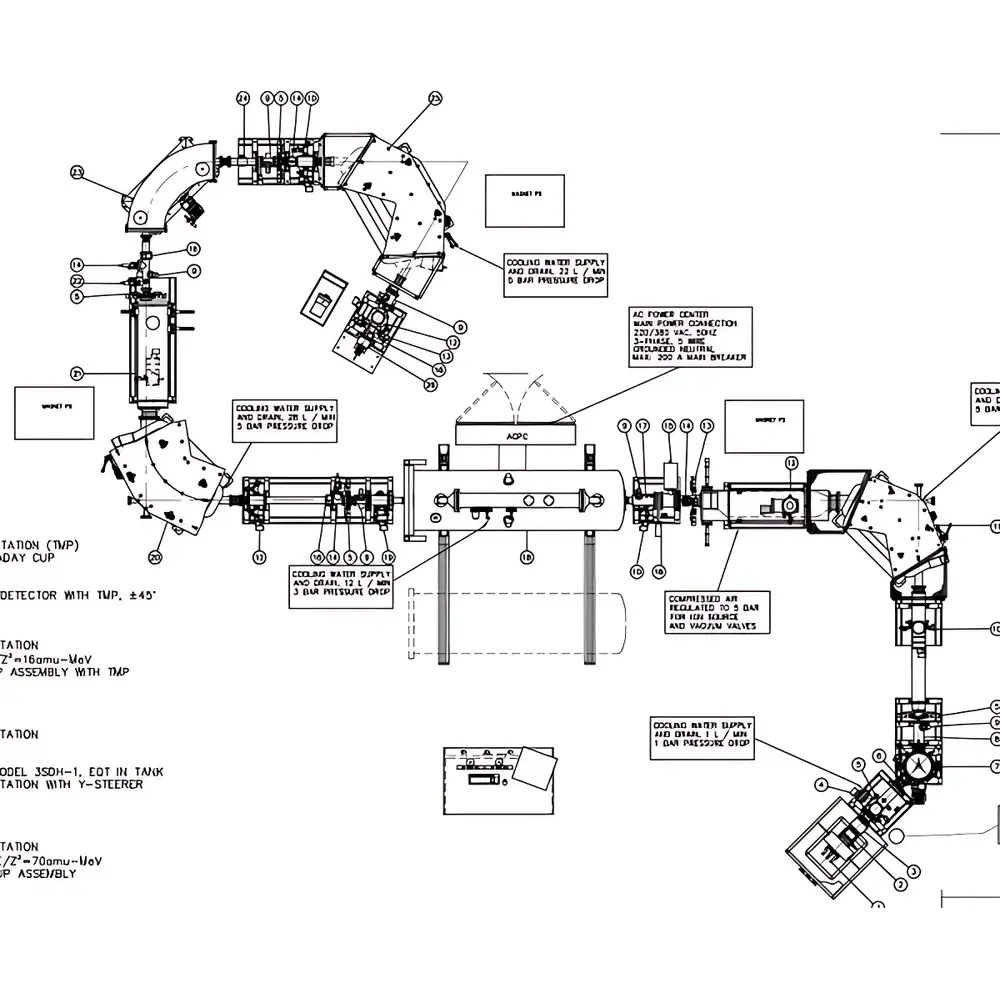
NEC UAMS Pelletron® Tandem Electrostatic Ion Accelerator System
| Origin | USA |
|---|---|
| Manufacturer Type | Authorized Distributor |
| Origin Category | Imported |
| Model | NEC UAMS |
| Price | USD $5,000,000 |
Overview
The NEC UAMS Pelletron® Tandem Electrostatic Ion Accelerator System is a high-voltage, custom-engineered ion beam platform designed for precision materials analysis, nuclear physics research, and ultra-trace isotopic quantification. Built upon National Electrostatics Corporation’s proprietary Pelletron® charging technology—featuring all-metal-and-ceramic acceleration tubes with zero organic components in the vacuum envelope—the UAMS delivers exceptional terminal voltage stability, long-term operational reproducibility, and immunity to hydrocarbon contamination. Unlike RF or linear accelerator architectures, the Pelletron operates on electrostatic principles: ions are accelerated through a series of graded potentials generated by a continuously moving metal-pellet charging chain, enabling precise energy control from keV to hundreds of MeV. This architecture supports both tandem (two-stage) and single-ended configurations, making it suitable for applications requiring high mass resolution, low background interference, and sub-zeptomole detection sensitivity—particularly in accelerator mass spectrometry (AMS) and MeV ion beam analysis.
Key Features
- All-metal-and-ceramic acceleration tube: Eliminates outgassing and carbon deposition, ensuring ultra-high vacuum integrity (>1×10⁻⁹ Torr) and long-term beam stability.
- Pelletron® charging system: Self-regulating metal-pellet chain provides <±0.01% terminal voltage regulation over multi-week continuous operation.
- Modular tandem design: Configurable for negative-ion injection, stripping in the high-voltage terminal (e.g., gas or foil stripper), and post-acceleration of positive ions—enabling isotopic separation of isobars (e.g., ¹⁴C/¹⁴N, ²⁶Al/²⁶Mg).
- Integrated beam transport: High-resolution magnetic dipoles and quadrupole doublets support microbeam focusing down to <1 µm spot size for micro-PIXE and micro-RBS mapping.
- Compliance-ready infrastructure: Designed to interface with ISO/IEC 17025-accredited lab workflows; compatible with FDA 21 CFR Part 11–compliant data acquisition modules for GLP/GMP environments.
Sample Compatibility & Compliance
The UAMS accommodates solid, powdered, and pressed pellet samples—including geological matrices (quartz, carbonate), biological tissues (bone collagen, blood serum), environmental filters (aerosol collectors), and semiconductor-grade wafers (Si, GaAs, SiC). Sample chambers support in-vacuum target positioning with ±0.1° angular resolution for channeling RBS and ion channelling studies. All beamline components meet ASTM E1553 (Standard Guide for Ion Beam Analysis) and ISO 11929 (Evaluation of measurement uncertainty in ion beam analysis). For AMS applications, the system conforms to IUPAC technical recommendations for isotopic ratio metrology and supports traceability to NIST SRMs (e.g., NIST SRM 4990C for ¹⁴C calibration).
Software & Data Management
Control and acquisition are managed via NEC’s proprietary IonBeam Suite™ v5.x—a real-time, deterministic Linux-based platform supporting synchronized detector readout (silicon surface barrier, gas ionization, time-of-flight), automated beam tuning, and spectral deconvolution using iterative least-squares fitting. Raw data files adhere to HDF5 format with embedded metadata (sample ID, beam energy, charge state, live time, vacuum status) for audit trail compliance. Export modules support ASCII, CSV, and CDF formats; integration with third-party tools (e.g., GUPIX for PIXE quantification, SIMNRA for RBS simulation) is native. Full audit logging—including user login, parameter changes, and calibration events—is retained for ≥10 years per GLP requirements.
Applications
- Accelerator Mass Spectrometry (AMS): Quantification of cosmogenic nuclides (¹⁰Be, ²⁶Al, ³⁶Cl, ⁴¹Ca) in geochronology, ice core dating, and nuclear forensics.
- MeV Ion Beam Analysis: Rutherford Backscattering Spectrometry (RBS), Elastic Recoil Detection (ERD), Particle-Induced X-ray Emission (PIXE), and Nuclear Reaction Analysis (NRA) for depth profiling of dopants, contaminants, and thin-film stoichiometry in semiconductor devices.
- Nuclear Physics Research: Low-energy nuclear reaction cross-section measurements, resonance fluorescence studies, and charge exchange experiments.
- Biomedical Tracer Studies: Ultra-sensitive detection of ⁴¹Ca-labeled bone metabolism markers and ²⁶Al exposure biomonitoring in human tissue.
- Environmental Monitoring: Isotopic fingerprinting of heavy metal sources (e.g., Pb, Sr) in soil and sediment cores using multi-collector AMS.
FAQ
What distinguishes the Pelletron® architecture from Van de Graaff or RF accelerators?
The Pelletron uses a mechanically driven metal-pellet chain instead of a rubber belt, eliminating triboelectric instability and organic outgassing—critical for maintaining MeV-level energy resolution and vacuum purity.
Can the UAMS be configured for both AMS and routine ion beam analysis?
Yes. The system supports rapid reconfiguration between high-transmission AMS mode (with gas or foil strippers and high-mass-resolution magnet analysis) and analytical beamline mode (RBS/PIXE/ERD) via interchangeable beamline sections and detector ports.
Is remote operation supported for multi-user facilities?
The IonBeam Suite™ includes role-based access control, TLS-encrypted web interface, and API endpoints for integration with facility-wide scheduling systems (e.g., LabArchives, ICE).