
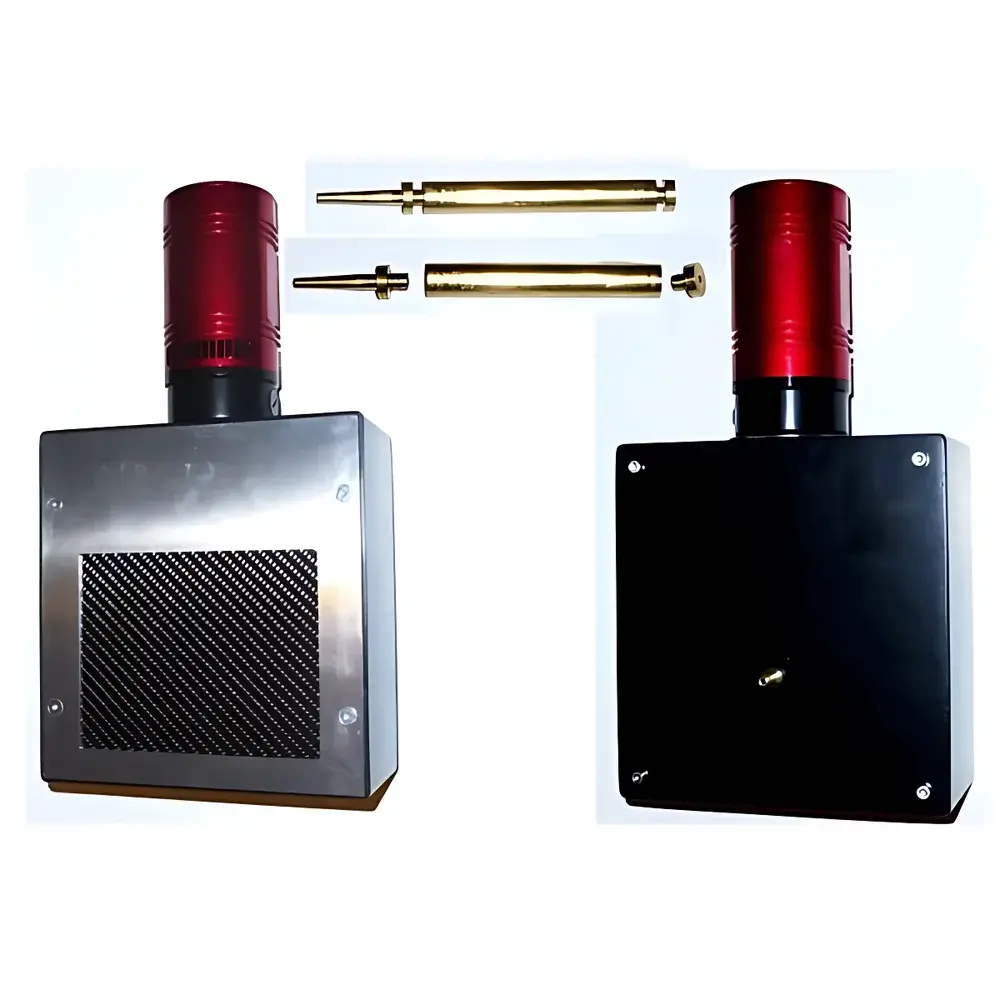
NeutronOptics Laue CCD Camera
| Origin | France |
|---|---|
| Manufacturer Type | Distributor |
| Origin Category | Imported |
| Model | Laue CCD Camera |
| Price Range | USD 14,000 – 70,000 |
Overview
The NeutronOptics Laue CCD Camera is a high-performance, dual-sensor X-ray and neutron diffraction imaging system engineered for precise crystallographic orientation mapping in single-crystal materials. Based on the Laue diffraction principle—where polychromatic (white) X-ray or neutron beams interact with a stationary crystal to produce a geometrically encoded pattern of Bragg reflections—the camera captures real-time, high-fidelity Laue patterns without mechanical scanning or monochromation. Unlike legacy Polaroid-based Laue cameras, this system replaces film with two synchronized, high-sensitivity CCD sensors coupled to a large-aperture imaging lens and scintillator screen. The optical path incorporates micro-lens arrays on each CCD pixel to maximize quantum efficiency and spatial resolution. Designed for both forward- and backscattering geometries, the camera supports rapid orientation determination (<5 s per pattern), quantitative lattice parameter analysis, and strain mapping—making it suitable for academic crystallography labs, industrial crystal growth facilities, and synchrotron beamline end-stations.
Key Features
- Dual-CCD architecture eliminates central collimator shadowing and extends effective field of view to 160 × 120 mm2 after software-based image stitching
- Carbon-fiber vacuum window (160 × 120 mm) with >70% transmission at 8 keV (Cu Kα), enabling high-efficiency white-beam operation
- Modular scintillator options optimized for X-ray (e.g., Gd2O2S:Tb) or neutron (e.g., 6LiF/ZnS) detection
- Integrated collimation system compatible with both transmission (forward-scatter) and reflection (back-scatter) Laue configurations
- Real-time readout capability with full-frame acquisition at up to 1 Hz (dependent on exposure time and binning mode)
- Designed for ambient or vacuum environments; flange-mounted for integration into goniometer stages and diffractometers
Sample Compatibility & Compliance
The Laue CCD Camera accommodates a broad range of crystalline samples—including metals (e.g., Ni, Pt, Cu), semiconductors (Si, GaAs), oxides (Al2O3, YAG), and organic molecular crystals—without requiring sample rotation or alignment prior to exposure. Its wide dynamic range (≥104:1) and low-noise readout support weakly diffracting or highly absorbing specimens (e.g., Pt(111) backscatter measurements at 35 kV/50 mA). The system complies with ISO 11146 (laser beam profiling standards, adapted for diffraction pattern metrology), and its digital output workflow aligns with GLP and GMP documentation requirements when paired with timestamped metadata logging. While not FDA-certified as a medical device, its data integrity features—including lossless TIFF output, non-destructive raw frame storage, and ImageJ-compatible metadata headers—support audit-ready traceability per 21 CFR Part 11 when deployed in regulated R&D environments.
Software & Data Management
The camera operates natively with open-source ImageJ/Fiji via custom plugins developed by NeutronOptics. These tools automate geometric correction (distortion, magnification, relative sensor offset), intensity normalization, and multi-image stitching using sub-pixel cross-correlation algorithms. Calibration routines support both linear and polynomial lens distortion models derived from grid or pinhole test patterns. All raw frames are saved in uncompressed 16-bit TIFF format with embedded EXIF-like metadata (exposure time, HV, filter status, collimator ID). Batch processing scripts enable automated peak indexing using standard Laue indexing engines (e.g., LAUEGEN, MTEX integration). Export formats include CIF-compliant orientation matrices, CSV-based spot lists (x/y/pixel intensity/hkl assignment), and vectorized SVG overlays for publication-grade figure generation.
Applications
- Rapid crystal orientation screening in metallurgy and semiconductor wafer manufacturing
- In situ monitoring of crystal growth dynamics and phase transformation kinetics
- Residual stress and elastic strain mapping via Laue peak splitting analysis
- Single-crystal alignment for neutron scattering experiments at reactor or spallation sources
- Educational demonstration of reciprocal space geometry and Bragg’s law in undergraduate solid-state physics laboratories
- Pre-characterization of seed crystals for epitaxial thin-film deposition processes
FAQ
What radiation sources is this camera compatible with?
It supports laboratory X-ray tubes (Cu, Mo, Ag anodes), synchrotron white-beam ports, and neutron beams (thermal/cold) when equipped with appropriate scintillators and shielding.
Can the system be used in vacuum or helium environments?
Yes—the carbon-fiber window and stainless-steel housing are rated for ≤10−6 mbar vacuum; optional helium purge ports are available for moisture-sensitive experiments.
Is real-time orientation feedback possible during data collection?
Orientation solutions can be computed within 2–3 seconds post-acquisition using pre-calibrated detector geometry and standard indexing libraries; live streaming to external control systems requires API-level integration.
Does the camera support automated calibration routines?
Yes—built-in routines use reference grid patterns to determine pixel scale, rotation, and non-linear distortion coefficients; calibration files are stored per-detector and applied automatically during image reconstruction.
How is radiation damage mitigated for sensitive biological or organic crystals?
The system enables ultra-short exposures (down to 10 ms) combined with high-gain EMCCD mode (optional upgrade); backscatter geometry further reduces dose deposition compared to transmission Laue.




