
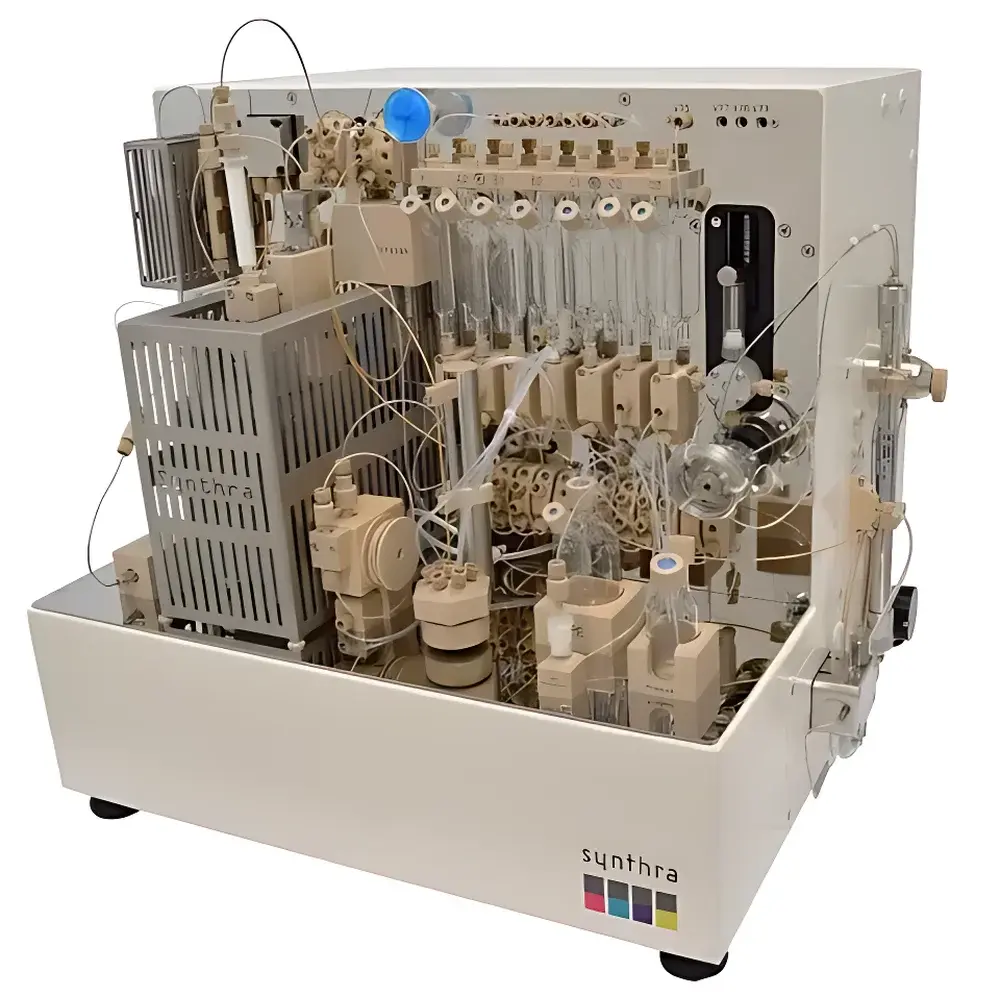
Synthra MeIplus Research PET Radioisotope Fully Automated Synthesis System
| Origin | Germany |
|---|---|
| Manufacturer Type | Authorized Distributor |
| Origin Category | Imported |
| Model | Synthra MeIplus Research |
| Pricing | Available Upon Request |
Overview
The Synthra MeIplus Research is a fully automated, closed-loop radiochemical synthesis platform engineered for the reliable, reproducible, and GMP-compliant production of carbon-11 (¹¹C)-labeled positron emission tomography (PET) tracers. It operates on the principle of nucleophilic ¹¹C-methylation—primarily using [¹¹C]methyl iodide ([¹¹C]CH₃I) or optionally [¹¹C]methyl triflate ([¹¹C]CH₃OTf)—enabling rapid, high-yield synthesis of diverse radiopharmaceuticals including [¹¹C]PIB, [¹¹C]raclopride, [¹¹C]flumazenil, and [¹¹C]methionine. The system integrates modular reaction control, cryogenic trapping, HPLC-based purification, solid-phase extraction (SPE), and sterile filtration within a single shielded enclosure, minimizing operator radiation exposure while maximizing synthetic robustness and batch-to-batch consistency.
Key Features
- Fully enclosed, chemically inert fluidic architecture with <35 µL dead volume valves and PFA/ETFE wetted surfaces—ensuring trace-level purity and simplifying decontamination and maintenance.
- Dual cryo-cooled reaction vessels operating from –196 °C to +250 °C, enabling low-temperature trapping of volatile [¹¹C]CH₃I and high-temperature Grignard-type coupling reactions.
- Nine reagent positions (seven 1–3 mL vials + two 10–15 mL vials), all temperature-controlled across nine independent heating zones—four of which support active cooling down to –196 °C via liquid nitrogen.
- Integrated preparative radio-HPLC system featuring dual analytical-grade columns, column-switching valve, quaternary gradient pump (flow range: 0.1–40 mL/min), and variable-wavelength UV detector (190–600 nm) for real-time reaction monitoring and in-process purification.
- Six radiation-shielded NaI(Tl) or BGO gamma detectors distributed across synthesis, HPLC, SPE, and formulation modules—providing quantitative activity tracking at each critical process step.
- Automated filter integrity testing (forward flow & bubble point) compliant with ASTM F838 and USP , performed post-sterile filtration under controlled pressure hold conditions.
- Chemically inert vacuum system (<5 hPa ultimate vacuum) with liquid nitrogen–cooled cold trap for quantitative capture of volatile radioactive species—protecting both the vacuum pump and facility exhaust.
- 18-channel embedded electronics for real-time I/O control, analog signal acquisition, and deterministic timing—supporting sub-second valve actuation and precise temperature ramping.
Sample Compatibility & Compliance
The Synthra MeIplus Research supports synthesis of a broad spectrum of ¹¹C-labeled small molecules, including but not limited to amino acids, neurotransmitter analogs, receptor ligands, and amyloid-binding agents. All wetted materials comply with USP Class VI and ISO 10993 biocompatibility standards. The system is designed and validated in accordance with EU Annex 1, FDA 21 CFR Part 11 (electronic records/signatures), and ICH GCP/GLP principles. Full cGMP documentation—including IQ/OQ/PQ protocols, calibration logs, alarm history, and audit-trail-enabled method versioning—is natively supported through CythRaveVIEW software.
Software & Data Management
CythRaveVIEW (Windows 10–based) provides role-based, password-protected access with configurable user privileges (operator, supervisor, administrator). It enables intuitive graphical method building via drag-and-drop workflow editor, real-time visualization of temperature, pressure, flow, and radioactivity profiles, and automated generation of electronic batch records (EBRs). All process data—including timestamps, setpoints, deviations, and detector counts—are time-stamped, digitally signed, and stored in encrypted SQLite databases compliant with ALCOA+ data integrity requirements. Remote monitoring and TCP/IP-based integration with LIMS or MES systems are supported without third-party middleware.
Applications
- Routine production of clinical and preclinical ¹¹C-radiotracers for neuroimaging (e.g., amyloid, dopamine D2, GABAA receptors).
- Method development and optimization of novel ¹¹C-labeling strategies under controlled, reproducible conditions.
- Multi-step radiosynthesis involving cryogenic trapping, sequential addition, and inline purification—without manual intervention.
- Support for regulatory submissions requiring full traceability, validation documentation, and 21 CFR Part 11–compliant data handling.
- Integration into centralized radiopharmacy facilities where uptime, repeatability, and audit readiness are mission-critical.
FAQ
What radiochemical yields can be expected for [¹¹C]PIB synthesis using this system?
Typical decay-corrected radiochemical yields (RCY) for [¹¹C]PIB range between 35–55%, depending on precursor purity, reaction temperature profile, and [¹¹C]CH₃I delivery efficiency—consistent with published literature using comparable platforms.
Is the system qualified for clinical manufacturing under cGMP?
Yes—the Synthra MeIplus Research is supplied with full qualification documentation (IQ/OQ/PQ), pre-validated cleaning procedures, and software features meeting FDA 21 CFR Part 11 and EU GMP Annex 11 requirements for computerized systems.
Can the HPLC configuration be modified for alternative tracers?
Yes—column selection is fully programmable via the column-switching valve; users may install up to two additional HPLC columns (e.g., C18, phenyl-hexyl, or mixed-mode) and define custom gradient methods within CythRaveVIEW.
How is radiation safety maintained during operation?
All synthesis, purification, and formulation steps occur inside lead-shielded enclosures (≥50 mm Pb equivalent); pneumatic actuation eliminates manual handling; and real-time gamma monitoring triggers automatic shutdown upon threshold exceedance.
What maintenance intervals are recommended for the vacuum pump and HPLC components?
The chemical-inert diaphragm vacuum pump requires inspection every 6 months; HPLC pump seals and UV lamp are scheduled for replacement every 12 months or after 2,000 injection cycles—log entries are automatically generated by CythRaveVIEW.
Related Products





