
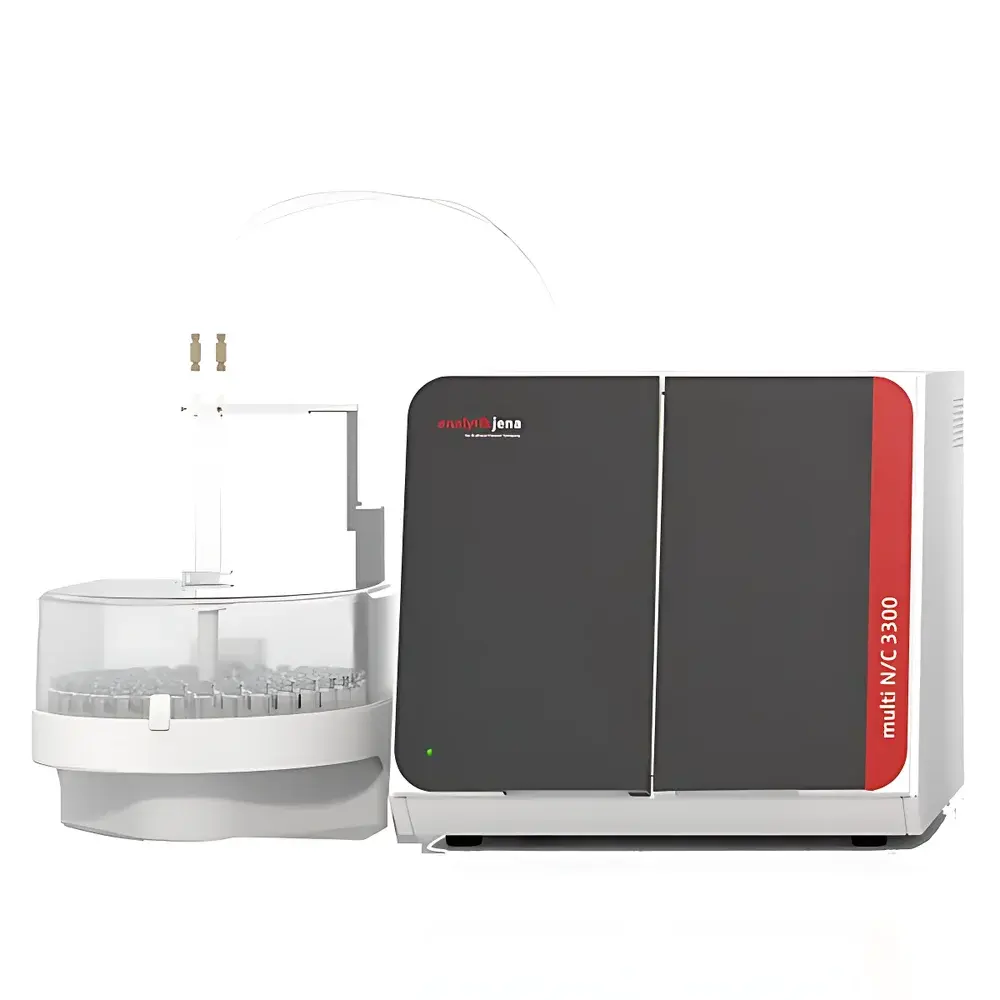
Analytik Jena multi N/C 3300 Total Organic Carbon and Total Bound Nitrogen Analyzer
| Brand | Analytik Jena |
|---|---|
| Origin | Germany |
| Manufacturer | Analytik Jena AG |
| Instrument Type | Laboratory TOC/TNb Analyzer |
| Detection Principle | Non-Dispersive Infrared (NDIR) Absorption |
| Oxidation Method | High-Temperature Catalytic Combustion (up to 1000 °C) |
| Optional Oxidation | Dual-Wavelength High-Intensity UV Photolysis (for wet chemical oxidation) |
| Detection Modules | NDIR for TOC/TC/TIC/NPOC/POC |
| Sample Introduction | Ceramic Valve-Based Loop Injection System |
| Sample Compatibility | Suspended-solids-rich wastewater, high-salinity matrices, ultrapure water, and solid samples (with optional solid module) |
| Automation Level | Fully Modular, Configurable for Unattended Operation |
| Compliance Support | Designed for GLP/GMP environments |
Overview
The Analytik Jena multi N/C 3300 is a dual-detection laboratory analyzer engineered for the simultaneous quantification of Total Organic Carbon (TOC) and Total Bound Nitrogen (TNb) in aqueous and solid environmental matrices. It employs high-temperature catalytic combustion (up to 1000 °C) as the primary oxidation method, ensuring complete mineralization of refractory carbon and nitrogen species—including humic substances, nitrates, nitrites, and organonitrogen compounds—into CO₂ and NOₓ. Carbon dioxide is measured via a high-stability, temperature-compensated Non-Dispersive Infrared (NDIR) detector, while nitrogen oxides are converted and quantified using either a Chemiluminescence Detector (CLD) or Conductivity Detector (ChD), depending on configuration. This dual-path architecture enables trace-level detection across an exceptionally broad dynamic range without manual dilution—critical for regulatory compliance testing in drinking water, wastewater, pharmaceutical process water, and environmental monitoring laboratories.
Key Features
- VITA® (Variable Integration Time Algorithm): Patented flow-rate adaptive signal processing that dynamically adjusts integration windows to compensate for transient sample matrix effects—enhancing precision in heterogeneous or particulate-laden samples.
- Easy Cal®: Single-point calibration protocol validated per ISO 8245 and ASTM D5903; achieves long-term calibration stability (>72 h) without intermediate recalibration under routine operation.
- Ceramic Valve Loop Injection System: Chemically inert, wear-resistant fluid path design enabling reliable analysis of suspended solids (up to 500 mg/L SS) and viscous samples without clogging or carryover.
- Dual Oxidation Capability: Switchable between high-temperature catalytic combustion (for total oxidation) and dual-wavelength (185/254 nm) high-intensity UV photolysis (for selective NPOC determination or low-carbon matrices).
- SCS (Safety Control System): Real-time pressure, temperature, and gas-flow monitoring with automatic shutdown and fault logging—certified to IEC 61010-1 for laboratory safety compliance.
- Modular Architecture: Interchangeable detector modules (NDIR, CLD, ChD), optional solid-sample combustion unit, and integrated autosampler support scalable deployment from QC screening to regulated R&D workflows.
Sample Compatibility & Compliance
The multi N/C 3300 accommodates diverse sample types: liquid matrices ranging from ultrapure water (resistivity ≥18.2 MΩ·cm) to undiluted industrial wastewater containing >200 µm particulates; saline waters (up to 35 g/L NaCl); and solid samples (soils, sediments, filters) via optional high-temperature solid combustion module (900–1000 °C). All configurations meet essential regulatory frameworks including EPA Method 415.3, ISO 8245, DIN 38409-H3, and USP . When operated with optional software packages (e.g., aquaSoft® GxP), the system supports full 21 CFR Part 11 compliance—including electronic signatures, role-based access control, and immutable audit trails—making it suitable for GLP and GMP-regulated environments.
Software & Data Management
Control and data acquisition are managed through aquaSoft®—a Windows-based platform supporting method templates, sequence scheduling, real-time chromatogram visualization, and automated report generation (PDF/CSV/XLSX). The software implements ALCOA+ principles (Attributable, Legible, Contemporaneous, Original, Accurate, Complete, Consistent, Enduring, Available) for raw data integrity. Integrated instrument diagnostics monitor catalyst activity, detector baseline drift, and carrier gas purity; alerts trigger preventive maintenance recommendations. Data export conforms to LIMS-compatible formats (ASTM E1384, HL7) and supports direct integration with enterprise laboratory information management systems.
Applications
- Regulatory compliance testing for TOC and TNb in drinking water distribution systems (per EU Drinking Water Directive 2020/2184 and U.S. EPA Stage 2 DBP Rule)
- Pharmaceutical water system validation (PW, WFI, Purified Water) per USP , EP 2.2.44, and JP 2.05
- Wastewater treatment plant performance assessment—including nitrification/denitrification efficiency and carbon loading calculations
- Environmental fate studies: carbon/nitrogen mass balance in soil leachates, sediment pore water, and groundwater plumes
- Research applications in biogeochemistry, aquatic ecology, and advanced oxidation process (AOP) optimization
FAQ
What oxidation methods does the multi N/C 3300 support?
It offers two primary oxidation modes: high-temperature catalytic combustion (0–1000 °C, Pt catalyst) and dual-wavelength UV photolysis (185 nm + 254 nm), selectable via software.
Can the system analyze solid samples without digestion?
Yes—when equipped with the optional solid combustion module, it directly combusts dried solids (e.g., soils, filters, biomass) at up to 1000 °C without acid digestion or slurry preparation.
Is the NDIR detector temperature-stabilized?
Yes—the NDIR cell incorporates active thermal regulation and pressure compensation to minimize drift across ambient temperature fluctuations (15–30 °C).
How does VITA® improve measurement reproducibility?
VITA® continuously adapts signal integration timing based on actual carrier gas flow rate and peak width, correcting for minor pneumatic variations that would otherwise affect area-based quantitation.
Does the system comply with 21 CFR Part 11 out of the box?
Hardware supports compliance-ready operation; full 21 CFR Part 11 functionality requires aquaSoft® GxP license and proper IT infrastructure configuration (e.g., domain authentication, backup policies, access logs).







