
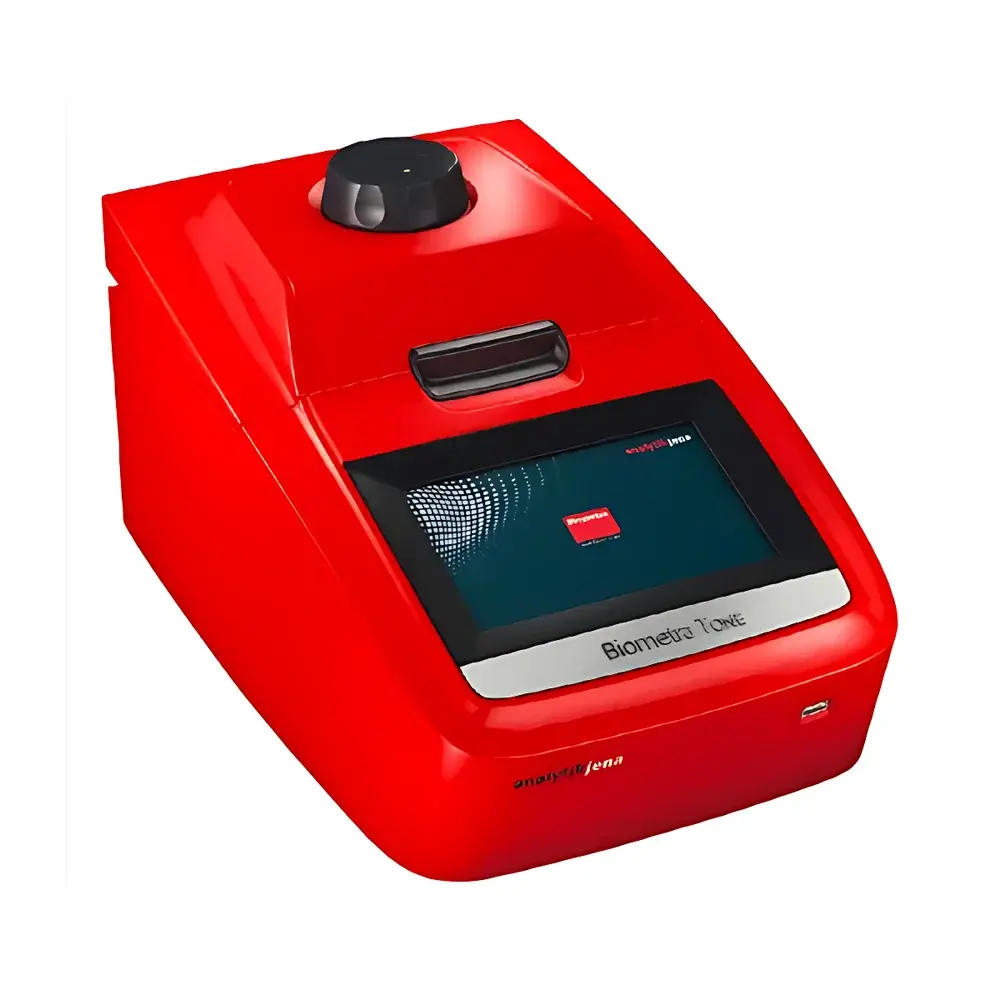
Analytik Jena Biometra TOne 96G Gradient PCR Cycler
| Brand | Analytik Jena |
|---|---|
| Origin | Germany |
| Manufacturer | Analytik Jena GmbH |
| Product Type | Gradient PCR Instrument |
| Sample Capacity | 96-well format |
| Heating Rate | 4 °C/s |
| Temperature Accuracy | ±0.1 °C |
| Well-to-Well Temperature Uniformity | ±0.2 °C |
| Gradient Configuration | 12-column linear or randomized gradient profiles |
Overview
The Analytik Jena Biometra TOne 96G Gradient PCR Cycler is a high-precision thermal cycler engineered for reproducible nucleic acid amplification under tightly controlled and spatially resolved temperature conditions. Based on Peltier-based thermoelectric heating and cooling architecture, the instrument delivers rapid thermal transitions and exceptional thermal stability across all 96 wells—critical for optimizing primer annealing in complex multiplex assays, variant detection, and assay development workflows. Its design reflects over three decades of German-engineered PCR platform development, integrating robust thermal management with intuitive human-machine interaction. The system operates within a validated temperature range of 4 °C to 99 °C and supports both standard cycling and gradient-enabled protocol refinement—enabling users to empirically determine optimal annealing temperatures without iterative manual re-runs.
Key Features
- High-performance aluminum sample block with corrosion-resistant alloy coating ensures uniform heat conduction, long-term thermal stability, and resistance to oxidative degradation from repeated thermal cycling.
- Thermal accuracy of ±0.1 °C at setpoint and well-to-well uniformity of ±0.2 °C across the full 96-well plate—meeting stringent requirements for quantitative PCR (qPCR) method validation and ISO/IEC 17025-compliant laboratories.
- Gradient functionality with 12 independently controllable column zones allows two distinct modes: linear gradient (monotonic temperature ramp across columns) and randomized gradient (user-defined non-linear temperature assignment per column), facilitating empirical optimization of multi-primer systems and allele-specific amplification.
- 4 °C/s maximum heating rate reduces overall cycle time without compromising denaturation efficiency or enzyme integrity—particularly beneficial for fast-cycling polymerases and high-throughput screening applications.
- Ultra-quiet operation (<35 dB(A) at 1 m distance) achieved via low-vibration fan control and acoustic dampening materials, supporting use in shared core facilities and noise-sensitive environments such as teaching labs or cleanroom-adjacent spaces.
- Ergonomic 7-inch color capacitive touchscreen interface with gesture support and context-aware soft keys simplifies protocol creation, real-time monitoring, and error diagnostics—no external PC required for routine operation.
Sample Compatibility & Compliance
The TOne 96G accommodates standard 96-well PCR plates (full-skirted, semi-skirted, and unskirted), 8-tube strips, and individual 0.2 mL thin-wall PCR tubes—ensuring compatibility with major consumables suppliers and legacy lab inventory. Its open-platform design supports third-party reagents and master mixes without proprietary lock-in. From a regulatory standpoint, the instrument’s firmware architecture supports audit trail generation and user access logging, aligning with GLP and GMP documentation expectations. While not FDA 510(k)-cleared as an IVD device, its performance characteristics comply with ASTM E2500-13 (Standard Guide for Specification, Design, and Verification of Pharmaceutical and Biopharmaceutical Manufacturing Systems) and ISO 13485:2016 Annex A.2 for equipment used in quality-controlled manufacturing environments.
Software & Data Management
The integrated firmware includes built-in protocol storage (up to 1,000 methods), password-protected user accounts, and automatic event logging (start/stop times, temperature deviations, lid status, error codes). Optional connectivity via USB or Ethernet enables integration with laboratory information management systems (LIMS) through CSV export or RESTful API endpoints (available via Analytik Jena’s CyBio Control Suite v3.2+). All data files include embedded metadata (operator ID, timestamp, instrument serial number, calibration status), satisfying traceability requirements under 21 CFR Part 11 when paired with appropriate electronic signature configuration.
Applications
- Optimization of annealing temperature in conventional and hot-start PCR protocols
- Development and validation of multiplex PCR assays targeting co-amplified genomic loci
- Genotyping by allele-specific amplification and melting curve analysis
- Preparation of templates for downstream sequencing (Sanger and NGS library prep)
- Teaching and training in molecular biology core curricula requiring visual, real-time thermal profiling
- QC testing of oligonucleotide primers and polymerase activity under variable thermal stress
FAQ
Does the TOne 96G support touch-down or touchdown-like gradient protocols?
Yes—the randomized gradient mode permits stepwise reduction of annealing temperature across columns, enabling pseudo-touchdown strategies without modifying cycling steps.
Is the instrument compatible with qPCR fluorescent dyes such as SYBR Green or hydrolysis probes?
The TOne 96G is a conventional thermal cycler and does not include optical modules; however, it serves as a reliable amplification engine prior to endpoint detection on dedicated qPCR platforms.
What calibration documentation is provided with the system?
Each unit ships with a factory-issued Certificate of Conformance and optional NIST-traceable temperature verification report (per ISO/IEC 17025-accredited calibration service).
Can the gradient function be disabled for standard uniform-temperature runs?
Yes—gradient mode is fully optional and can be toggled off in the protocol editor to execute identical temperature profiles across all wells.
Is remote monitoring or control supported out-of-the-box?
Basic remote status viewing is available via web browser through the onboard HTTP server; full remote control requires CyBio Control Suite installation on a network-connected host PC.





