
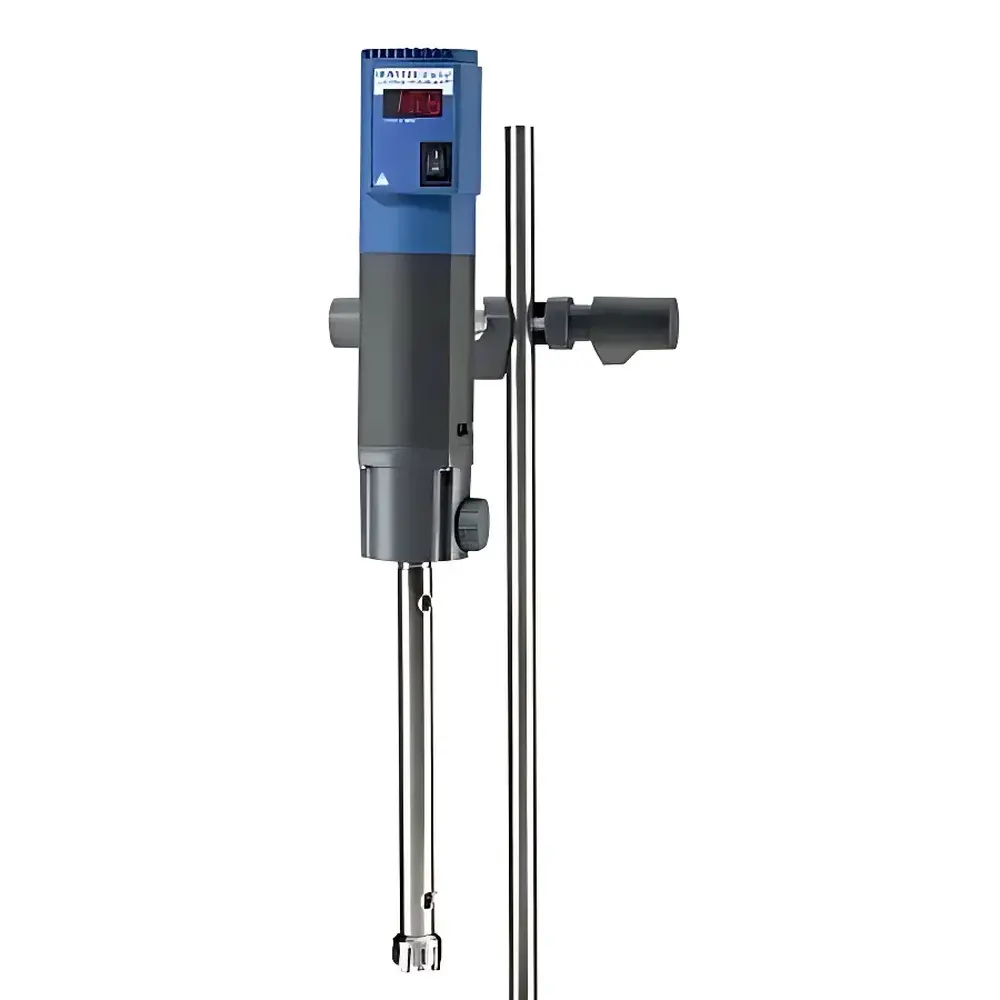
IKA T25 Digital Ultra-Turrax Disperser
| Brand | IKA |
|---|---|
| Origin | Germany |
| Model | T25 Digital |
| Motor Input Power | 500 W |
| Motor Output Power | 300 W |
| Speed Range | 3,400–24,000 rpm |
| Speed Accuracy | ±1 % |
| Display | LED Digital |
| Max. Viscosity | 5,000 mPa·s |
| Volume Range (H₂O) | 1 mL–2 L |
| Drive Shaft Diameter | 13 mm |
| Drive Shaft Length | 175 mm |
| Dimensions (W×H×D) | 65×240×80 mm |
| Weight | 1.6 kg |
| Ambient Temperature Range | 5–40 °C |
| Relative Humidity Limit | 80 % |
| Protection Class | IP20 |
| Voltage | 220–240 V / 100–120 V |
| Frequency | 50/60 Hz |
| Noise Level (without dispersing tool) | 73 dB(A) |
| Processing Mode | Batch |
| Compliance | DIN EN 60529 |
Overview
The IKA T25 Digital Ultra-Turrax Disperser is a high-performance, benchtop batch homogenizer engineered for precise and reproducible dispersion, emulsification, suspension, and cell disruption in research and quality control laboratories. Based on the proven rotor-stator principle—where high-shear forces are generated by the relative motion between a rapidly rotating rotor and a fixed stator—the T25 delivers consistent energy input across variable sample volumes. Its robust brushless motor architecture supports continuous operation at speeds up to 24,000 rpm, enabling efficient processing of low- to medium-viscosity fluids (up to 5,000 mPa·s) within volumes ranging from 1 mL to 2 L (water-equivalent). Designed for versatility, the unit operates reliably under ambient, vacuum, or pressurized conditions—making it suitable for applications including diagnostic specimen preparation, polymer dispersion, nanoparticle formulation, and bioreactor feedstock homogenization. The device conforms to DIN EN 60529 for ingress protection (IP20), ensuring safe operation in standard laboratory environments.
Key Features
- Digitally controlled speed regulation with continuous (stepless) adjustment from 3,400 to 24,000 rpm and real-time LED display for accurate process monitoring
- Three precision-machined drive bearings ensure long-term mechanical stability and minimal runout, critical for repeatable shear delivery
- Interchangeable rotor-stator dispersing tools—engineered over three decades of Ultra-Turrax development—provide optimized geometry for specific material classes (e.g., tissue, viscous suspensions, heat-sensitive formulations)
- Compact footprint (65 × 240 × 80 mm) and lightweight design (1.6 kg) facilitate integration into fume hoods, glove boxes, or modular lab workstations
- Thermally stable motor housing and integrated thermal cutoff prevent overload-induced drift during extended batch cycles
- Universal voltage compatibility (100–120 V / 220–240 V, 50/60 Hz) enables global deployment without hardware modification
Sample Compatibility & Compliance
The T25 Digital accommodates a broad spectrum of sample types—including aqueous buffers, organic solvents, semi-solid pastes, and biological matrices—provided viscosity remains within its operational envelope (≤5,000 mPa·s). Its sealed drive shaft (13 mm diameter, 175 mm length) supports immersion depth flexibility while maintaining structural rigidity under dynamic load. The instrument meets DIN EN 60529 (IP20) for protection against solid objects ≥12.5 mm; it is not rated for liquid ingress or explosive atmospheres. While the base unit lacks RS-232 or analog output interfaces, its mechanical performance aligns with common method validation frameworks used in GLP-compliant labs—for example, ASTM D3418 (viscosity measurement preparation) and ISO 13320 (laser diffraction sample dispersion protocols). Users implementing SOP-driven workflows should validate dispersing tool selection, immersion depth, and hold time per USP or Ph. Eur. 2.9.30 guidelines where applicable.
Software & Data Management
The T25 Digital operates as a standalone, microprocessor-controlled instrument without embedded data logging or external software coupling. All operational parameters—including set speed, runtime, and motor status—are monitored via the front-panel LED display. For traceable documentation in regulated environments (e.g., pharmaceutical QC or clinical diagnostics), users must integrate external recording solutions: manual entry into ELN systems, time-synchronized video capture, or third-party USB-based data loggers interfaced via auxiliary triggers (if externally wired). Though the device does not support FDA 21 CFR Part 11-compliant electronic signatures or audit trails natively, its deterministic speed control (±1 % deviation) and mechanical repeatability enable robust process mapping when combined with validated dispersing tools and documented procedural controls.
Applications
- Preparation of homogeneous suspensions for particle size analysis (e.g., ISO 13320-compliant laser diffraction feedstocks)
- Routine homogenization of clinical specimens—including blood, sputum, and tissue lysates—prior to PCR, ELISA, or flow cytometry
- Dispersion of nanomaterials (e.g., carbon nanotubes, metal oxides) in polymer matrices or aqueous carriers
- Emulsification of oil-in-water or water-in-oil systems for cosmetic, food, and agrochemical R&D
- In-process blending of catalyst slurries and battery electrode slurries in materials science labs
- Cell lysis and organelle isolation in molecular biology workflows requiring shear-based disruption
FAQ
Is the T25 Digital compatible with vacuum or pressure vessels?
Yes—its sealed drive shaft and mechanical design allow safe operation inside vacuum-rated glass reactors or pressurized stainless-steel vessels, provided appropriate feedthrough seals are installed.
Can I use non-IKA dispersing tools with this unit?
No—only IKA-certified rotor-stator tools (e.g., S25N-10G, S25N-19G, S25N-25F) are mechanically and dynamically balanced for the T25’s shaft assembly; third-party tools risk imbalance, premature bearing wear, or inconsistent shear profiles.
Does the unit include a dispersing tool by default?
No—the T25 Digital is supplied without any dispersing tool; users must select and order compatible tools separately based on volume, viscosity, and application requirements.
What maintenance intervals are recommended for long-term reliability?
IKA recommends visual inspection of the drive shaft and collet before each use; annual lubrication of internal bearings is not required due to the sealed, maintenance-free motor design—but periodic verification of speed accuracy using a calibrated tachometer is advised every 6 months in GxP environments.
How does ambient temperature affect performance?
Operation outside 5–40 °C may cause thermal derating of motor output or condensation-related electrical hazards; humidity above 80 % RH increases risk of surface tracking on PCB traces and should be mitigated with climate control.



