
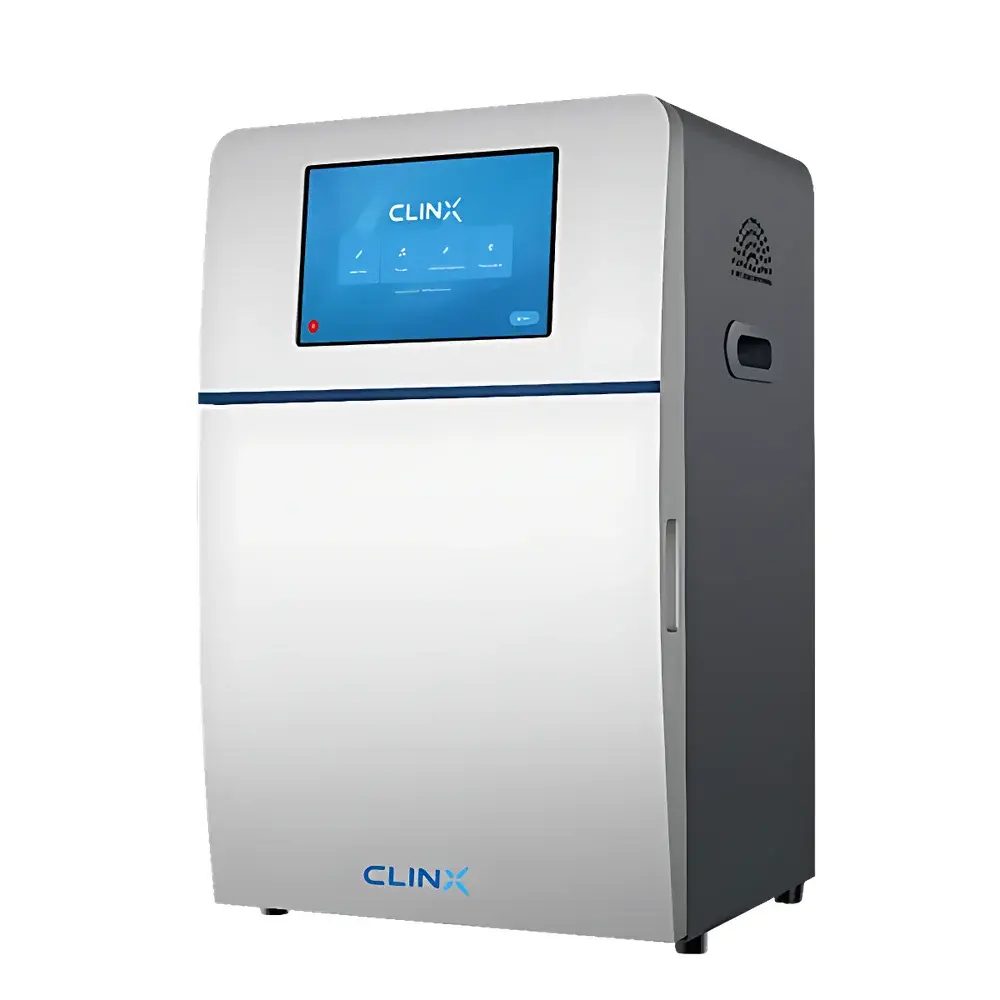
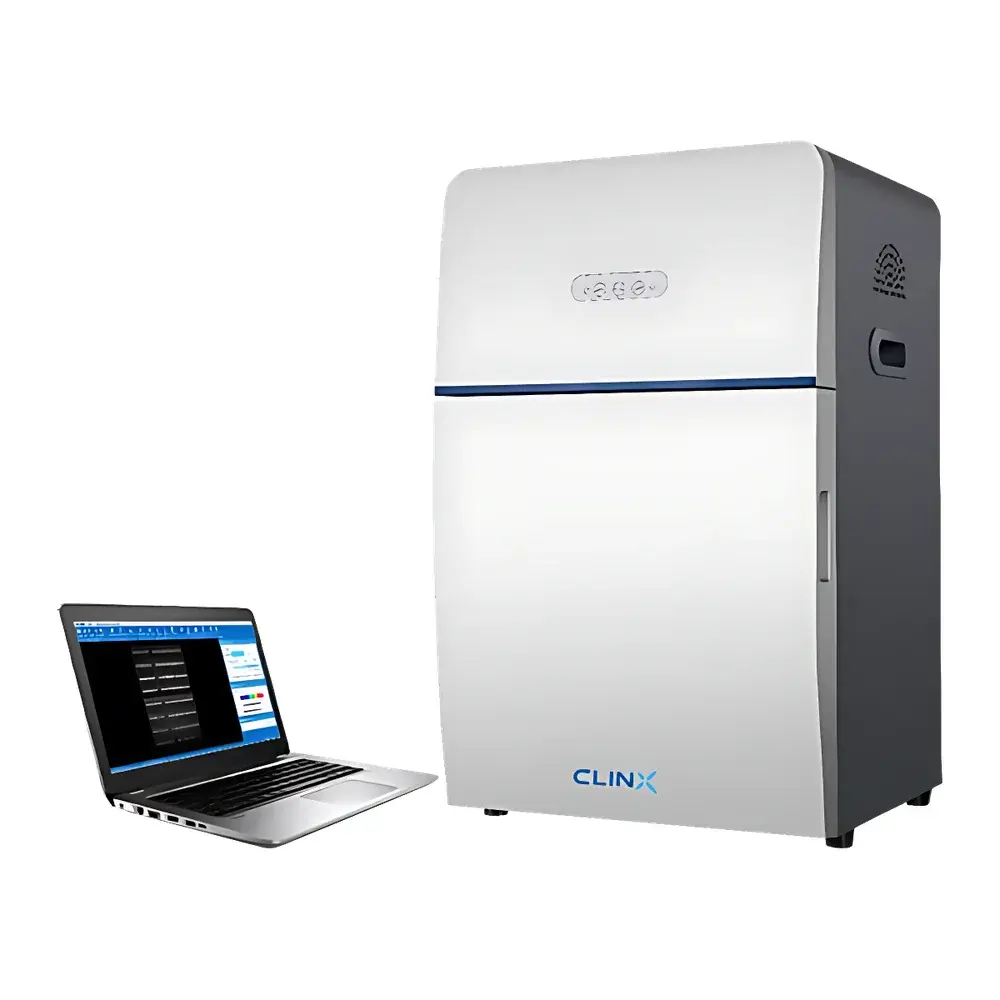
CLINX ChemiScope 6100 Touch Multifunctional Chemiluminescence Imaging System
| Brand | CLINX |
|---|---|
| Origin | Shanghai, China |
| Model | ChemiScope 6100 Touch |
| Instrument Type | Chemiluminescence Gel Imaging System |
| CCD Resolution | 6.0 Megapixels |
Overview
The CLINX ChemiScope 6100 Touch is a high-performance, multifunctional chemiluminescence and fluorescence imaging system engineered for quantitative analysis of nucleic acids and proteins in molecular biology laboratories. It operates on the principle of low-light digital imaging using a thermoelectrically cooled scientific-grade CCD sensor, enabling detection of faint chemiluminescent signals generated by enzyme-substrate reactions (e.g., HRP-luminol or AP-AMPPD systems) with exceptional signal-to-noise ratio. The system supports both transmitted and reflected illumination modes and is optimized for Western blotting, Southern/Northern blotting, EMSA, and multiplex fluorescent gel documentation. Its integrated touchscreen interface eliminates dependency on external PCs during routine acquisition, while hardware-level cooling (−25 °C below ambient) ensures stable dark current suppression over extended exposure durations—critical for reproducible quantification of low-abundance targets.
Key Features
- 6.0-megapixel thermoelectrically cooled CCD sensor with 16-bit analog-to-digital conversion for high dynamic range (>4.8 OD) and precise densitometric linearity.
- F/0.8 motorized auto-focus lens assembly with variable focal length (e.g., 25–75 mm range), maximizing photon collection efficiency and enabling optimal resolution across sample formats from mini-gels to large-format blots.
- Integrated multi-spectral LED illumination platform: UV (302 nm), blue light (470 nm), and white light (RGB-balanced) transilluminators with automatic tray recognition—each delivering uniform irradiance (±5% intensity variation across active area) and rated for >30,000 hours of operational life.
- Touchscreen-driven acquisition software with one-click chemiluminescence auto-exposure, real-time histogram feedback, and embedded color marker overlay functionality for immediate molecular weight estimation without post-acquisition image processing.
- Modular optical design accommodating optional fluorescence excitation/emission filter sets (e.g., Cy2/Cy3/Cy5, FITC/TRITC, DAPI), supporting dual- or triple-channel multiplex detection when configured with appropriate LED sources and bandpass filters.
Sample Compatibility & Compliance
The ChemiScope 6100 Touch accommodates standard electrophoresis formats including mini-gels (up to 10 × 10 cm), midi-gels (up to 16 × 16 cm), and full-size transfer membranes (up to 20 × 25 cm). Sample holders are precision-machined aluminum with anti-reflective black anodization to minimize stray light interference. All optical components comply with IEC 61000-6-3 (EMC emission standards) and IEC 61000-6-2 (immunity requirements). The system meets ISO 13485-aligned manufacturing controls and supports audit-ready documentation workflows compliant with GLP and GMP environments—data files include embedded EXIF metadata (exposure time, binning mode, lens aperture, temperature, user ID) and support time-stamped, password-protected audit trails per FDA 21 CFR Part 11 guidelines when used with validated networked software deployment.
Software & Data Management
Acquisition and analysis are managed via CLINX ImageStudio Pro v5.x—a Windows-based application validated for analytical use in regulated labs. Key capabilities include background subtraction (rolling ball algorithm), lane/band detection with adaptive thresholding, relative quantification (normalized to internal controls or total lane density), and export of calibrated TIFF/PNG/CSV outputs. The software supports LIMS integration through HL7 and ASTM E1384-compliant data exchange protocols. Raw image archives are stored in lossless 16-bit TIFF format with embedded calibration curves; processed results can be exported as PDF reports containing metadata, annotations, and statistical summaries (CV%, R², linear range). Optional cloud synchronization enables secure remote access and collaborative review across geographically distributed research teams.
Applications
- Quantitative Western blot analysis of phosphorylated or ubiquitinated protein isoforms under low-expression conditions.
- Detection of CRISPR-Cas9 editing efficiency via chemiluminescent probe hybridization on denaturing gels.
- High-throughput validation of siRNA knockdown efficacy using multiplexed fluorescent labeling.
- Quality control of recombinant protein purification batches via SDS-PAGE densitometry with Coomassie or SYPRO Ruby staining.
- Validation of DNA methylation status using bisulfite-converted PCR products resolved on high-percentage polyacrylamide gels.
FAQ
What is the minimum detectable horseradish peroxidase (HRP) activity level on this system?
Typical detection limit is ≤0.1 pg of HRP-conjugated secondary antibody on nitrocellulose membranes using standard luminol-based substrates, assuming 5-minute exposure at −25 °C sensor temperature.
Does the system support time-resolved chemiluminescence (TRCL) acquisition?
No—ChemiScope 6100 Touch is optimized for static endpoint imaging rather than kinetic luminescence monitoring; for TRCL applications, consider dedicated plate readers with microsecond gating capability.
Can third-party analysis software such as ImageJ or Fiji be used with exported images?
Yes—16-bit TIFF exports retain full bit-depth and spatial calibration; however, CLINX-provided calibration files must be applied manually in open-source tools to ensure accurate OD conversion.
Is UV exposure safety interlocked?
Yes—the UV transilluminator automatically deactivates upon lid opening and includes redundant mechanical and optical sensors meeting IEC 62471 photobiological safety classification for Risk Group 1 (exempt).
How often does the CCD sensor require recalibration?
Factory calibration is stable for ≥24 months under normal operating conditions; annual verification using NIST-traceable neutral density filters is recommended for GLP/GMP compliance.
Related Products



