
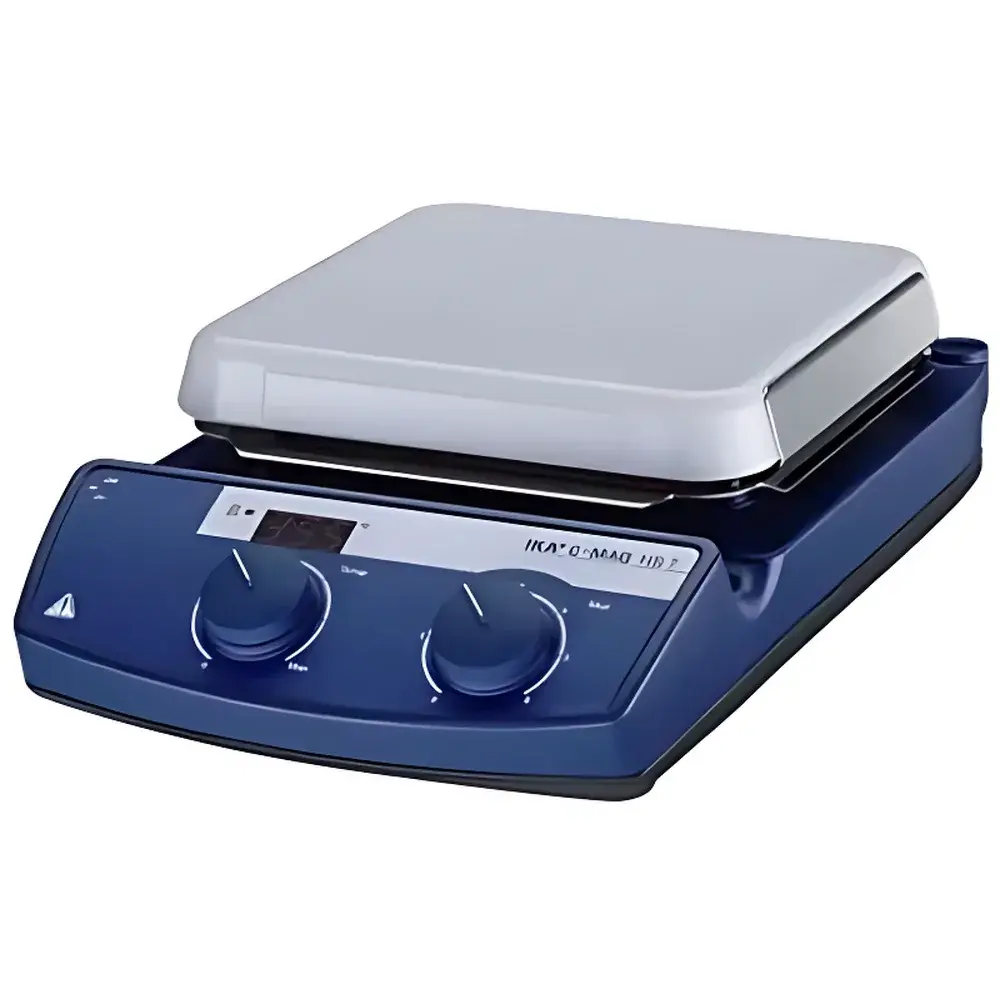
IKA C-MAG HS7 IKAMAG® Magnetic Stirrer with Heating
| Brand | IKA |
|---|---|
| Origin | Germany |
| Model | C-MAG HS7 |
| Instrument Type | Magnetic Stirrer |
| Max. Stirring Volume | 10 L (H₂O) |
| Speed Range | 100–1500 rpm |
| Heating Temperature Range | 50–500 °C |
| Heating Power | 1000 W |
| Plate Material | Ceramic |
| Plate Dimensions | 180 × 180 mm |
| Safety Cut-off | 550 °C |
| External Temperature Sensor Interface | DIN 12878 (compatible with ETS-D5) |
| Temp. Control Accuracy (with external probe) | ±3 K |
| Media Temperature Stability | ±3 K |
| IP Rating | IP21 |
| Input Voltage | 230 V, 50/60 Hz |
| Weight | 5 kg |
Overview
The IKA C-MAG HS7 IKAMAG® is a high-performance benchtop magnetic stirrer with integrated heating, engineered for precision temperature-controlled mixing in research laboratories, quality control environments, and routine analytical workflows. Utilizing a robust permanent magnet drive system coupled with a high-efficiency ceramic heating plate, the device delivers stable rotational torque and uniform thermal distribution across the working surface. Its design adheres to fundamental principles of convective heat transfer and electromagnetic coupling—ensuring consistent stirring dynamics even at elevated temperatures and viscous load conditions. Unlike basic stirrers, the C-MAG HS7 incorporates dual-mode thermal regulation: direct plate temperature control (±10 K accuracy) and optional closed-loop sample temperature feedback via DIN 12878-compliant external probes (e.g., ETS-D5), enabling compliance with method-critical protocols requiring traceable media temperature stability (±3 K).
Key Features
- Ceramic-coated heating plate (180 × 180 mm) offering chemical resistance, scratch tolerance, and uniform heat dispersion—eliminating hot spots during extended operation.
- Dual-safety thermal architecture: programmable upper limit (50–500 °C) plus hardware-based fixed cut-off at 550 °C to prevent overheating under fault conditions.
- Elevated control panel design minimizes liquid ingress risk from splashes or condensation during reflux or open-vessel applications.
- Digital LED display for simultaneous real-time readout of setpoint and actual plate temperature, along with speed setting and error codes (e.g., E1 = sensor fault, E2 = overtemperature).
- Integrated DIN 12878 interface supports plug-and-play connection of calibrated contact thermometers, enabling ISO/IEC 17025-aligned temperature validation and GLP-compliant data traceability.
- Optimized motor design delivers 1.5 W mechanical output power with low-noise operation and sustained torque up to 10 L aqueous volume—validated per IKA’s internal mixing performance protocol using standard PTFE-coated stir bars (≤80 mm length).
Sample Compatibility & Compliance
The C-MAG HS7 accommodates a wide range of vessel geometries—including beakers (50 mL to 5 L), round-bottom flasks, and crystallization dishes—when paired with appropriately sized magnetic stir bars. Its ceramic surface is inert toward common solvents (e.g., ethanol, acetone, dilute acids/bases) and compatible with sterilization via wipe-down with 70% isopropanol. The unit complies with EN 61010-1:2019 (Safety Requirements for Electrical Equipment for Measurement, Control, and Laboratory Use) and carries CE marking under the EU Low Voltage and EMC Directives. Its IP21 rating confirms protection against vertically falling drips and solid objects >12.5 mm, making it suitable for general laboratory environments—not cleanrooms or high-humidity enclosures. While not intrinsically safe for explosive atmospheres, it may be deployed in fume hoods when handling volatile organics, provided local ventilation standards (e.g., ANSI Z9.5) are observed.
Software & Data Management
The C-MAG HS7 operates as a standalone instrument without proprietary software dependency. All operational parameters—including speed, plate temperature, error logs, and safety lock status—are displayed locally via its LED interface. For regulated environments (e.g., pharmaceutical QC labs governed by FDA 21 CFR Part 11), users may integrate the device into broader lab management systems via manual log entry or third-party data acquisition tools that monitor relay outputs (if externally wired). When used with an ETS-D5 temperature probe, the system supports audit-ready documentation of thermal profiles, fulfilling requirements for USP , ISO 13485 process validation, and internal SOPs mandating temperature deviation reporting.
Applications
- Precipitation and crystallization studies requiring controlled nucleation kinetics through gradual thermal ramping (e.g., 1–5 K/min in 1 L aqueous solutions).
- Buffer preparation and reagent dissolution where homogeneity and thermal consistency impact downstream assay reproducibility (e.g., ELISA coating buffers).
- Pre-analytical sample conditioning prior to HPLC, ICP-MS, or titration—ensuring complete solute dispersion and equilibrium temperature attainment.
- Method development for ASTM D7042 (dynamic viscosity of transparent and opaque liquids) using standardized stir bar geometry and thermal equilibration periods.
- Teaching laboratories demonstrating Arrhenius-type reaction rate dependencies on temperature, leveraging the device’s stable ±3 K media control with external sensing.
FAQ
Does the C-MAG HS7 support RS232 or USB connectivity for remote control?
No—this model features manual analog/digital controls only and lacks digital communication interfaces.
Can it maintain temperature stability in open vessels under ambient drafts?
Plate temperature remains stable; however, media temperature stability (±3 K) is achievable only with an external probe and appropriate vessel insulation (e.g., aluminum foil wrap or air jacketing).
What stir bar length is recommended for optimal performance at 10 L capacity?
IKA recommends 70–80 mm PTFE-coated stir bars with centered magnetic cores for maximum vortex formation and torque transmission in tall-form containers.
Is calibration of the heating plate traceable to national standards?
The unit itself does not include factory calibration certificates; users must perform periodic verification using NIST-traceable thermocouples or RTD probes per internal QA procedures.
How often should the ceramic plate be cleaned to ensure thermal efficiency?
Wipe after each use with non-abrasive cloth and deionized water; avoid chloride-containing cleaners to prevent long-term surface etching.



