
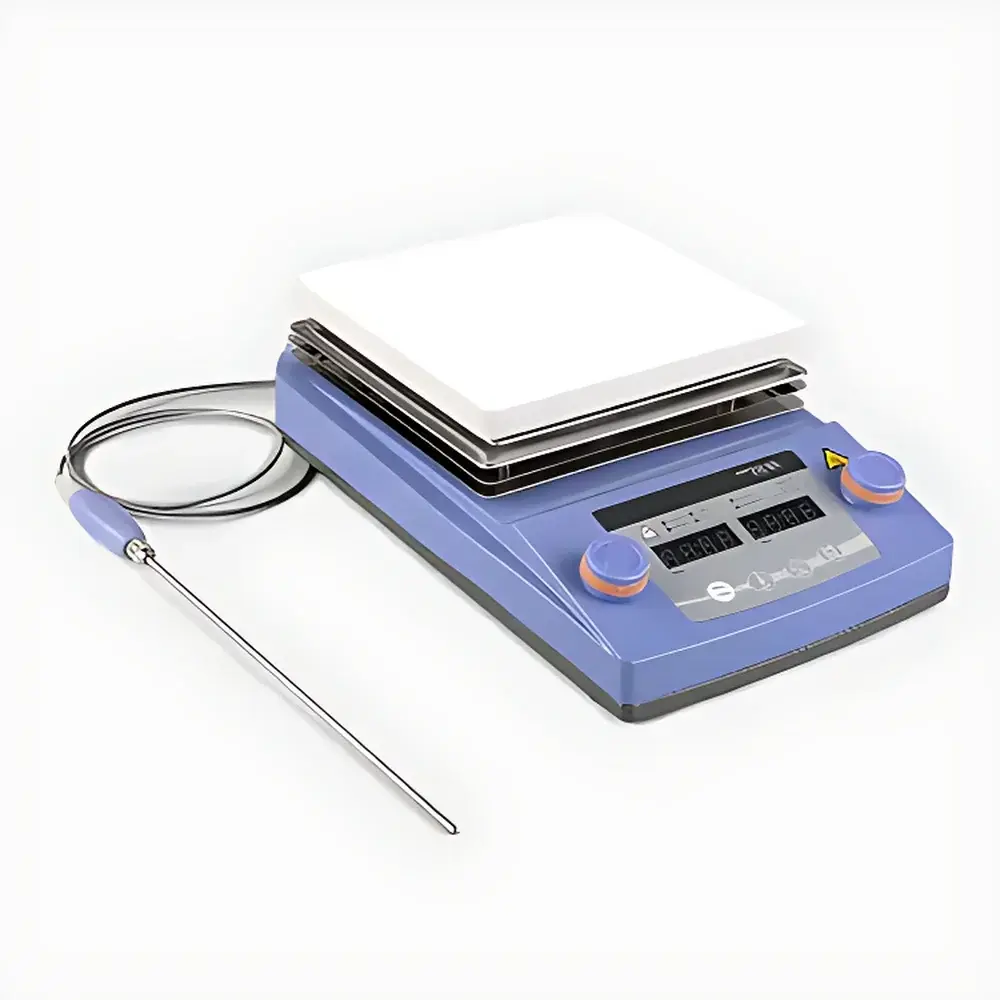
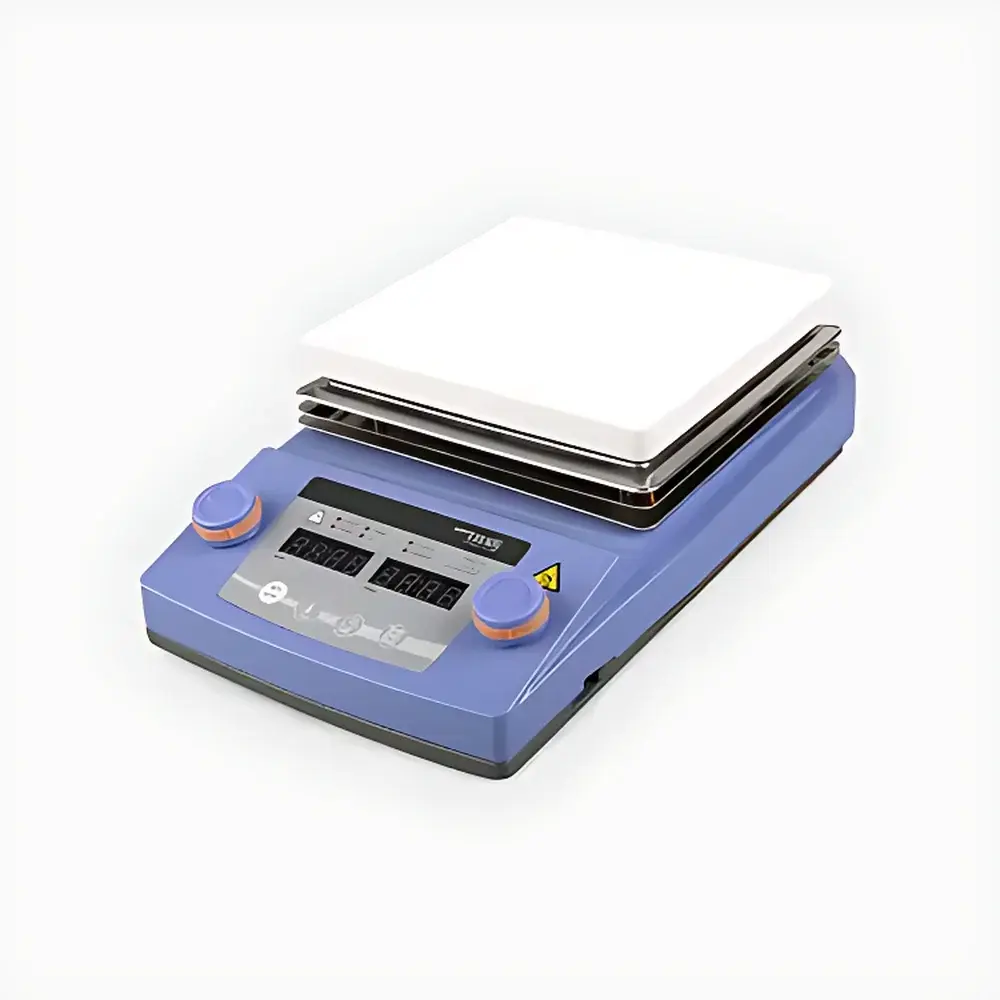
Titan HMS-18 Digital Heating Magnetic Stirrer
| Brand | Titan |
|---|---|
| Origin | Shanghai, China |
| Manufacturer Type | Direct Manufacturer |
| Country of Origin | China |
| Model | HMS-18 |
| Instrument Type | Magnetic Stirrer |
| Maximum Stirring Volume | 20 L |
| Speed Range | 30–2000 rpm |
| Temperature Control Range | Ambient to 350 °C |
Overview
The Titan HMS-18 Digital Heating Magnetic Stirrer is an integrated laboratory instrument engineered for precision mixing and temperature-controlled sample processing in research, quality control, and production environments. It operates on the principle of magnetic coupling—rotating a PTFE- or ceramic-coated stir bar within a vessel via a rotating magnetic field generated beneath a thermally stable ceramic plate. Simultaneous digital regulation of both rotational speed and surface heating enables reproducible thermal-mechanical conditioning of liquids, suspensions, and low-viscosity solutions. Designed for continuous-duty operation, the HMS-18 delivers consistent torque output across its full speed range and maintains ±1 °C temperature stability at setpoints up to 350 °C—making it suitable for applications requiring elevated-temperature homogenization, dissolution testing, or solvent reflux preparation.
Key Features
- Digital microprocessor control with dual LED displays for independent real-time monitoring of speed (rpm) and plate temperature (°C)
- Ceramic-coated aluminum heating plate offering rapid thermal response, uniform heat distribution, and chemical resistance to common solvents and acids
- Brushless DC motor ensuring maintenance-free operation, low noise (<45 dB(A)), and high-speed stability up to 2000 rpm
- Programmable ramping function for controlled heating profiles—enabling gradual temperature increase to prevent bumping or thermal shock
- Overheat protection circuitry with automatic shutdown if surface temperature exceeds 380 °C or if internal electronics exceed safe operating thresholds
- Ergonomic front-panel interface with rotary encoder and tactile buttons; intuitive menu navigation without reliance on external software
- Robust housing constructed from flame-retardant ABS with reinforced base for vibration damping during high-speed stirring
Sample Compatibility & Compliance
The HMS-18 accommodates standard laboratory glassware including beakers (50 mL–2000 mL), round-bottom flasks, and crystallization dishes, supporting effective agitation of volumes up to 20 L when used with appropriately sized vessels and stir bars. Its temperature range (ambient to 350 °C) permits compatibility with high-boiling-point solvents such as ethylene glycol, silicone oil, and molten salts in open-vessel configurations. The unit complies with IEC 61010-1:2010 for electrical safety in laboratory equipment and meets EMC requirements per EN 61326-1:2013. While not intrinsically rated for hazardous area use, optional accessories—including explosion-proof stir bars and secondary containment trays—are available for enhanced operational safety in regulated environments. Documentation supports GLP-compliant recordkeeping when paired with external data loggers.
Software & Data Management
The HMS-18 operates as a standalone instrument with no embedded firmware update capability or USB/Bluetooth connectivity. All operational parameters are configured and retained locally via non-volatile memory. For laboratories requiring audit trails or electronic records, integration with third-party data acquisition systems is supported through analog 0–10 V outputs for speed and temperature signals (available via optional rear-panel interface module). These analog outputs enable synchronization with LIMS platforms or SCADA systems under FDA 21 CFR Part 11–compliant validation protocols when paired with appropriate electronic signature and access control infrastructure. Calibration certificates traceable to NIM (National Institute of Metrology, China) are provided with each unit.
Applications
- Preparation of homogeneous catalyst slurries and nanoparticle dispersions in materials science labs
- Dissolution testing of pharmaceutical tablets and capsules per USP , using calibrated temperature ramps and constant-speed agitation
- Controlled synthesis of metal-organic frameworks (MOFs) and covalent organic frameworks (COFs) requiring extended heating-stirring cycles
- Standardization of calibration standards for ICP-OES and AAS analysis where matrix viscosity and temperature affect nebulization efficiency
- Environmental sample digestion workflows involving HNO₃/HF mixtures under heated, closed-vessel conditions (when used with compatible hotplate adapters)
- Teaching laboratories conducting kinetics experiments, Arrhenius parameter estimation, or polymer solution viscosity profiling
FAQ
What is the maximum recommended vessel diameter for optimal stirring performance?
For consistent vortex formation and efficient heat transfer, vessels with diameters between 60 mm and 180 mm are recommended. Larger vessels may require custom stir bar geometry or auxiliary support stands.
Is the HMS-18 compatible with corrosive reagents such as concentrated hydrochloric acid?
The ceramic-coated plate resists short-term exposure to diluted acids; however, prolonged contact with concentrated mineral acids is not advised. Use of borosilicate glass containers and chemically inert stir bars (e.g., PTFE-encapsulated or glass-coated) is strongly recommended.
Does the unit support external temperature probe feedback control?
No—the HMS-18 regulates only surface plate temperature. For solution-phase temperature control, an external PT100 probe must be interfaced via optional analog input modules or integrated into a separate PID controller loop.
Can the HMS-18 be operated inside a fume hood?
Yes, provided adequate ventilation is maintained and the unit’s rear ventilation grilles remain unobstructed. Ambient air intake and exhaust pathways must remain clear to ensure thermal management integrity.
What maintenance intervals are recommended for long-term reliability?
Visual inspection of the ceramic plate for microcracks and cleaning of debris from the motor housing vents every 6 months is advised. No lubrication or internal servicing is required due to the brushless motor architecture.



