
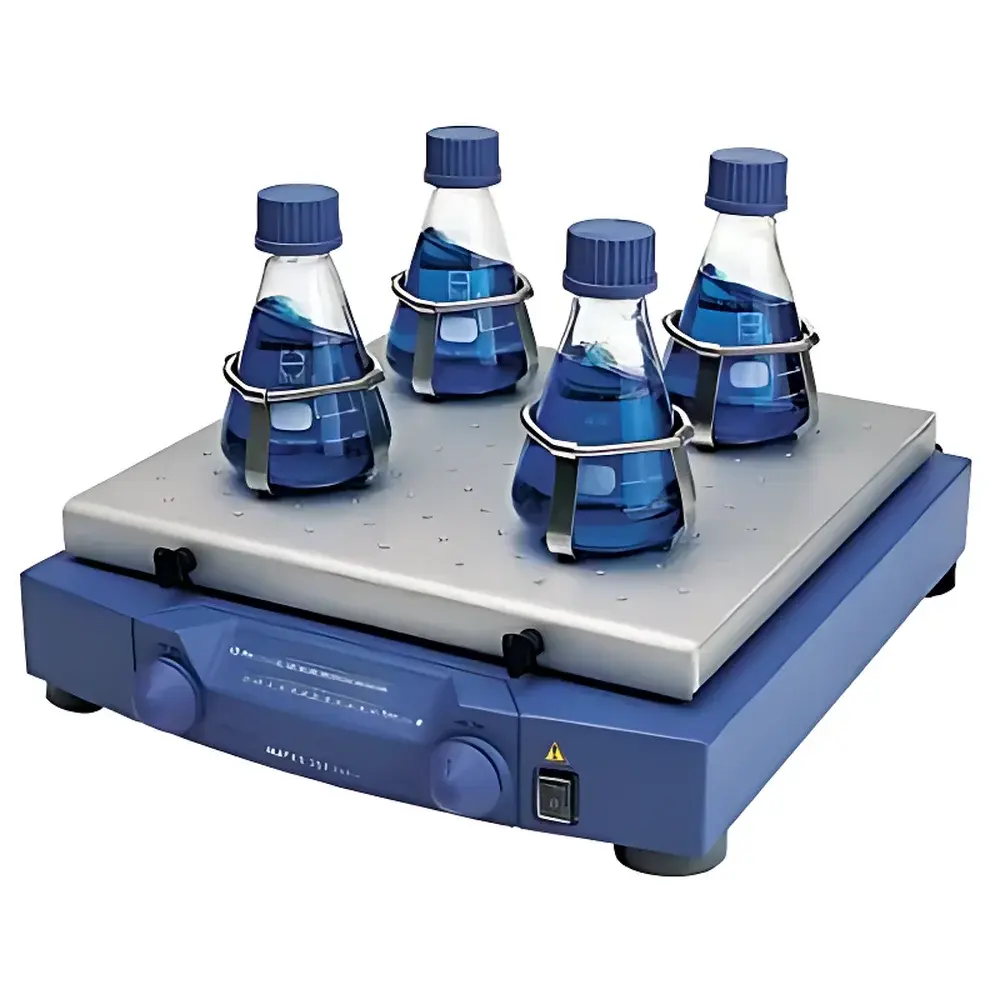
IKA KS260 Basic Orbital Shaker
| Brand | IKA |
|---|---|
| Origin | Germany |
| Model | KS260 Basic |
| Timer Range | 5–50 min |
| Oscillation Speed | 0–500 rpm |
| Orbit Diameter | 10 mm |
| Temperature Range | 5–50 °C |
| Platform Quantity | 1 |
| Max Load Capacity (incl. clamp) | 7.5 kg |
| Display | LED for speed & time |
| Power Input | 45 W |
| Dimensions (W×H×D) | 360 × 98 × 420 mm |
| Weight | 8.5 kg |
| Protection Class | IP21 |
| Operating Ambient | 5–50 °C, ≤80% RH |
| Output Signal | Analog (0–10 V) |
| Voltage | 100–120 V / 220–240 V, 50/60 Hz |
| Continuous Duty Rating | 100% |
| Regulatory Compliance | DIN EN 60529 |
Overview
The IKA KS260 Basic Orbital Shaker is a compact, benchtop laboratory shaker engineered for precision and reliability in routine biological and biochemical applications. It operates on the principle of orbital motion—generating a smooth, circular oscillation with a fixed 10 mm orbit diameter—to ensure uniform mixing, suspension, and aeration of liquid samples across flasks, tubes, and multi-well plates. Designed for non-temperature-controlled environments (ambient operation), the KS260 Basic delivers stable rotational performance from 20 rpm (minimum adjustable speed) up to 500 rpm, with electronic speed control and real-time LED feedback. Its robust brushless motor architecture provides consistent torque output and low mechanical drift over extended duty cycles, supporting uninterrupted operation at 100% duty rating. The unit complies with DIN EN 60529 for ingress protection (IP21), ensuring safe operation under standard laboratory ambient conditions (5–50 °C, ≤80% relative humidity). Unlike incubated or refrigerated shakers, the KS260 Basic is optimized for cost-effective, high-reproducibility shaking where thermal regulation is managed externally—e.g., inside cold rooms or temperature-stabilized enclosures.
Key Features
- Orbital motion with precise 10 mm orbit diameter for homogeneous sample agitation and minimal splashing
- Stepless electronic speed control (20–500 rpm) with LED digital display for real-time monitoring of setpoint and actual speed
- Digital timer with programmable range from 5 to 50 minutes; supports both timed and continuous operation modes
- High-load capacity platform rated for up to 7.5 kg total mass (including clamps and vessels), enabling scalable use with Erlenmeyer flasks, culture bottles, and microtiter plates
- Analog output (0–10 V) for external process monitoring or integration into centralized lab automation systems
- Compact footprint (360 × 98 × 420 mm) and lightweight design (8.5 kg) for flexible placement on biosafety cabinets, laminar flow hoods, or shared benchtops
- Energy-efficient motor with 10 W mechanical output and 45 W electrical input—optimized for low heat generation and long-term stability
Sample Compatibility & Compliance
The KS260 Basic accommodates a broad range of vessel formats via interchangeable clamps (sold separately), including universal platform adapters, flask holders (for 25–2000 mL volumes), tube racks (15 mL, 50 mL), and microplate carriers. Clamp selection must align with vessel geometry, mass distribution, and required g-force profile to maintain mechanical balance and prevent resonance-induced vibration. The shaker meets DIN EN 60529 (IP21) for protection against vertically falling solid objects and limited ingress of moisture—suitable for ISO Class 5–8 cleanroom-adjacent environments. While not certified for GLP/GMP-regulated workflows out-of-the-box, its analog output and stable speed repeatability support integration into validated systems compliant with FDA 21 CFR Part 11 when paired with appropriate data acquisition hardware and audit-trail software.
Software & Data Management
The KS260 Basic operates as a standalone instrument without embedded firmware-based data logging or PC connectivity. It lacks RS232, USB, or Ethernet interfaces. However, its analog output (0–10 V proportional to actual rpm) enables connection to external chart recorders, PLCs, or DAQ systems for time-synchronized speed traceability. Users implementing electronic lab notebooks (ELNs) or LIMS can manually log operational parameters—including start time, duration, set rpm, and load configuration—for batch documentation. For laboratories requiring automated calibration verification or periodic performance qualification (PQ), third-party validation protocols may reference speed accuracy (±2 rpm tolerance per IKA technical specification), timer deviation (< ±1%), and platform wobble (< 0.3 mm radial runout at 500 rpm).
Applications
- Cell culture maintenance: gentle suspension of adherent or suspension cell lines during passaging and media exchange
- Molecular biology workflows: plasmid miniprep binding/wash steps, enzyme reaction mixing, and antibody incubations
- Microbiology: bacterial growth curve studies, broth enrichment, and serial dilution homogenization
- Protein biochemistry: solubilization of inclusion bodies, affinity resin equilibration, and dialysis buffer exchange
- Quality control testing: dissolution rate screening, particle dispersion in suspensions, and reagent reconstitution verification
FAQ
Is the KS260 Basic suitable for use inside an incubator or cold room?
Yes—its ambient-rated design (5–50 °C operating range) and lack of internal heating/cooling elements allow safe installation in externally temperature-controlled enclosures, provided ventilation and condensation management are maintained.
Are clamps included with the base unit?
No—clamps are optional accessories and must be ordered separately based on vessel type, size, and quantity requirements.
Does the shaker support speed ramping or programmable profiles?
No—the KS260 Basic offers only fixed-speed operation with manual adjustment; it does not feature acceleration/deceleration curves or multi-step protocols.
What is the maximum allowable unbalance tolerance?
For optimal longevity and noise reduction, total load asymmetry should not exceed ±5% of total mass across the platform; users are advised to center vessels and verify balance before initiating operation.
Can the analog output signal be used for closed-loop speed control?
No—the 0–10 V output is strictly a monitoring signal (not a control interface); it reflects actual motor speed but does not accept feedback or command inputs.



