
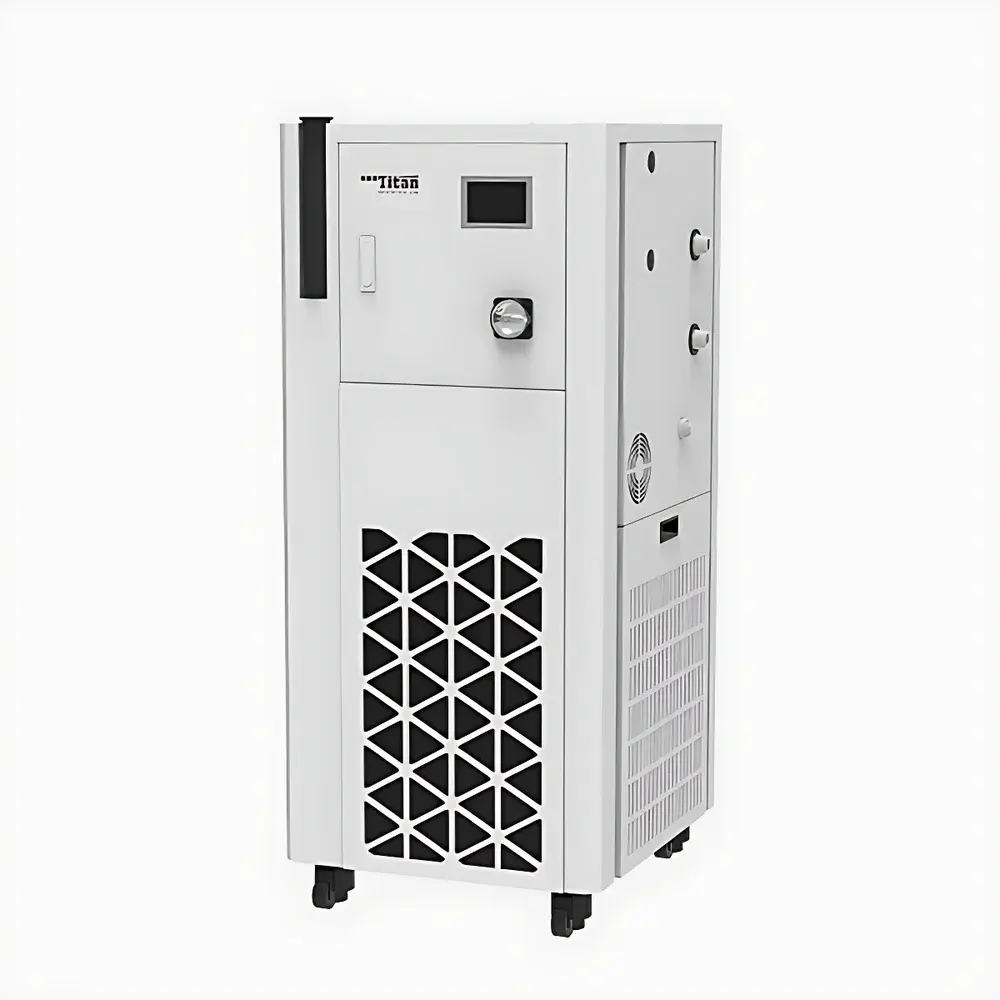
Titan HLD-55 Integrated Dynamic Temperature Control System
| Brand | Titan |
|---|---|
| Origin | Shanghai, China |
| Manufacturer Type | Direct Manufacturer |
| Country of Origin | China |
| Model | HLD-55 |
| Instrument Type | Integrated Circulating Chiller |
| Cooling Method | Air-Cooled |
| Temperature Range | –40 °C to +200 °C |
| Cooling Capacity | 5500 W (Heating Capacity: 6000 W) |
| Temperature Stability | ±0.1 °C |
| Circulation Pump Pressure | 3.8 bar |
| Circulation Flow Rate | 56 L/min |
| Reservoir Volume | 10 L |
| Operation Mode | Continuous Duty |
Overview
The Titan HLD-55 Integrated Dynamic Temperature Control System is an engineered solution for high-precision thermal management in laboratory and pilot-scale applications requiring bidirectional temperature control across an extended range. Based on a dual-mode refrigeration–heating architecture with independent compressor and electric heating circuits, the system delivers stable, programmable thermal environments from –40 °C to +200 °C—enabling seamless transitions between cryogenic conditioning and high-temperature stabilization without external fluid exchange or manual intervention. Its design adheres to fundamental thermodynamic principles governing heat transfer in closed-loop liquid circulation systems, utilizing R-404A or R-507 refrigerant (depending on regional compliance requirements) and a high-efficiency scroll compressor paired with PID-controlled resistive heating elements. The unit is intended for integration with external equipment such as reaction calorimeters, material testing chambers, spectroscopic cells, and jacketed reactors where precise, reproducible thermal profiles are critical to experimental integrity.
Key Features
- Wide operational temperature span (–40 °C to +200 °C) achieved via synchronized refrigeration and heating subsystems, eliminating thermal lag during ramping cycles
- Air-cooled condenser design optimized for ambient operation up to 35 °C, reducing infrastructure dependency on chilled water or dedicated ventilation ducts
- High-flow, high-pressure circulation pump delivering 56 L/min at 3.8 bar—suitable for low-impedance and moderately restrictive external loops (e.g., coiled tubing, microfluidic manifolds, or multi-zone jackets)
- 10-liter stainless-steel reservoir with level sensor, anti-corrosion coating, and integrated filtration to maintain long-term fluid integrity and minimize particulate carryover
- Digital PID controller with real-time setpoint programming, ramp/soak profiles, and over-temperature/low-flow safety interlocks compliant with IEC 61000-6-2 EMC standards
- Continuous-duty rated architecture validated for 24/7 operation under full-load conditions, supported by thermal overload protection and compressor discharge temperature monitoring
Sample Compatibility & Compliance
The HLD-55 is compatible with standard heat-transfer fluids including water–glycol mixtures (up to 50% v/v), silicone oils (e.g., DC-200 series), and polyalphaolefin (PAO)-based synthetic coolants—subject to viscosity and flash point constraints within the specified temperature window. Fluid selection must ensure compatibility with 316 stainless steel wetted parts and EPDM/NBR elastomer seals. The system meets CE marking requirements per Machinery Directive 2006/42/EC and Low Voltage Directive 2014/35/EU. While not certified for hazardous area use (ATEX/IECEx), its electrical enclosure conforms to IP20 ingress protection. For regulated environments, optional audit-trail logging and user-access-level configuration (Level 1–3) support alignment with GLP and GMP documentation practices.
Software & Data Management
The embedded controller supports RS485 Modbus RTU and optional Ethernet TCP/IP communication protocols, enabling integration into centralized lab automation platforms (e.g., LabVantage, Thermo Fisher SampleManager). Logged data—including setpoint, actual bath temperature, flow rate, compressor status, and heater duty cycle—is timestamped with millisecond resolution and exportable via USB or network interface in CSV format. Firmware supports firmware update via secure signed package verification. No cloud-based telemetry or proprietary SaaS dependencies are included; all data remains locally resident unless explicitly routed through customer-configured IT infrastructure.
Applications
- Thermal validation of pharmaceutical stability chambers and accelerated aging studies per ICH Q1A(R3)
- Temperature-controlled rheological testing of polymers and viscoelastic materials using rotational or capillary rheometers
- Calibration of infrared thermography systems and blackbody sources across sub-zero to elevated temperature ranges
- Process simulation for chemical synthesis involving exothermic initiation followed by controlled post-reaction quenching
- Material characterization in differential scanning calorimetry (DSC), dynamic mechanical analysis (DMA), and thermogravimetric analysis (TGA) auxiliary cooling modules
FAQ
What fluids are recommended for operation below –20 °C?
A 40% propylene glycol–water mixture is validated for continuous use down to –40 °C; avoid ethylene glycol in biosafety-sensitive labs due to toxicity concerns.
Can the HLD-55 be used with external pressure-rated reactors?
Yes—its maximum delivery pressure of 3.8 bar permits direct coupling to jacketed vessels rated ≥6 bar test pressure, provided external relief valves and expansion tanks are installed per ASME B31.5 guidelines.
Is remote monitoring possible without third-party gateways?
Yes—the built-in Modbus RTU interface allows direct connection to PLCs or SCADA systems using standard industrial serial-to-Ethernet converters.
How often does the refrigerant require servicing?
Under normal operation and proper installation (vibration isolation, adequate airflow), the sealed refrigeration circuit requires no scheduled maintenance for ≥8 years; annual visual inspection of condenser fins and electrical terminations is advised.
Does the system comply with FDA 21 CFR Part 11 for electronic records?
Out-of-the-box, it provides audit-ready event logs; full Part 11 compliance requires implementation of customer-defined access controls, electronic signatures, and backup retention policies per organizational SOPs.



