
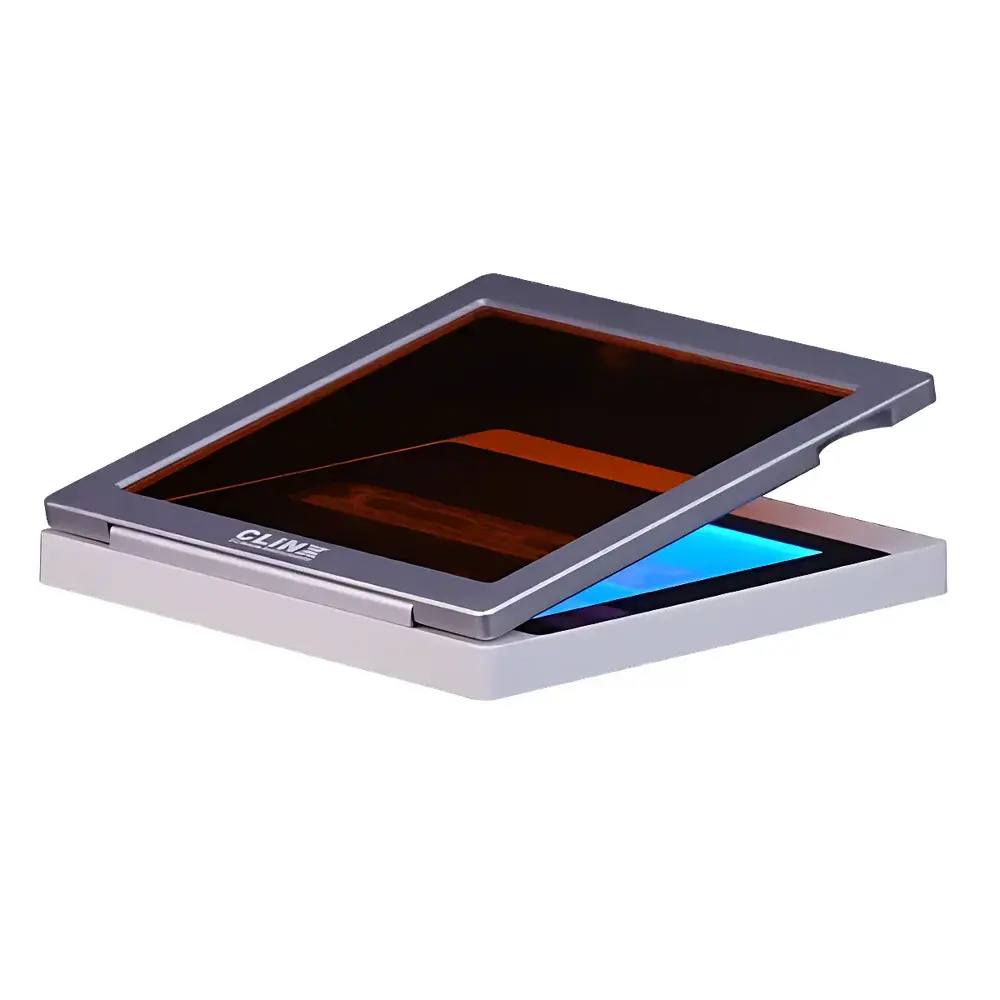
Clinkx BV200 Series Blue Light Transilluminator and Gel Cutter
| Brand | Clinkx |
|---|---|
| Origin | Shanghai, China |
| Instrument Type | Benchtop |
| Model | BV200 Series |
| Wavelength | 470 nm (single-band blue LED) |
| Active Imaging Area | 170 mm × 130 mm |
| Dimensions (L×W×H) | 210 mm × 210 mm × 30 mm |
| LED Lifetime | >100,000 hours |
| Quantum Efficiency | ≥95% |
| Filter | Amber-colored cut-on filter |
| Safety Design | Eye-safe operation without UV-blocking goggles required |
| Compatible Dyes | SYBR Safe, GelRed, GelGreen, BlueView, and other non-UV nucleic acid stains |
Overview
The Clinkx BV200 Series Blue Light Transilluminator and Gel Cutter is an engineered benchtop solution for safe, high-fidelity visualization and precise excision of nucleic acid bands following electrophoretic separation. Unlike conventional UV transilluminators that rely on 254 nm or 302 nm ultraviolet radiation—known to cause thymine dimer formation and irreversible DNA damage—the BV200 utilizes narrowband 470 nm high-intensity blue LEDs. This wavelength excites modern, low-toxicity fluorescent nucleic acid stains (e.g., SYBR Safe, GelRed, BlueView) while minimizing photodegradation of DNA/RNA fragments. Its optical architecture integrates a uniform illumination module with tightly controlled spectral output and an amber long-pass filter, ensuring high signal-to-background ratio and consistent band contrast across the entire 170 mm × 130 mm active imaging area. Designed for routine molecular biology workflows—including cloning, PCR verification, restriction digest analysis, and NGS library QC—the BV200 eliminates operator exposure to mutagenic UV radiation without compromising detection sensitivity.
Key Features
- Eye-safe blue-light illumination (470 nm) eliminates requirement for UV-protective eyewear during gel visualization and cutting.
- Ultra-thin profile (30 mm height) and compact footprint (210 mm × 210 mm) enable seamless integration into crowded laminar flow hoods, cold rooms, or shared core facility benches.
- Imported high-efficiency blue LEDs with ≥95% quantum efficiency deliver stable, homogeneous irradiance—critical for reproducible band quantification and downstream applications such as mass spectrometry or Sanger sequencing.
- Adjustable-angle amber filter cover allows single-hand operation: tilt for real-time observation, close for hands-free cutting under optimal viewing conditions.
- Passive thermal management system ensures stable LED output over extended use (>100,000 hour rated lifetime), eliminating fan noise, vibration, or maintenance downtime.
- Optimized optical path minimizes stray light and background fluorescence, enabling clear resolution of low-abundance bands and reducing post-acquisition image processing overhead.
Sample Compatibility & Compliance
The BV200 is validated for use with all commercially available blue-light–compatible nucleic acid stains, including but not limited to SYBR Safe (Thermo Fisher), GelRed (Biotium), GelGreen (Biotium), BlueView (VWR), and LunaSafe (Lonza). It is incompatible with ethidium bromide (EtBr) due to its lack of excitation at 470 nm—a deliberate design choice aligned with institutional biosafety policies discouraging carcinogenic reagent use. The instrument conforms to IEC 61010-1:2010 for electrical safety in laboratory equipment and meets EN 62471:2006 photobiological safety requirements for lamp-based devices (Risk Group 1: exempt from hazard classification). No UV emission above 400 nm is detectable per calibrated spectroradiometric measurement, supporting compliance with OSHA laboratory standard 29 CFR 1910.1200 and institutional chemical hygiene plans.
Software & Data Management
As a standalone hardware platform, the BV200 does not include embedded software or connectivity interfaces. It operates via a simple on/off switch and manual filter positioning—intentionally omitting digital controls to maximize reliability, minimize electromagnetic interference near sensitive electrophoresis systems, and ensure uninterrupted operation in GLP/GMP-adjacent environments where firmware validation would otherwise be required. Users integrate the BV200 with third-party gel documentation systems (e.g., Bio-Rad GelDoc, Azure Sapphire, UVP ChemStudio) via standard white-light or blue-light excitation modes. All imaging metadata—including exposure time, lens aperture, and stain identity—is retained within the host acquisition software, satisfying traceability requirements under ISO/IEC 17025 and FDA 21 CFR Part 11 when paired with compliant digital imaging platforms.
Applications
- Routine agarose and polyacrylamide gel documentation for academic teaching labs and diagnostic QC units.
- Cutting of DNA fragments for TA/Blunt-end cloning, Gibson assembly, or CRISPR gRNA vector construction—without UV-induced nicking or crosslinking artifacts.
- Verification of RNA integrity (e.g., ribosomal RNA bands) under conditions preserving downstream RT-qPCR performance.
- Preparative isolation of size-selected amplicons for next-generation sequencing library normalization.
- Training environments where minimizing PPE dependency improves procedural adherence and reduces ergonomic fatigue during extended lab sessions.
FAQ
Can the BV200 be used with ethidium bromide (EtBr)?
No. EtBr requires UV excitation (~302 nm) and exhibits negligible fluorescence under 470 nm blue light. Use only blue-light–optimized stains listed in the compatibility section.
Is the amber filter removable for alternative imaging configurations?
The amber filter is fixed within the hinged cover assembly and is not user-removable; it is optically matched to the 470 nm LED spectrum to suppress ambient visible light and maximize contrast.
Does the BV200 generate heat that could melt low-melting-point agarose gels?
No. Surface temperature rise remains below 5 °C above ambient after 30 minutes of continuous operation, verified by thermographic imaging—safe for all standard electrophoresis matrices.
What is the recommended working distance for camera-based documentation?
For optimal resolution and uniformity, position documentation systems between 15–25 cm above the active surface; avoid direct contact with the filter cover to prevent mechanical stress.
Is calibration or annual verification required?
Not applicable. The BV200 contains no adjustable optical or electronic calibration parameters. Intensity stability is ensured by LED binning and passive thermal design, with lifetime performance validated per LM-80 test reports from the LED manufacturer.
Related Products




