
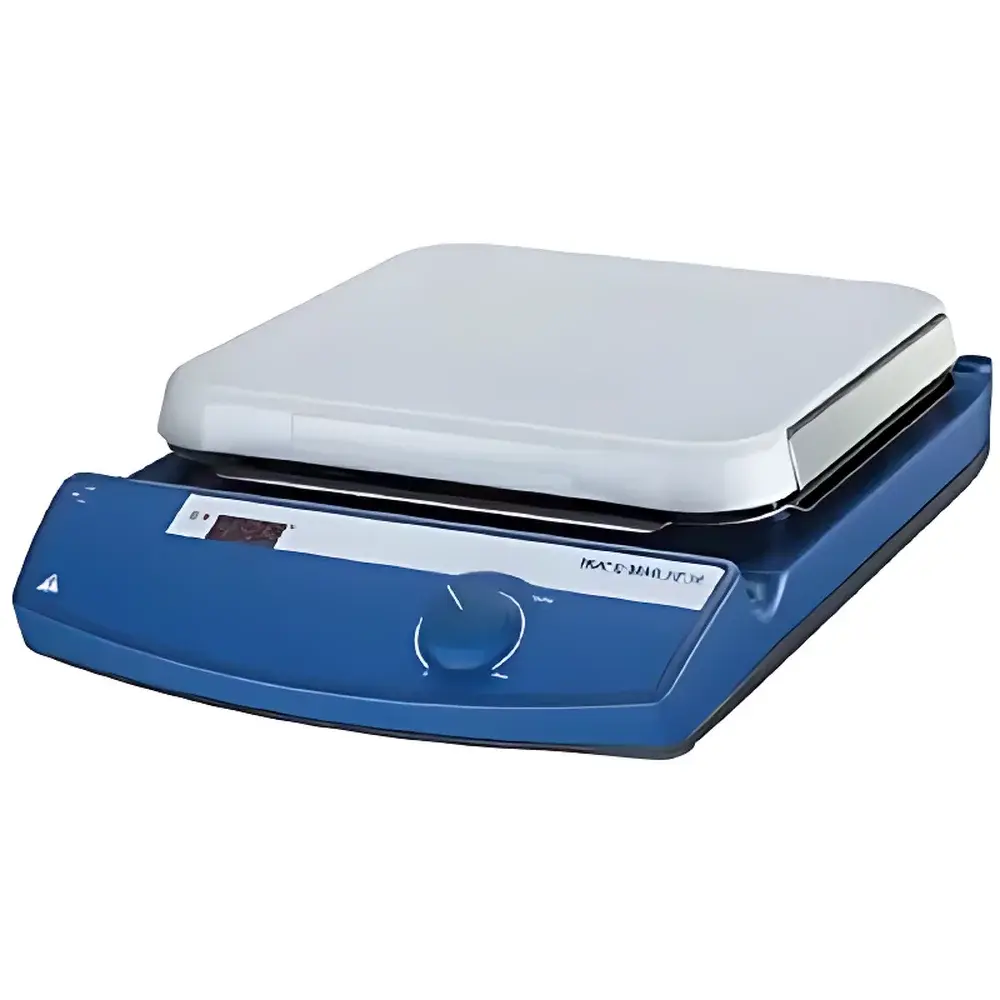
IKA C-MAG HP10 Electric Heating Plate
| Brand | IKA |
|---|---|
| Origin | Germany |
| Model | C-MAG HP10 |
| Heating Power | 1505 W |
| Max. Heating Temperature | 500 °C |
| Temperature Uniformity | Achieved via external contact electronic thermometer ETS-D5 (optional, for precise solution temperature control) |
| Plate Dimensions | 300 × 105 × 415 mm (W × H × D) |
| Heating Area | 260 × 260 mm |
| Display | Digital LED display with independent temperature setpoint and status indication |
| Safety Cut-off | Automatic shutdown at >550 °C |
| Operating Ambient | 5–40 °C, ≤80% RH |
| Ingress Protection | IP21 (DIN EN 60529) |
| Voltage/Frequency | 230 V, 50/60 Hz |
| Weight | 6 kg |
Overview
The IKA C-MAG HP10 Electric Heating Plate is a high-performance, single-position laboratory heating system engineered for precision, safety, and long-term reliability in demanding sample preparation and digestion workflows. Designed and manufactured in Germany, it operates on the principle of resistive ceramic heating—delivering stable thermal energy across a robust, seamless alumina-ceramic surface. Unlike open-coil or stainless-steel plates, the C-MAG HP10’s monolithic ceramic plate offers exceptional resistance to chemical attack from strong acids (e.g., HNO₃, HCl, HF), alkalis, and organic solvents commonly used in EPA Method 3050B, ASTM D5175, or ISO 11466 sample digestion protocols. Its integrated microprocessor continuously monitors heater output and—when paired with an optional ETS-D5 external probe—enables closed-loop feedback control of actual solution temperature rather than just surface temperature, significantly improving reproducibility in gravimetric analysis, standard solution preparation, and controlled evaporation applications.
Key Features
- Ceramic heating surface (260 × 260 mm): Chemically inert, scratch-resistant, and thermally stable up to 500 °C; eliminates hot-spot formation and ensures uniform heat distribution.
- Digital LED interface: Enables precise temperature setpoint entry (in 1 °C increments) and real-time display of current plate temperature; supports repeatable method recall for SOP-driven labs.
- Integrated safety architecture: Dual-stage overtemperature protection—electronic cut-off at 550 °C prevents thermal runaway; visual warning indicator (flashing LED) alerts users during active heating.
- Elevated control panel design: Positioned above the heating zone to minimize risk of liquid ingress and improve ergonomics during prolonged operation.
- Microprocessor-based regulation: Compensates for ambient fluctuations and load-dependent thermal lag; maintains ±3 K stability (with ETS-D5 probe) and ±10 K accuracy (plate-sensor mode).
- IP21-rated enclosure: Provides basic protection against vertically falling drips and solid objects >12.5 mm—suitable for general laboratory environments compliant with IEC 61010-1 safety standards.
Sample Compatibility & Compliance
The C-MAG HP10 accommodates standard laboratory glassware (e.g., beakers, digestion vessels, round-bottom flasks) up to 4 L capacity. Its flat, non-porous ceramic surface ensures compatibility with PTFE, quartz, borosilicate glass, and acid-washed silica crucibles. The unit meets essential regulatory requirements for analytical laboratories, including conformity with EN 61010-1 (electrical safety), EN 61326-1 (EMC), and RoHS 2011/65/EU. When operated with traceable calibration certificates for the ETS-D5 sensor and documented temperature mapping (per ASTM E2251), it supports GLP-compliant temperature validation for methods requiring documented thermal consistency—such as USP environmental monitoring prep or ISO/IEC 17025-accredited digestion procedures.
Software & Data Management
The C-MAG HP10 operates as a standalone analog-digital hybrid instrument without embedded data logging or PC connectivity. However, its analog output port (ETS-D4 interface) allows integration with third-party data acquisition systems (e.g., LabVIEW, Delta-T Loggers) when used with compatible temperature transmitters. For audit-trail compliance under FDA 21 CFR Part 11, users may pair the unit with external calibrated loggers that record time-stamped temperature readings, user ID, and setpoint changes—enabling full traceability in regulated QC/QA environments. Routine verification follows ISO/IEC 17025 Clause 6.4.10: equipment performance must be verified prior to use via NIST-traceable reference thermometers (e.g., Fluke 1523 with PT100 probe).
Applications
- Acid digestion of environmental, biological, and geological samples prior to ICP-OES or ICP-MS analysis.
- Controlled solvent evaporation in residue testing (e.g., pesticide analysis per SANTE/11813/2021).
- Standardization of volumetric solutions (e.g., NaOH, KMnO₄) under constant-temperature conditions to minimize density drift.
- Pre-heating and thermal conditioning of reaction vessels in synthetic chemistry workflows.
- Supporting ASTM D86, D1298, and ISO 3675 density measurements where bath-equivalent stability is required.
- General-purpose heating in teaching labs, pharmaceutical QC, and food safety testing facilities.
FAQ
Can the C-MAG HP10 be used for reflux or distillation setups?
Yes—its stable 500 °C maximum surface temperature and large 260 × 260 mm heating area support standard reflux condenser assemblies and round-bottom flask configurations, provided appropriate thermal insulation and vapor management are implemented.
Is the ETS-D5 temperature probe included with the unit?
No—the ETS-D5 is an optional accessory. The base unit controls only surface temperature; solution-level accuracy requires separate purchase and connection of the ETS-D5 with compatible cable (ETS-D5-A).
What is the recommended calibration frequency for routine use?
Per ISO/IEC 17025, calibration should occur before first use, after any physical impact or repair, and at defined intervals—typically every 6–12 months depending on usage intensity and criticality of application.
Does the unit support programmable ramp-soak profiles?
No—the C-MAG HP10 provides only manual setpoint control; it does not feature built-in programming logic or multi-step temperature sequencing.
Can it operate continuously at 500 °C?
Yes—provided adequate ventilation, ambient temperature remains ≤40 °C, and no volatile or flammable materials are present within 30 cm of the unit. Continuous operation at max temperature reduces long-term ceramic emissivity stability; periodic verification is advised.



