
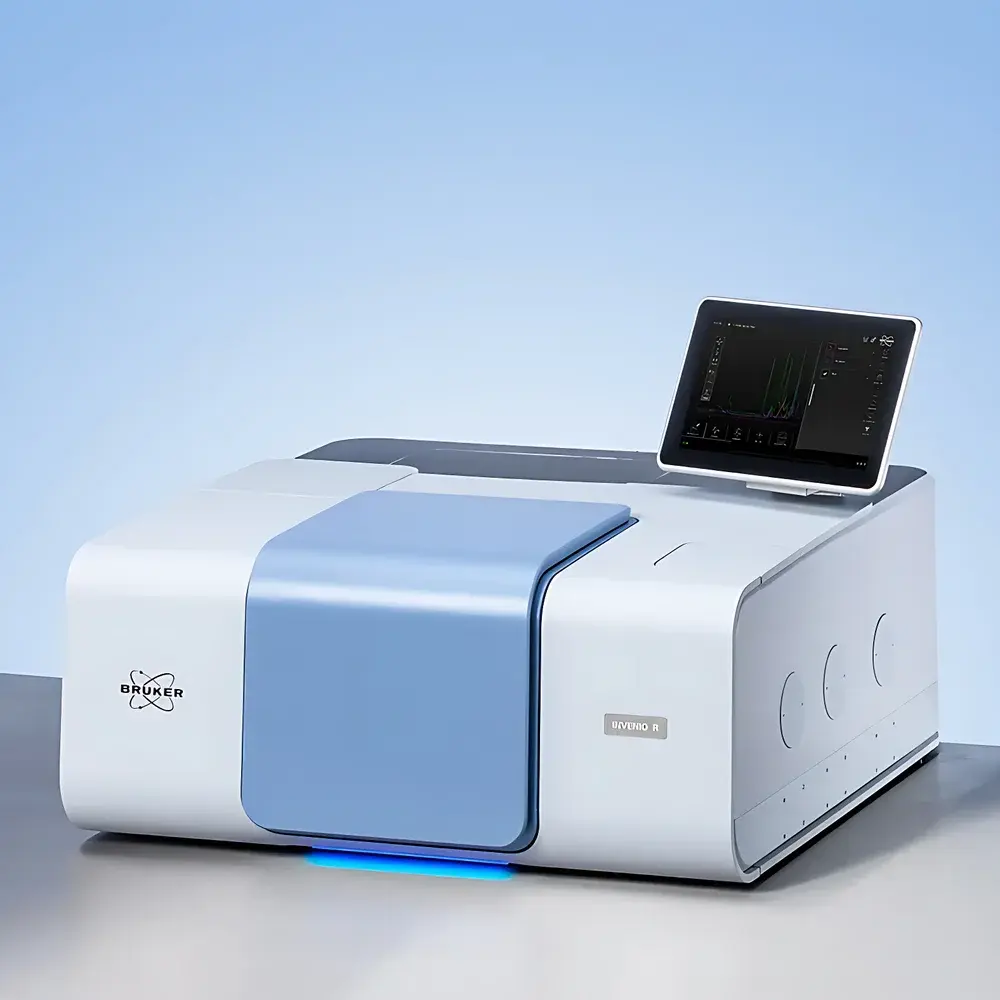
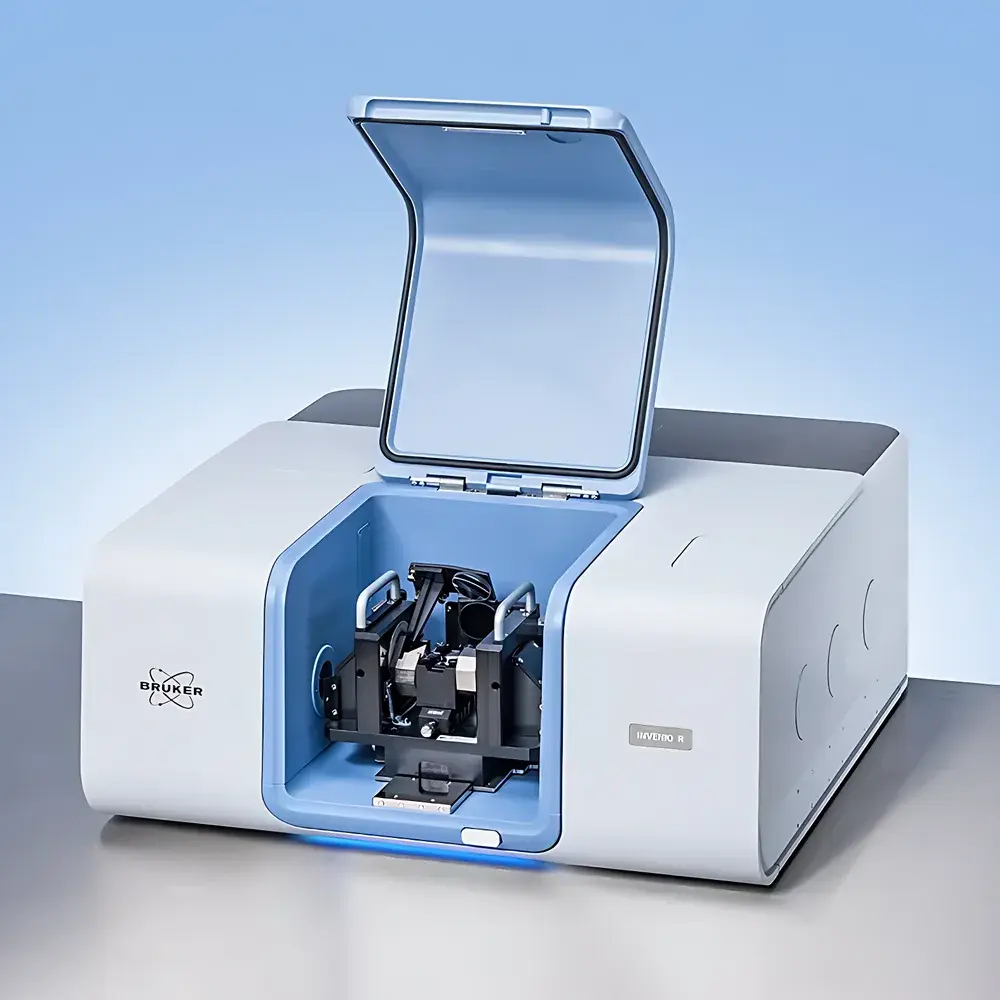
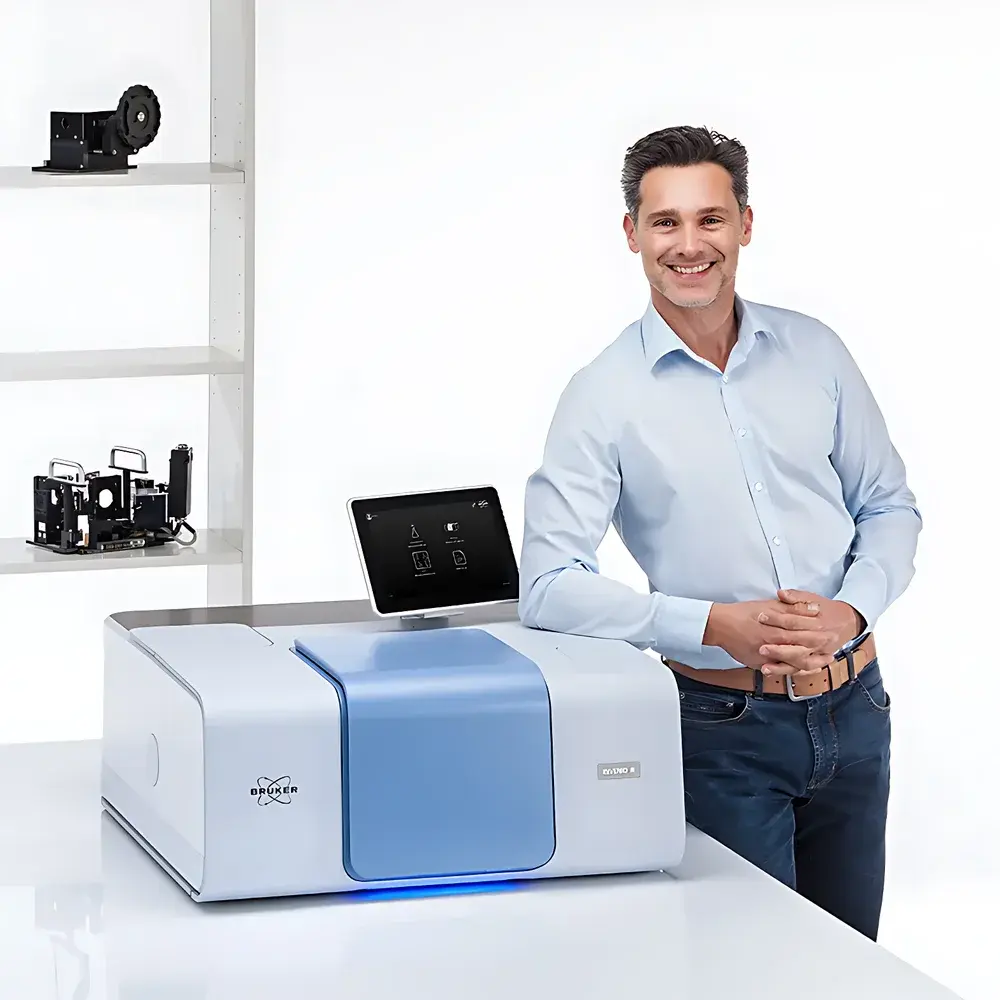
Bruker INVENIO Fourier Transform Infrared (FTIR) Spectrometer
| Brand | Bruker |
|---|---|
| Origin | Germany |
| Model | INVENIO |
| Instrument Type | Laboratory FTIR Spectrometer |
| Wavenumber Range | 8,000 – 350 cm⁻¹ |
| Spectral Resolution | 0.16 cm⁻¹ |
| Scan Speed | 20 spectra/sec |
| Signal-to-Noise Ratio | >10,000:1 |
Overview
The Bruker INVENIO is a research-grade, modular Fourier Transform Infrared (FTIR) spectrometer engineered for maximum flexibility, long-term stability, and seamless spectral range expansion—from far-infrared (FIR) to ultraviolet/visible (UV/VIS). At its core lies the RockSolid™ permanently aligned interferometer, eliminating sensitivity drift due to mechanical misalignment and ensuring high reproducibility across thousands of scans. The instrument operates on Michelson interferometry principles, where infrared radiation from a broadband source is split, reflected, recombined, and detected as an interferogram—digitally transformed via Fast Fourier Transform (FFT) into a high-fidelity absorption or transmission spectrum. Designed for rigorous academic, pharmaceutical, materials science, and industrial R&D environments, the INVENIO delivers sub-0.16 cm⁻¹ resolution and >10,000:1 SNR (at 4 cm⁻¹, 1 min scan, MCT detector), enabling precise identification of molecular vibrations in gases, liquids, thin films, and bulk solids. Its architecture supports full compliance with analytical data integrity requirements under GLP and GMP frameworks.
Key Features
- RockSolid™ Interferometer: Monolithic, kinematically mounted design ensures permanent alignment—no manual recalibration required after optical component changes or transport.
- MultiTect™ Detector Technology: Supports up to five fully automated, software-controlled room-temperature detectors (e.g., DTGS, Si, InGaAs) within a single instrument platform—enabling rapid spectral region switching without hardware intervention.
- DigiTect™ Detector Bay: Dedicated slot for cryogenically cooled detectors (e.g., liquid nitrogen-cooled MCT or InSb), independently configurable and electrically isolated for optimal signal fidelity.
- Transit™ Mid-IR Transmission Channel: Integrated auxiliary beam path with dedicated DTGS detector; allows fast, routine mid-IR transmission measurements without disrupting main sample compartment configuration.
- Bruker FM (Far-Mid) Synchronous Measurement: Proprietary wide-range beamsplitter and DLaTGS detector enable simultaneous acquisition from 6000 cm⁻¹ to 80 cm⁻¹ in a single scan—eliminating need for manual optics swaps.
- Modular Beam Port Architecture: Three output and two input beam ports, software-selectable; optional fourth output port available for complex multi-accessory setups (e.g., microscopes, gas cells, ATR modules).
- QuickLock™ Accessory Interface: Magnetic, electronically encoded mounting system automatically recognizes installed accessories (e.g., ATR crystals, beam condensers) and loads optimized parameter sets in OPUS software.
Sample Compatibility & Compliance
The INVENIO accommodates diverse sampling techniques—including transmission, reflection (specular/diffuse), attenuated total reflectance (ATR), photoacoustic spectroscopy (PAS), and gas-phase analysis—via standardized Bruker-compatible external modules. All optical paths adhere to ISO 17025 traceability guidelines when used with certified reference materials (e.g., NIST SRM 1921a for wavenumber accuracy). The system supports audit-trail-enabled operation per FDA 21 CFR Part 11 when deployed with OPUS software configured for electronic signatures and user-role-based access control. Routine performance qualification (PQ) can be executed using built-in validation tools, including wavenumber accuracy verification, photometric linearity assessment, and resolution testing per ASTM E1421 and ISO 18389.
Software & Data Management
OPUS-TOUCH R&D is the native touch-optimized interface, pre-installed on an integrated industrial-grade tablet with motorized tilt and lateral adjustment for ergonomic operation. It provides guided workflows for common tasks (e.g., background acquisition, sample measurement, baseline correction) and real-time spectral preview. For advanced analysis—including multivariate modeling (PCA, PLS), kinetic deconvolution, or spectral library searching—the system seamlessly connects to desktop OPUS software running on Windows-based workstations. Raw interferograms and processed spectra are stored in Bruker’s proprietary OPUS format (.0), fully compatible with third-party tools (e.g., MATLAB, Python SciPy) via documented binary structure and XML metadata headers. All data files include embedded instrument configuration logs, environmental sensor readings (temperature, humidity), and operator metadata—ensuring full ALCOA+ (Attributable, Legible, Contemporaneous, Original, Accurate, Complete, Consistent, Enduring, Available) compliance.
Applications
- Pharmaceutical solid-state characterization (polymorph screening, hydrate/solvate identification, excipient compatibility)
- Failure analysis of polymer composites and coatings (oxidation, degradation, filler dispersion)
- In situ catalysis monitoring (time-resolved DRIFTS, reaction kinetics under controlled atmosphere)
- Forensic fiber and paint chip analysis with micro-FTIR coupling
- Quality control of semiconductor thin films (SiO₂ thickness, Si–H bond density)
- Environmental microplastic identification in water and soil matrices
- Biomedical tissue diagnostics (FTIR histopathology, lipid/protein secondary structure mapping)
FAQ
What spectral ranges can the INVENIO cover with factory-standard configurations?
Standard delivery includes 8,000–350 cm⁻¹ (mid- to near-IR); optional upgrades extend coverage to 15 cm⁻¹ (far-IR) or 28,000 cm⁻¹ (UV/VIS) via additional sources, beamsplitters, and detectors.
Is the INVENIO compatible with existing VERTEX-series accessories?
Yes—all VERTEX-compatible external modules (microscopes, gas cells, emission accessories) integrate directly via standardized beam ports and electrical interfaces.
How does the Transit™ channel improve throughput in QC labs?
It enables rapid mid-IR transmission measurements without removing ATR crystals, integrating mirrors, or recalibrating the main optical path—reducing turnaround time by ~40% for routine batch analysis.
Can the INVENIO meet regulatory requirements for GxP environments?
When deployed with validated OPUS software, electronic signature modules, and documented IQ/OQ/PQ protocols, it fulfills FDA 21 CFR Part 11, EU Annex 11, and ICH Q5C data integrity expectations.
What maintenance is required for long-term RockSolid™ interferometer stability?
None beyond periodic desiccant replacement and ambient environment monitoring; the interferometer contains no moving alignment screws or wear-prone flexures—design lifetime exceeds 10 years under continuous operation.
Related Products






