
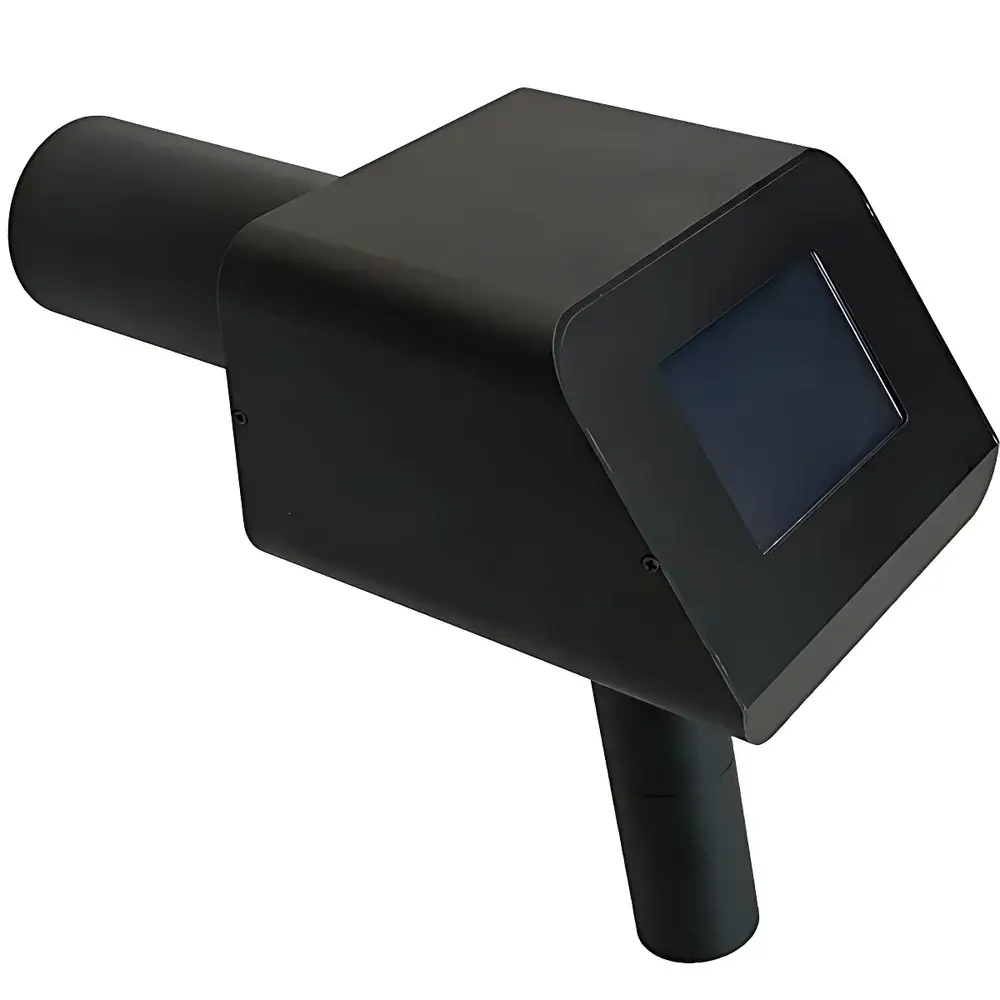
PKSAIR 1121T Portable X- and Gamma-Ray Dose Rate Meter
| Brand | PKSAIR |
|---|---|
| Origin | Beijing, China |
| Model | PKSAIR 1121T |
| Instrument Type | Portable Dosimeter |
| Radiation Type | X-ray and Gamma-ray |
| Detector | 2" × 2" Plastic Scintillator + Hamamatsu Photomultiplier Tube |
| Dose Rate Range | 10 nSv/h – 10 mSv/h |
| Sensitivity | 130 CPM per mR/hr (referenced to Cs-137) |
| Energy Response | 30 keV – 7.0 MeV (±20% deviation) |
| Intrinsic Error | ≤ ±10% (at 137Cs, 100 µSv/h) |
| Response Time | 30 ms |
| Display | 3.5-inch Color Touchscreen LCD |
| Power | 7.4 V Li-ion Battery (≥8 h continuous operation) |
| Operating Temperature | −25 °C to +50 °C |
| Relative Humidity | <95% RH (non-condensing) |
| Dimensions | 265 × 210 × 134 mm |
| Weight | ~1106 g |
| Compliance | GB/T 14583–1993, JJG 521–2006 |
Overview
The PKSAIR 1121T is a portable, high-sensitivity radiation dosimeter engineered for real-time measurement of ambient dose equivalent rate H*(10) from X- and gamma-ray fields. It operates on the principle of scintillation detection: incident ionizing photons interact with a 2-inch × 2-inch air-equivalent plastic scintillator, generating visible light pulses proportional to deposited energy; these are converted into amplified electrical signals by a Hamamatsu photomultiplier tube (PMT) and digitized via a low-noise, high-speed signal processing chain. The instrument delivers rapid response (≤30 ms), stable energy response across 30 keV–7.0 MeV (±20%), and traceable performance against national standards GB/T 14583–1993 and JJG 521–2006—ensuring metrological suitability for environmental monitoring, radiation protection surveys, and emergency response applications where regulatory-grade field data integrity is required.
Key Features
- High-efficiency 2″ × 2″ plastic scintillation detector with optimized light collection geometry and Hamamatsu PMT coupling for superior sensitivity (130 CPM/mR/hr at Cs-137) and long-term stability.
- Real-time dual-parameter display: instantaneous dose rate (nSv/h to mSv/h) and accumulated dose (0–9999 mSv), both updated continuously with timestamped logging.
- 3.5-inch color capacitive touchscreen interface with intuitive Chinese-language UI, supporting direct parameter configuration, alarm setup, and historical data review.
- Embedded high-speed microprocessor enabling real-time spectral weighting, dead-time correction, and automatic background subtraction for improved accuracy in variable-field conditions.
- Expandable architecture: optional integrated GM tube module extends upper range capability for high-dose-rate environments (e.g., nuclear facility perimeter checks or post-incident triage).
- Robust aluminum alloy housing (IP54-rated ingress protection), ergonomic detachable grip, and MIL-STD-810G-aligned mechanical design for field durability under harsh operational conditions.
- Built-in real-time clock (RTC) with battery-backed memory ensures time-stamped data integrity even after power loss; >4000 measurement records retained non-volatilely.
Sample Compatibility & Compliance
The PKSAIR 1121T is calibrated and validated for use with solid-phase environmental samples—including soil, concrete, building materials, and surface-contaminated objects—as defined in GB/T 14583–1993 for terrestrial gamma dose rate assessment. Its air-equivalent plastic scintillator provides near-flat energy response across diagnostic and industrial X-ray spectra (30–150 keV) and common gamma emitters (e.g., Cs-137, Co-60, Am-241), meeting the energy dependence requirements specified in JJG 521–2006 for environmental and occupational dosimeters. The device satisfies national verification protocols for type approval of survey meters used in radiological protection programs, including those governed by China’s National Nuclear Safety Administration (NNSA) and Ministry of Ecology and Environment (MEE). While not certified to IEC 60846-1:2014 or ANSI N42.17B, its documented intrinsic error (≤±10% at 100 µSv/h, Cs-137) and response linearity align with internationally accepted tolerances for Class II portable survey instruments.
Software & Data Management
Data acquisition, storage, and export are managed through an embedded firmware platform compliant with GLP-aligned audit trail principles: all user actions (e.g., alarm threshold changes, calibration resets) are timestamped and logged. Measurement records include dose rate, cumulative dose, date/time, battery status, and detector temperature—each stored with CRC-16 checksum validation. Optional Bluetooth 5.0 module enables secure wireless transmission to Android/iOS companion apps (PKSAIR Connect), supporting CSV export, geotagged reporting, and integration with centralized radiation management platforms. Firmware updates are performed via USB-C interface with signed binary verification to prevent unauthorized modification—supporting traceability requirements under ISO/IEC 17025:2017 Clause 5.9.
Applications
- Environmental radiation baseline surveys and long-term trend monitoring in urban, rural, and industrial zones.
- Routine radiation protection audits in hospitals (radiology, nuclear medicine), research laboratories, and industrial radiography facilities.
- Emergency response for orphan source localization, post-accident contamination mapping, and border control screening at customs, ports, and airports.
- Decommissioning support: real-time dose rate profiling during nuclear facility dismantling and radioactive waste handling operations.
- Educational use in university health physics labs for hands-on training in dosimetry fundamentals, energy dependence evaluation, and instrument calibration procedures.
FAQ
What radiation quantities does the PKSAIR 1121T measure?
It measures ambient dose equivalent rate H*(10) in nSv/h to mSv/h, and accumulated H*(10) in mSv, as defined in ICRP Publication 60 and implemented in GB/T 14583–1993.
Is the instrument suitable for measuring radon progeny or alpha/beta emitters?
No. It is optimized exclusively for penetrating X- and gamma-ray photons. Alpha and beta particles are fully attenuated by the detector housing and scintillator encapsulation.
Can the device be calibrated traceably to national standards?
Yes. Factory calibration is performed using Cs-137 and Co-60 reference sources accredited to CNAS (China National Accreditation Service) standards; users may perform field verification using check sources per JJG 521–2006 Annex B.
Does the PKSAIR 1121T support external data logging or network connectivity?
Standard configuration includes internal flash memory (≥4000 records); optional Bluetooth module enables wireless telemetry. Ethernet or cellular modules are not supported.
What maintenance is required to ensure continued metrological validity?
Annual recalibration is recommended; PMT gain stability should be verified quarterly using a reference source. No consumables or periodic detector replacement is required under normal operating conditions.
Related Products







