
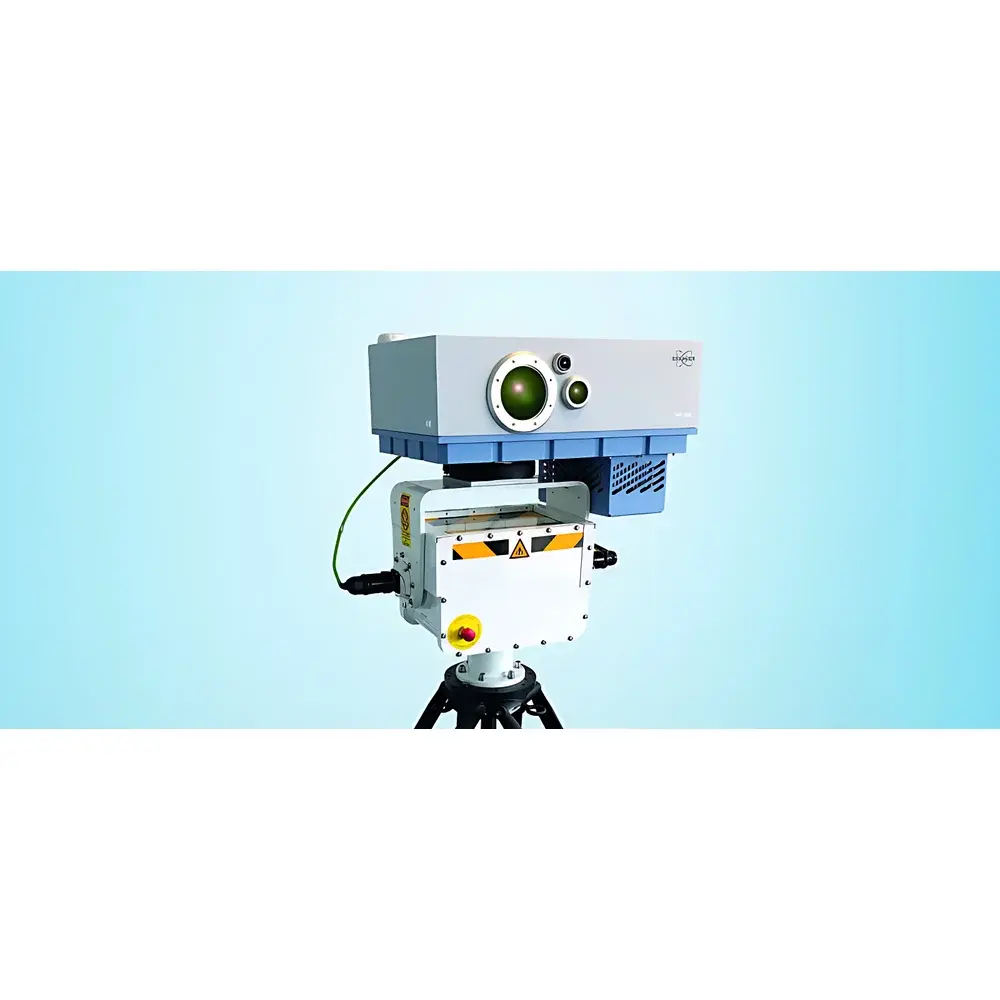
Bruker HI 90 Hyperspectral Imaging System
| Brand | Bruker |
|---|---|
| Origin | Germany |
| Manufacturer Type | Authorized Distributor |
| Origin Category | Imported |
| Model | HI 90 |
| Pricing | Available Upon Request |
Overview
The Bruker HI 90 Hyperspectral Imaging System is a high-performance, field-deployable imaging Fourier transform spectrometer (IFTS) engineered for real-time, standoff detection and quantitative analysis of gaseous plumes in the mid-infrared (MIR) spectral region. Unlike conventional point-sampling or scanning-based gas analyzers, the HI 90 operates on the principle of spatially resolved interferometry: it captures full interferograms simultaneously across a two-dimensional focal plane array (FPA), enabling pixel-level spectral reconstruction via fast Fourier transformation. Each pixel records the complete interferometric signature of its corresponding field-of-view element, yielding a hyperspectral data cube (x, y, λ) with inherent radiometric calibration and high spectral fidelity. Designed for operational robustness in demanding outdoor environments, the system integrates a stabilized interferometer core, cooled MCT detector array, and precision optical alignment—ensuring high reproducibility, low instrument line shape (ILS) distortion, and minimal phase error across extended acquisition periods.
Key Features
- Real-time hyperspectral imaging in the 2–12 µm spectral range, optimized for fundamental vibrational absorption bands of industrial and environmental gases (e.g., SO₂, CO, CH₄, NH₃, HCl, HF, NO₂)
- Focal plane array (FPA) architecture enabling simultaneous acquisition of spatial and spectral information—no mechanical scanning required
- High spatial resolution (< 1 mrad instantaneous field of view) supporting identification and mapping of sub-meter-scale gas structures at ranges up to several kilometers
- Integrated real-time processing engine performing on-the-fly spectral unmixing, concentration retrieval (ppm·m to %·m path-integrated quantities), and false-color plume visualization
- Ruggedized, weather-resistant enclosure rated to IP54, with passive thermal stabilization and shock-mounted optics for mobile platform integration (e.g., vehicle-mounted, tripod-based, or UAV-deployable configurations)
- Modular design supporting optional accessories: motorized pan-tilt units, GPS/IMU fusion modules, calibrated blackbody references, and auxiliary visible/NIR co-boresighted cameras
Sample Compatibility & Compliance
The HI 90 is designed for non-contact, open-path analysis of gaseous species dispersed in ambient air—requiring no sample extraction, pre-concentration, or consumables. It is equally applicable to surface-emission characterization (e.g., soil VOC fluxes, liquid hydrocarbon spills, or solid-phase contaminant distribution) when used in near-field reflectance or emissivity mode. The system complies with international standards governing optical remote sensing instrumentation, including ISO 14064-3 (greenhouse gas quantification), ASTM D6785 (FTIR open-path monitoring), and EN 15267-3 (performance certification of automated measuring systems). Data integrity and auditability are supported through time-stamped metadata embedding, hardware-synchronized GPS tagging, and optional 21 CFR Part 11–compliant software modules for regulated environmental monitoring programs.
Software & Data Management
The HI 90 is operated via OPUS® HYPERMAP—a dedicated, Windows-based application developed by Bruker for hyperspectral IFTS data acquisition, processing, and reporting. Core capabilities include spectral library matching (NIST, HITRAN, PNNL databases), constrained least-squares fitting for multi-gas quantification, background subtraction using reference spectra or principal component analysis, and dynamic thresholding for plume segmentation. All raw interferograms and processed data cubes are stored in HDF5 format with embedded calibration coefficients and traceable measurement parameters. Export options include GeoTIFF (georeferenced plume maps), CSV (concentration time-series), and XML (metadata-compliant reports) for integration into GIS platforms or regulatory submission workflows. Software updates and spectral library revisions are delivered through Bruker’s secure customer portal, aligned with annual instrument recalibration cycles.
Applications
- Volcanic gas monitoring: Real-time SO₂ and CO₂ flux estimation for eruption forecasting and hazard assessment
- Industrial fence-line monitoring: Continuous detection of fugitive emissions from refineries, chemical plants, and landfills
- Environmental compliance verification: Quantitative validation of emission control system performance per EPA Method 320 and EU BREF guidelines
- Emergency response: Rapid identification and dispersion modeling of hazardous gas releases during chemical incidents or transportation accidents
- Ecological research: Mapping methane ebullition from wetlands, ammonia volatilization from agricultural fields, and CO₂ exchange over forest canopies
- National security: Standoff detection of chemical warfare agent simulants and toxic industrial chemicals under varying atmospheric conditions
FAQ
What spectral resolution does the HI 90 achieve?
The system delivers adjustable spectral resolution ranging from 0.5 cm⁻¹ to 4 cm⁻¹ (unapodized), configurable via mirror scan length and apodization function selection.
Can the HI 90 operate autonomously for unattended monitoring?
Yes—when integrated with external power management, environmental enclosures, and telemetry modules, the HI 90 supports scheduled acquisitions, onboard data reduction, and remote diagnostics via Ethernet or LTE.
Is calibration traceable to NIST standards?
All factory calibrations—including wavenumber accuracy, radiometric response, and spectral linearity—are traceable to NIST-certified reference sources and validated per ISO/IEC 17025 requirements.
Does the system support quantitative analysis of mixed gas plumes?
Yes—the embedded spectral unmixing algorithm enables simultaneous quantification of up to 12 co-located gases using constrained linear least-squares fitting with physical constraints (non-negativity, Beer–Lambert consistency).
What is the typical detection limit for SO₂ at 1 km standoff distance?
Under standard atmospheric conditions (23 °C, 50% RH, 10 cm⁻¹ resolution), the minimum detectable column density is ≤ 0.5 ppm·m for SO₂ with 10-second integration time and SNR > 100.







