
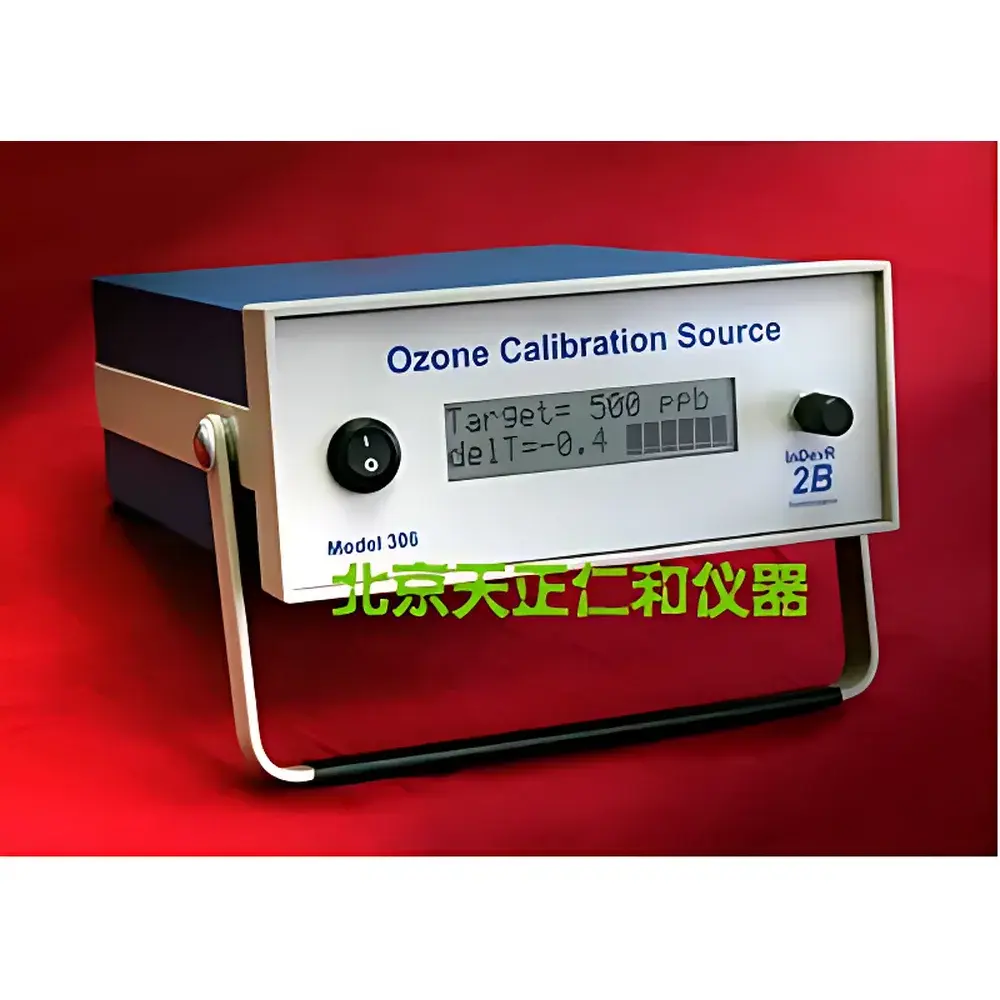
Ozone Calibration Source Model 306 – NIST-Traceable Portable Ozone Generator for Field and Lab Calibration
| [Origin | USA |
|---|---|
| Manufacturer Type | Authorized Distributor |
| Origin Category | Imported |
| Model | 306 |
| Price | Upon Request |
| Ozone Generation Method | 185 nm UV Photolysis |
| Ozone Concentration Range | 0 ppbv, 30–1000 ppbv |
| Output Precision & Accuracy | ±2 ppbv or ±2% of reading (whichever is greater) |
| Response Time to 95% of Target Concentration | ≤30 s |
| Total Output Flow Rate | 3.0 L/min |
| Power Supply | 12 V DC or 120/240 V AC, 18 W |
| Dimensions | 9 × 21 × 29 cm |
| Weight | 2.6 kg] |
Overview
The Model 306 Ozone Calibration Source™ is a portable, NIST-traceable ozone generator engineered for high-fidelity calibration of ozone monitoring instruments across environmental, industrial hygiene, and research applications. Unlike fixed-point ozone standards or permeation-based sources, the Model 306 employs 185 nm ultraviolet photolysis of ambient air to generate ozone in situ—eliminating reliance on compressed gas cylinders, chemical precursors, or external ozone generators. This principle ensures stable, reproducible output independent of ambient temperature, pressure, and relative humidity, with real-time control over ozone mixing ratio via an intuitive rotary menu interface. The device delivers a total volumetric flow of 3.0 L/min at a precisely regulated ozone concentration spanning 0 ppbv (zero air mode), 30 ppbv to 1000 ppbv in discrete or continuous steps. Its design conforms to the physical footprint and mechanical robustness of the Model 202 and Model 205 ozone analyzers—enabling seamless integration into existing field deployment workflows and mobile calibration carts.
Key Features
- NIST-traceable ozone output certified against primary standards maintained by the National Institute of Standards and Technology (NIST), supporting metrological traceability required under ISO/IEC 17025 and EPA PS-10 compliance frameworks.
- UV photolysis-based ozone generation (185 nm) using ambient air as feedstock—no consumables, no ozone transport hazards, and minimal maintenance.
- Dynamic concentration control with ≤30-second response time to 95% of target step change, enabling rapid multi-point calibration sequences (e.g., ascending/descending ramps across 0, 50, 100, 200, 400, 600, 800, and 1000 ppbv).
- Flow-compensated ozone mixing ratio control—output stability maintained across variable environmental conditions without manual correction.
- Zero-air capability via internal catalytic scrubber; verified ozone-free baseline <2 ppbv.
- Integrated bypass flow management: excess flow is directed through an internal ozone destruct unit, allowing direct connection to analyzer inlets without external flow splitters or regulators.
- Compact form factor (9 × 21 × 29 cm) and lightweight construction (2.6 kg) optimized for field use, mobile laboratories, and inter-laboratory transfer standard applications.
Sample Compatibility & Compliance
The Model 306 is compatible with all commercially available ozone monitors utilizing sample flows between 0.5–3.0 L/min, including UV absorption (254 nm), electrochemical, and chemiluminescence-based analyzers. It supports calibration protocols aligned with U.S. EPA Reference Method EQOA-0114-115 and ASTM D5012–22 for ozone generator validation. All calibration data generated using this source satisfy GLP documentation requirements when paired with timestamped, user-annotated logs. The instrument’s firmware allows authorized users to adjust internal calibration coefficients—enabling traceable transfer of calibration from a laboratory reference standard (e.g., a NIST-calibrated Model 205) to field-deployed units, consistent with EPA QA/G-5 guidance for network-wide ozone monitor harmonization.
Software & Data Management
The Model 306 operates without proprietary software—concentration selection, zero activation, and status monitoring are managed entirely via front-panel rotary switch and LED indicators. However, it is fully interoperable with third-party data acquisition systems via analog voltage output (0–5 V DC proportional to ozone concentration) and TTL-compatible status signals (e.g., “zero active”, “output stable”). For audit-ready calibration records, users may log target concentrations, timestamps, and associated analyzer responses in compliant electronic lab notebooks (ELNs) that support 21 CFR Part 11 audit trails. Firmware revision history and calibration certificate metadata (including NIST certificate ID and expiration date) are accessible via serial interface for integration into asset management databases.
Applications
- Field calibration and verification of regulatory-grade ozone monitors deployed in ambient air quality networks (e.g., U.S. EPA AirNow, EEA Air Quality e-Reporting).
- Transfer standard operation between central calibration labs and regional monitoring stations—ensuring long-term inter-site measurement equivalence.
- Controlled exposure studies evaluating ozone-induced degradation of elastomers, polymeric coatings, and aerospace sealants per ASTM D1149 and ISO 1431-1.
- Phytotoxicity research requiring precise, repeatable ozone dosing for controlled-environment chambers and open-top field fumigation systems.
- Validation of ozone sensor drift in industrial process monitoring (e.g., water treatment disinfection loops, semiconductor cleanroom ambient monitoring).
FAQ
Is the Model 306 suitable for calibrating ozone monitors used in regulatory compliance monitoring?
Yes—its NIST-traceable output, documented uncertainty budget, and adherence to EPA PS-10 and ISO 17025 metrological principles make it appropriate for calibrating reference and equivalent methods analyzers in regulatory networks.
Can the Model 306 generate ozone concentrations below 30 ppbv?
It provides a certified zero-air mode (<2 ppbv), but its calibrated range begins at 30 ppbv. Sub-30 ppbv operation is not supported with stated accuracy or traceability.
Does the device require periodic recalibration?
Annual recalibration against NIST-traceable ozone standards is recommended. A full calibration certificate—including ozone output verification across the entire 30–1000 ppbv range—is supplied with each unit and upon service.
How is humidity compensated during ozone generation?
The internal photolysis chamber includes real-time ambient humidity sensing; the control algorithm dynamically adjusts UV lamp intensity and residence time to maintain target ozone mixing ratio regardless of RH variation (10–90% non-condensing).
What power sources are compatible?
The unit accepts 12 V DC (e.g., vehicle battery or portable power station) or universal 120/240 V AC input (50/60 Hz), consuming ≤18 W under nominal operation.
Related Products







