
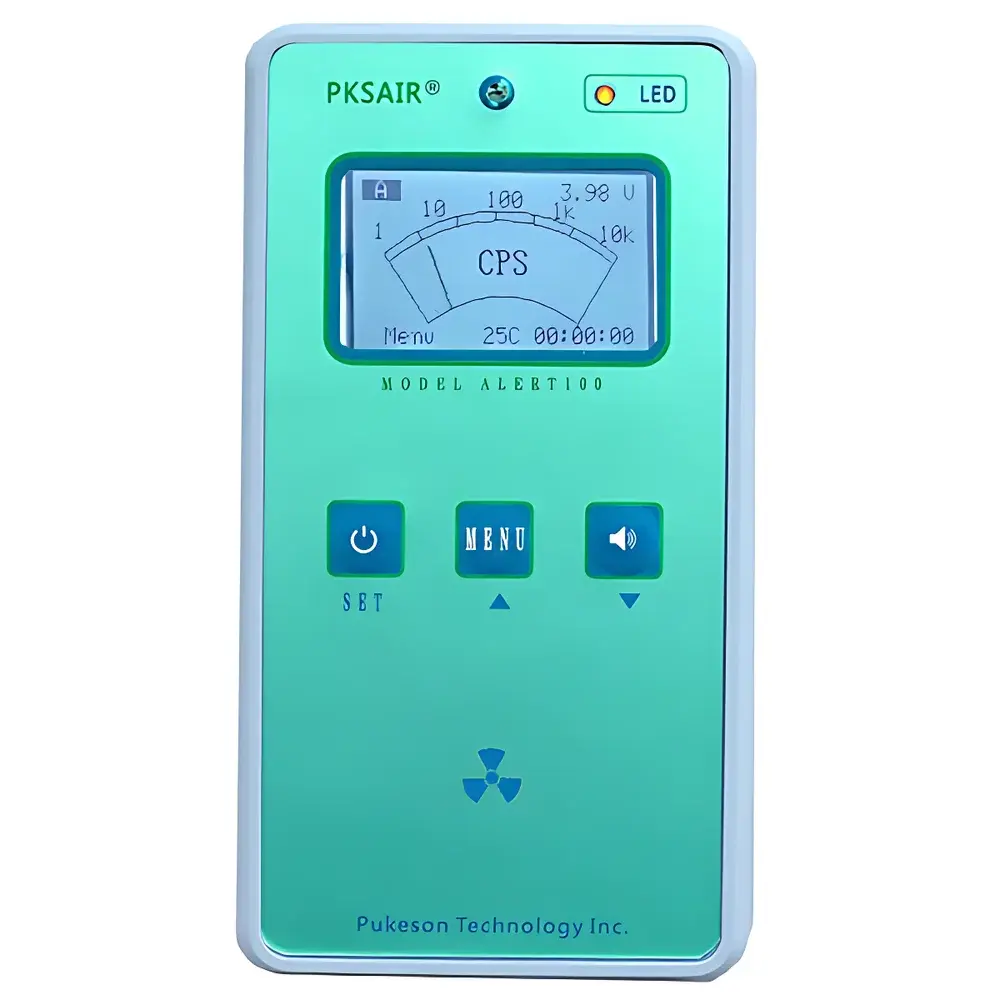
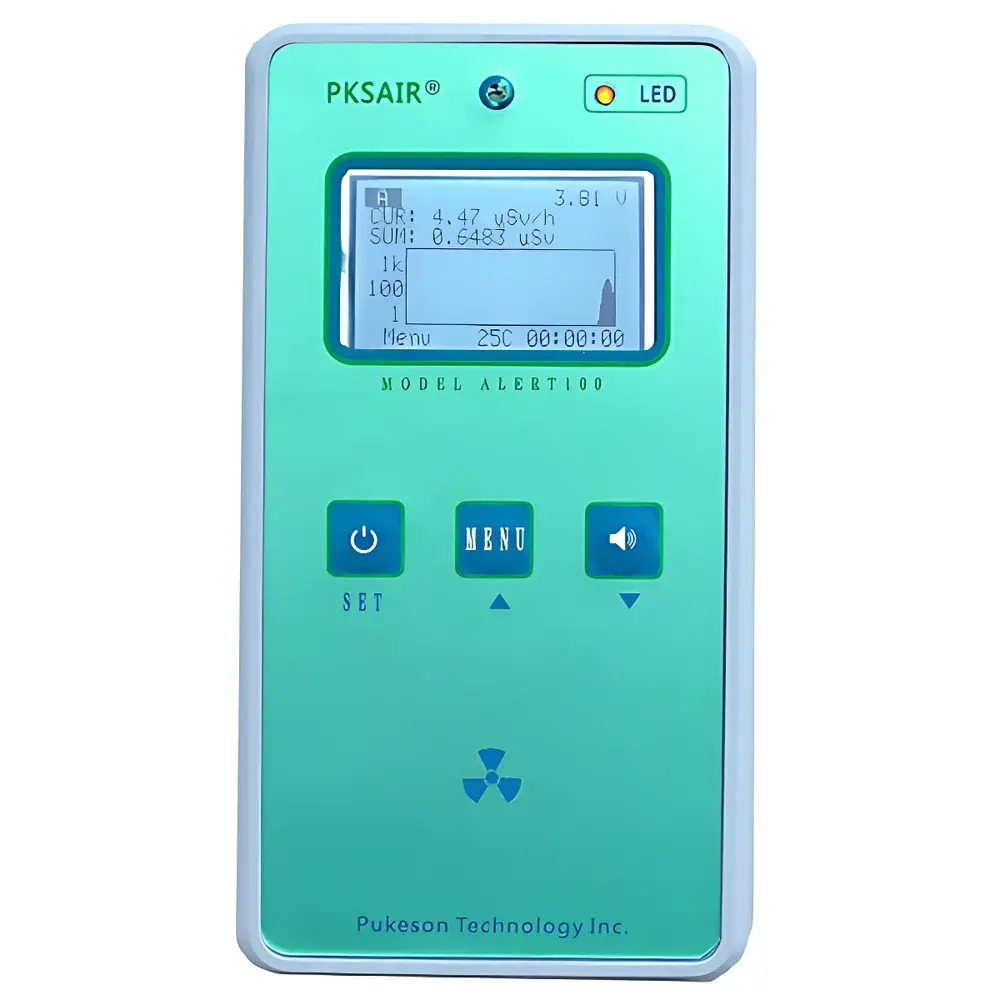
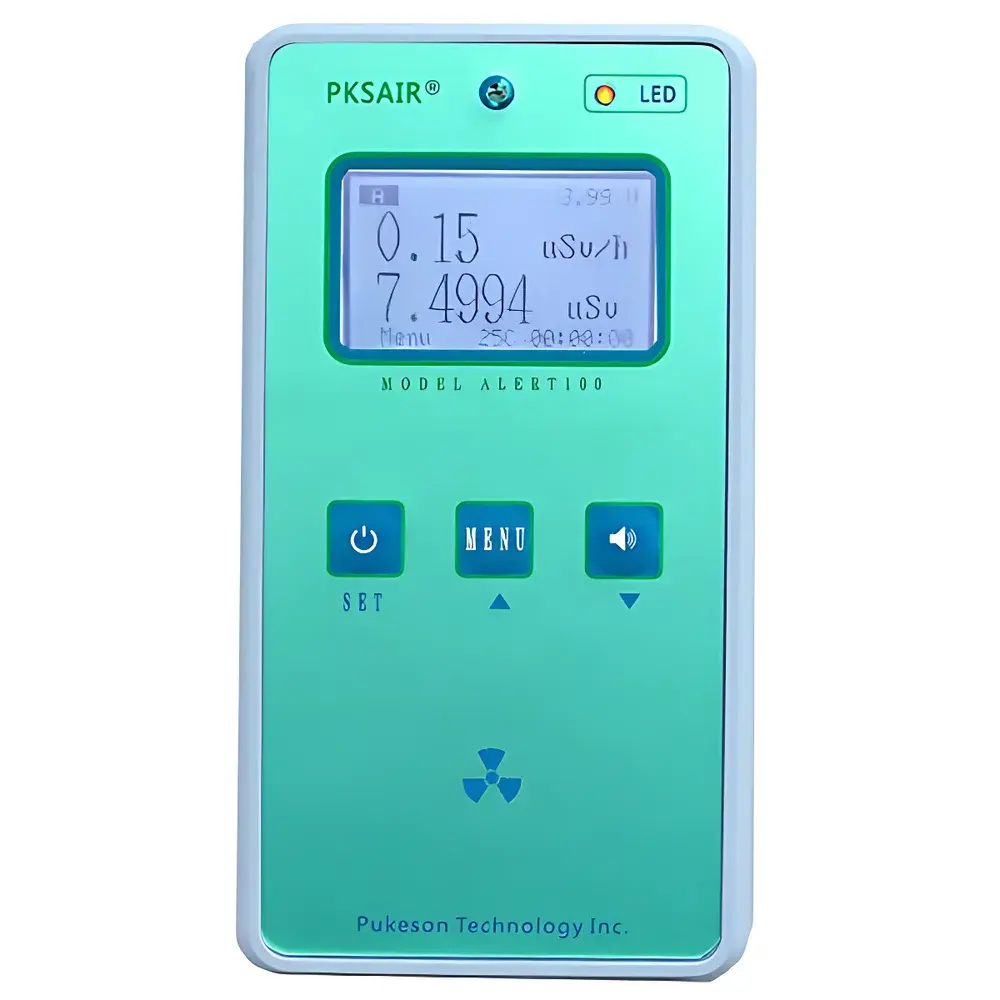
PKSAIR ALERT100 Handheld Multi-Radiation Detector
| Brand | PKSAIR |
|---|---|
| Origin | Beijing, China |
| Manufacturer Type | Authorized Distributor |
| Country of Origin | China |
| Model | ALERT100 |
| Instrument Category | Dose Rate Meter / Contamination Monitor |
| Instrument Type | Portable |
| Measured Media | Solid Surfaces |
| Detector Type | Halogen-quenched + Neon-filled GM Tube |
| Radiation Types Detected | Alpha (α), Beta (β), Gamma (γ), and X-rays |
| Dose Rate Range | 0.01–1100 µSv/h |
| Sensitivity | 342 CPM per µSv/h (Cs-137) |
| Energy Response | 25 keV – 3 MeV (±15% deviation) |
| Intrinsic Accuracy | ≤10% for γ dose rate |
| Angular Response (¹³⁷Cs) | ≤15% |
| Background Count | ~60 CPM |
| Detection Efficiency (⁹⁰Sr/⁹⁰Y β) | 54% |
| Surface Sensitivity (⁹⁰Sr/⁹⁰Y β) | 500 CPM/Bq·cm² |
| Alpha/β Counting Range | 0–8000 CPS each |
| Display Update Rate | 1 Hz (adaptive averaging over 6 s at low levels, shortening with increasing count rate) |
| Power Supply | Internal 3.7 V Li-ion battery (~100 h typical operation) |
| Operating Environment | 0–50 °C, 40–95% RH (non-condensing) |
| Dimensions | 144 × 78 × 33 mm |
| Weight | 0.38 kg |
Overview
The PKSAIR ALERT100 Handheld Multi-Radiation Detector is a field-deployable, dual-function instrument engineered for simultaneous radiation dose rate assessment and surface contamination screening. It operates on the principle of gas ionization within a halogen-quenched, neon-filled Geiger-Müller (GM) tube—specifically a large-area (45 mm diameter), thin mica-window detector manufactured by LND, Inc. (USA). This detector geometry and window density (1.4–2.0 mg/cm²) are optimized for efficient detection of low-penetrating α and β particles while maintaining calibrated response across a broad photon energy range (25 keV to 3 MeV). The device complies with fundamental performance criteria outlined in IEC 60846-1:2014 (Radiation protection instrumentation — Ambient and/or directional dose equivalent (rate) meters and/or monitors for beta, X and gamma radiation) and supports operational alignment with ANSI N42.33 (Portable Radiation Detection Instrumentation for Homeland Security) for rapid radiological survey applications.
Key Features
- Integrated dual-mode functionality: real-time γ/X-ray dose rate measurement (0.01–1100 µSv/h) and discrete α/β surface contamination counting (0–8000 CPS per channel)
- LND 45 mm flat spiral GM detector with ultra-thin mica window—enabling high-efficiency detection of low-energy β emitters (e.g., ⁹⁰Sr/⁹⁰Y) and surface α activity
- Adaptive digital averaging algorithm: default 6-second moving average at background levels, dynamically shortened under elevated count rates to preserve temporal resolution
- Multi-unit display support: selectable readouts in CPM, CPS, µSv/h, and µSv (integrated dose)
- User-configurable audible and visual alarm thresholds with mute capability for silent operation in sensitive environments
- Rugged metal housing (host + external probe) with integrated probe-mounting clamp for stable single-hand use
- Low-power architecture delivering up to 100 hours of continuous operation on a single 3.7 V Li-ion charge
- High-contrast LCD with large-font numeric display optimized for outdoor and low-light field conditions
Sample Compatibility & Compliance
The ALERT100 is validated for direct contact or proximity-based assessment of solid surfaces—including concrete, soil, metal, ceramic, glass, textiles, and human skin—without requiring sample preparation or lab processing. Its mica-window detector permits reliable α detection only when the source is within 1–2 cm and unobstructed; β sensitivity remains effective up to ~5 cm. For γ/X-ray measurements, isotropic response is maintained within ±15% angular variation (per ¹³⁷Cs calibration). The instrument meets functional requirements for routine environmental monitoring under ISO 7503-1 (Evaluation of surface contamination — Part 1: Beta- and alpha-emitting radionuclides) and supports documentation workflows compatible with GLP-aligned field reporting. While not certified to IEC 61526 for personal dosimetry, its dose rate accuracy (≤10% intrinsic error) and energy response profile render it suitable for preliminary hazard identification, regulatory screening, and emergency response triage per IAEA Safety Guide RS-G-1.8.
Software & Data Management
The ALERT100 operates as a standalone field instrument with no mandatory software dependency. All measurement data—including timestamped dose rate logs, count histograms, and alarm event flags—are retained in non-volatile memory (up to 10,000 records). Optional USB-C interface enables export of CSV-formatted datasets for post-processing in Excel, MATLAB, or laboratory information management systems (LIMS). Exported files include detector serial number, UTC timestamps, ambient temperature/humidity metadata (if logged via optional external sensor), and audit-trail-ready fields compliant with basic ALARA record-keeping practices. No cloud connectivity or remote telemetry is embedded; data sovereignty and offline operability are preserved by design—consistent with secure facility requirements under DOE Order 473.3 and NRC Regulatory Guide 8.32.
Applications
- Rapid survey of suspected α/β surface contamination in nuclear medicine labs, radiopharmaceutical synthesis suites, and decommissioning sites
- Screening of building materials (granite, tiles, ceramics) and consumer goods (antique glassware, glazed pottery) for natural radionuclide content (e.g., ²²⁶Ra, ⁴⁰K, ²³²Th series)
- Field verification of remediation efficacy at legacy uranium mill tailings or landfill sites
- Leak testing of industrial X-ray cabinets, baggage scanners, and non-destructive testing (NDT) equipment
- Baseline environmental monitoring around nuclear facilities, including air particulate filter analysis and groundwater sediment sampling support
- First-responder radiological reconnaissance during transportation incidents involving radioactive sources (Type A packages, medical isotopes)
- Academic and teaching use in health physics laboratories for demonstrating detector geometry effects, shielding attenuation, and inverse-square law behavior
FAQ
Can the ALERT100 detect radon gas directly?
No. Radon (²²²Rn) is an inert gas; the ALERT100 measures only progeny alpha emissions (e.g., ²¹⁸Po, ²¹⁴Po) deposited on surfaces or collected on filters—not gaseous Rn itself.
Is calibration traceable to national standards?
Yes. Factory calibration is performed using ¹³⁷Cs and ⁹⁰Sr/⁹⁰Y reference sources traceable to NIM (China National Institute of Metrology). Users receive a calibration certificate with uncertainty budget per ISO/IEC 17025 principles.
Does it meet FDA 21 CFR Part 11 requirements?
No. As a field survey meter without electronic signature or role-based access control, it does not comply with Part 11. However, exported CSV logs may be incorporated into Part 11-compliant LIMS environments with appropriate procedural controls.
What is the minimum detectable activity (MDA) for ⁹⁰Sr on a surface?
Based on 54% detection efficiency and 60 CPM background, the MDA (at 95% confidence, 100 s counting) is approximately 0.37 Bq/cm²—aligned with ISO 7503-1 Class II sensitivity thresholds.
Can the probe be replaced or upgraded?
Yes. PKSAIR offers OEM-compatible alternative probes—including pancake-style α/β detectors and energy-compensated γ probes—for specialized mission profiles. Probe interchange requires firmware version ≥2.1.







