
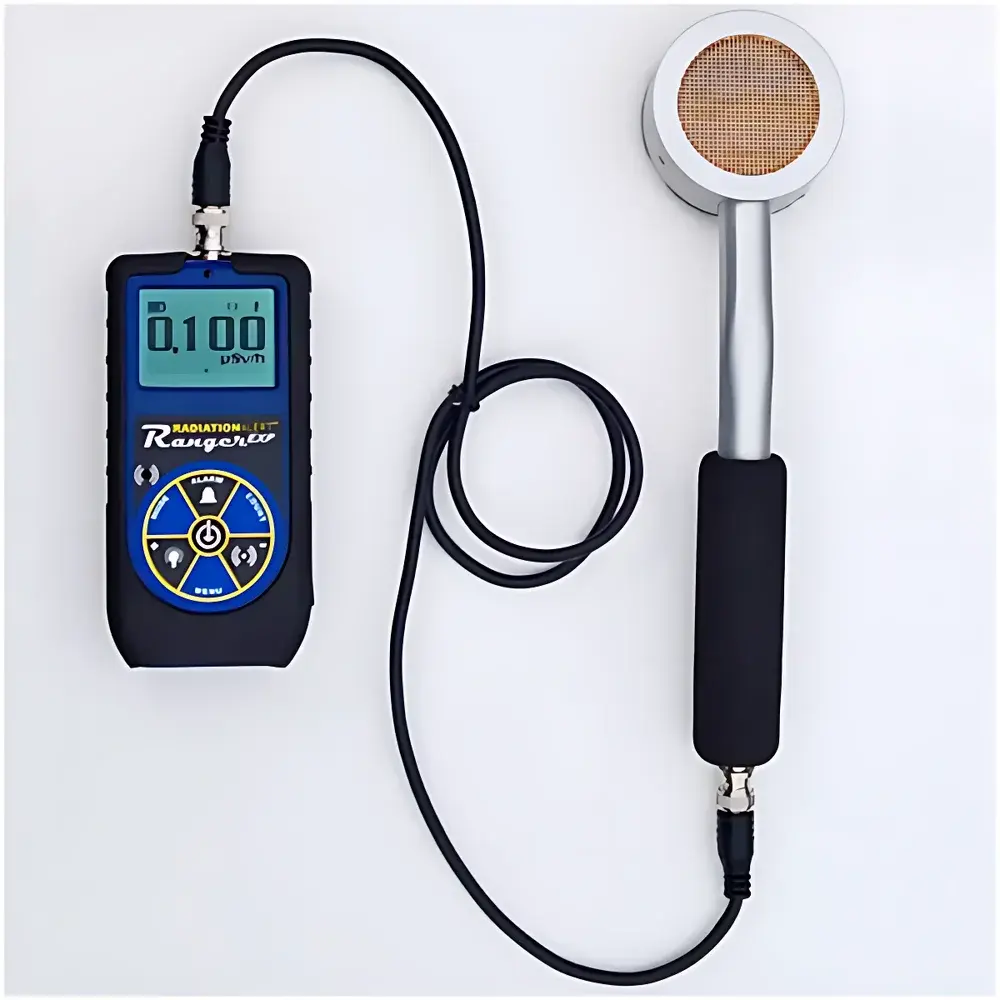
SE International Ranger EXP Multi-Function Radiation Detector
| Origin | USA |
|---|---|
| Manufacturer Type | Distributor |
| Origin Category | Imported |
| Model | Ranger EXP |
| Price Range | USD 1,400–2,800 (est.) |
| Instrument Class | Dose Rate / Survey Meter |
| Form Factor | Portable |
| Measurable Radiation Types | α, β, γ, and X-rays |
| Dose Rate Range | 0.001–1,000 µSv/hr |
| Sensitivity | 3,340 CPM per mR/hr (referenced to Cs-137) |
| Detector | External LND 7317 halogen-quenched Geiger-Müller tube, 1.77″ (45 mm) active diameter, mica window density 1.4–2.0 mg/cm² |
| Display | Backlit 4-digit LCD, 3-second update interval (adaptive averaging) |
| Accuracy | ±10% to ±15% |
| Alarm Thresholds | Adjustable 0.001–50 mR/hr or 1–160,000 CPM |
| Audio/Visual Alert | 70 dB @ 1 m, red LED flash per count |
| Data Interface | Mini-USB (data logging & bus-powered operation) |
| Power | Two AA batteries |
| Operating Temperature | 0–50 °C |
| Dimensions | 140 × 68 × 33 mm |
| Weight | 220 g (body only) |
| Compliance | CE, NIM (China National Institute of Metrology) certified |
| Preloaded Nuclides | S-35, Sr-90/Y-90, Cs-137, P-32, C-14, I-131, Co-60, α-emitters |
Overview
The SE International Ranger EXP is a professional-grade, portable multi-function radiation detector engineered for precise, real-time measurement of alpha (α), beta (β), gamma (γ), and X-ray emissions in field and laboratory environments. Built upon proven Geiger-Müller detection principles—specifically utilizing a large-area, thin-window halogen-quenched GM tube (LND 7317)—the Ranger EXP delivers high sensitivity across a broad energy spectrum, with optimized response down to 10 keV for γ/X-rays, 160 keV for β particles, and ≥2.0 MeV for α emitters. Unlike internal-sensor designs, its external probe architecture minimizes shielding interference and enhances geometric efficiency—critical for low-activity surface contamination surveys and weak-field environmental monitoring. The instrument operates on dual AA cells, supports USB bus power, and features an adaptive 3-second display refresh with dynamic averaging that shortens under elevated count rates to preserve temporal resolution without sacrificing statistical stability.
Key Features
- External high-sensitivity detector: 1.77″ (45 mm) active-diameter LND 7317 GM tube with ultra-thin mica window (1.4–2.0 mg/cm²), enabling efficient detection of low-penetrating α and β radiation.
- Multi-mode operational flexibility: Switch instantly between dose rate (µSv/hr, mR/hr), surface contamination (Bq/cm², DPM), pulse counting (CPS, CPM), and cumulative total count modes.
- Intuitive human-centered interface: Backlit 4-digit LCD with dedicated hardware shortcut keys for rapid mode selection, alarm setup, zeroing, and data recall—no training required for basic operation.
- Configurable radiation alarms: Independent threshold settings for dose rate (0.001–50 mR/hr) and count rate (1–160,000 CPM), with audible (70 dB @ 1 m) and visual (red LED flash per event) alerts; both may be disabled for silent operation.
- Onboard intelligence: Integrated high-speed microcontroller enables real-time spectral weighting, auto-ranging, anti-saturation logic (up to 100× full-scale recovery), and embedded nuclide-specific efficiency correction factors for eight preloaded isotopes (e.g., Cs-137, I-131, Co-60, C-14, P-32).
- Field-deployable data management: Internal memory stores time-stamped measurements; Mini-USB port supports direct PC connection for live streaming, firmware updates, and bidirectional data transfer using SEI’s proprietary desktop software.
Sample Compatibility & Compliance
The Ranger EXP is validated for direct measurement of radioactive surface contamination on solids (e.g., concrete, metal, ceramic, soil swipes), liquids (via wipe testing), and ambient air—without sample preparation. Its thin-window GM detector meets ANSI N42.33-2022 performance criteria for portable radiation survey instruments and complies with ISO 8529-1:2021 reference radiation fields for calibration traceability. CE marking confirms conformity with EU Electromagnetic Compatibility (2014/30/EU) and RoHS (2011/65/EU) directives. Calibration certificates issued by the China National Institute of Metrology (NIM) provide national-level metrological traceability for regulatory reporting in APAC jurisdictions. While not FDA 21 CFR Part 11–compliant out-of-the-box, audit-ready data logs—including timestamps, operator ID fields (via software), and checksummed records—support GLP/GMP-aligned workflows when used with documented SOPs.
Software & Data Management
SEI’s Windows-compatible desktop application transforms the Ranger EXP into a lightweight continuous monitoring station. The software provides real-time graphing (dose rate vs. time), automated background subtraction, one-click zero calibration, user-defined measurement protocols, and export to CSV/Excel for integration with LIMS or QA/QC databases. All stored readings retain metadata: date/time stamp, mode, units, alarm status, and battery level. Firmware updates are delivered via USB and include version-locked calibration constants to maintain metrological integrity. No cloud dependency or subscription model—the software is perpetual and offline-capable, aligning with institutional IT security policies common in healthcare, nuclear utilities, and government labs.
Applications
- Radiological emergency response: Rapid source localization, hot spot mapping, and perimeter dose-rate assessment during incidents involving orphan sources or transport accidents.
- Healthcare facilities: Routine verification of X-ray room shielding integrity, fluoroscopy leakage checks, and post-procedure contamination screening in nuclear medicine departments.
- Environmental compliance: Screening of landfill leachate, groundwater (Ra-226), construction materials (granite, fly ash), and legacy sites contaminated with U-238 decay series nuclides.
- Industrial QA/QC: Verification of radiographic source integrity in NDT operations, validation of radioactive tracer concentrations in oilfield applications, and scrap metal monitoring at recycling facilities.
- Academic & research use: Teaching radiation physics principles, validating Monte Carlo simulations, and supporting low-background experiments requiring gross alpha/beta screening.
- Consumer safety: Assessment of antiques (radium dials), ceramics (uranium glaze), gemstones (thoriated lenses), and imported goods subject to IAEA Code of Conduct guidelines.
FAQ
What radiation types does the Ranger EXP detect—and with what energy thresholds?
It detects α (≥2.0 MeV), β (≥160 keV), γ/X-ray (≥10 keV) using its external LND 7317 GM tube. Alpha detection requires proximity (<2 cm) due to air attenuation; beta detection benefits from the thin mica window’s low stopping power.
Can the Ranger EXP quantify surface contamination in Bq or DPM without lab analysis?
Yes—when configured with a preloaded nuclide (e.g., Cs-137, I-131), it applies built-in efficiency curves to convert CPM to activity units (Bq or DPM) directly on-device, assuming standard geometry and swipe recovery factors.
Is the instrument suitable for long-term unattended monitoring?
While designed primarily for handheld surveys, its USB bus-power capability and real-time data streaming enable deployment as a semi-permanent monitor when paired with a powered USB hub and PC running the acquisition software.
How is calibration maintained across different isotopes?
Users may perform manual calibration using traceable check sources and store custom conversion factors in non-volatile memory—preserving instrument-specific response characteristics for specialized radionuclides not in the default library.
Does the Ranger EXP meet international standards for radiation protection instrumentation?
It conforms to ANSI N42.33-2022 for portable survey meters and carries CE marking for EMC and safety. NIM certification ensures traceability to SI units per ISO/IEC 17025 requirements, though formal ISO 17025 accreditation applies to calibration labs—not end-user devices.







