
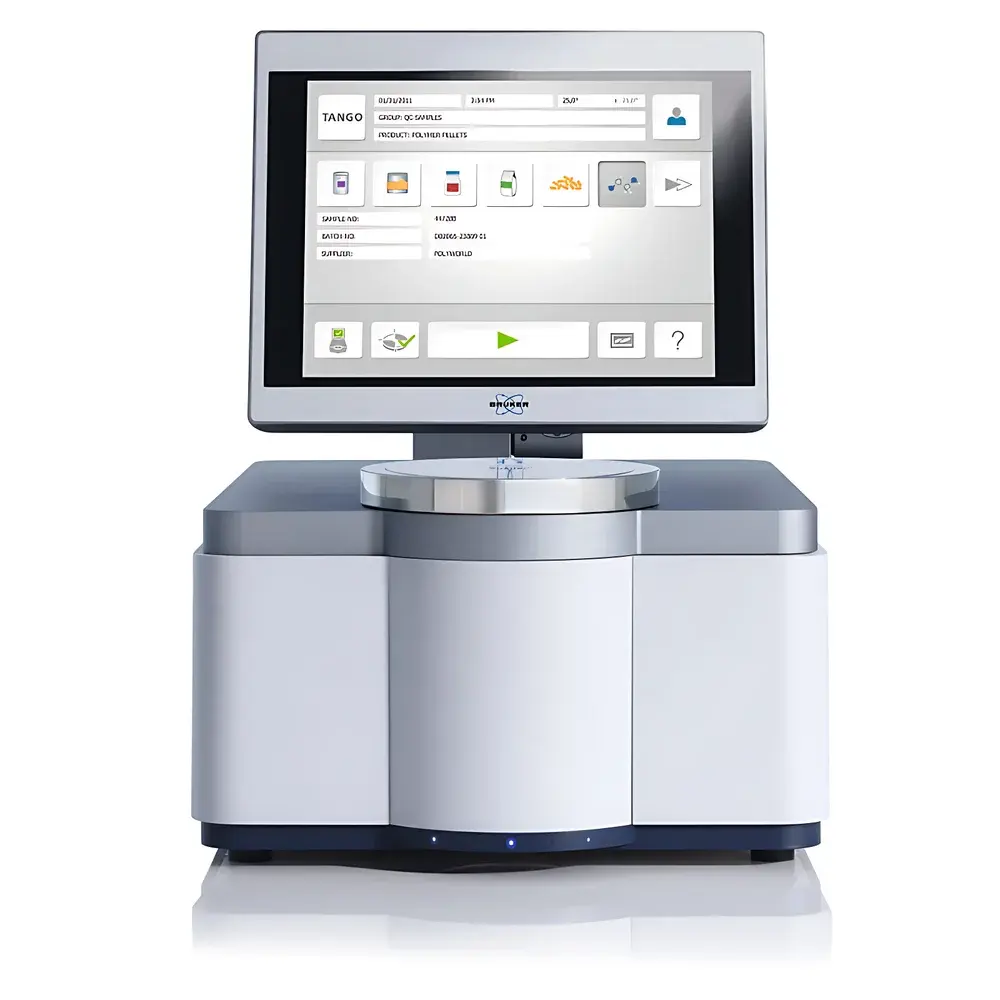
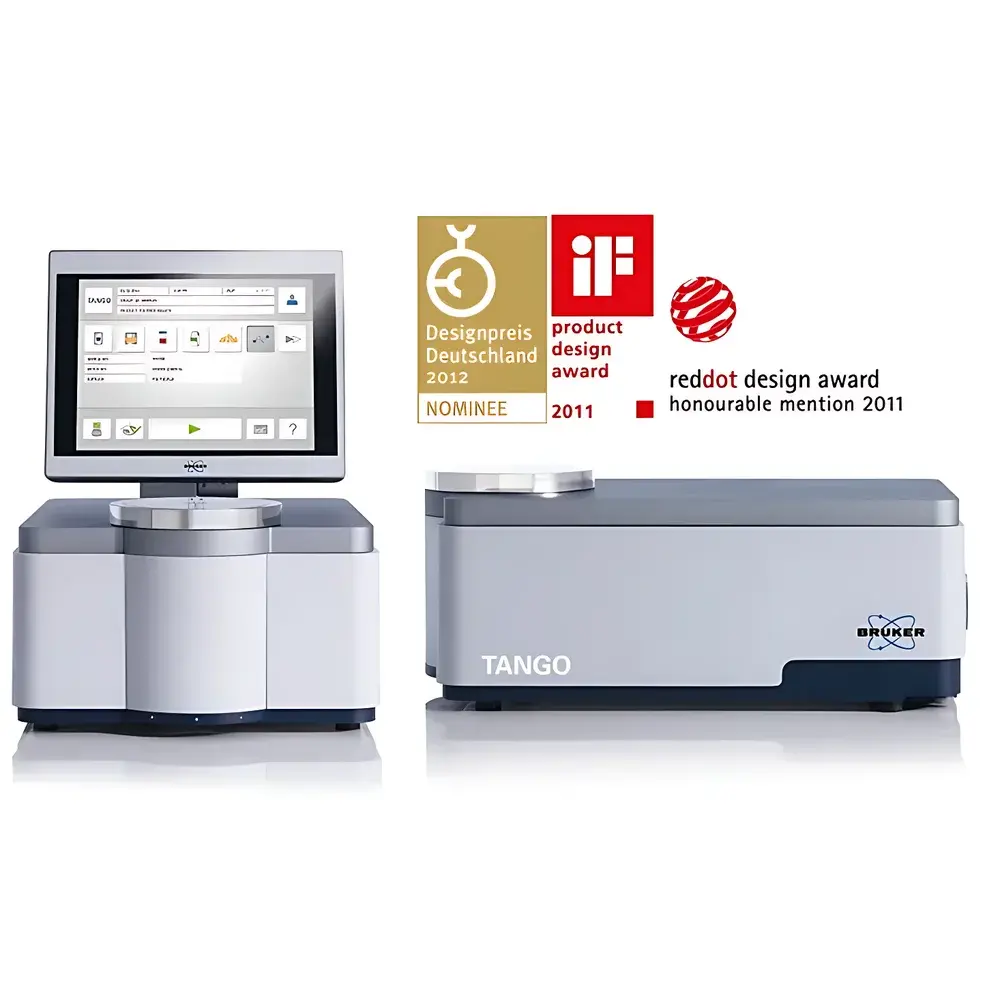
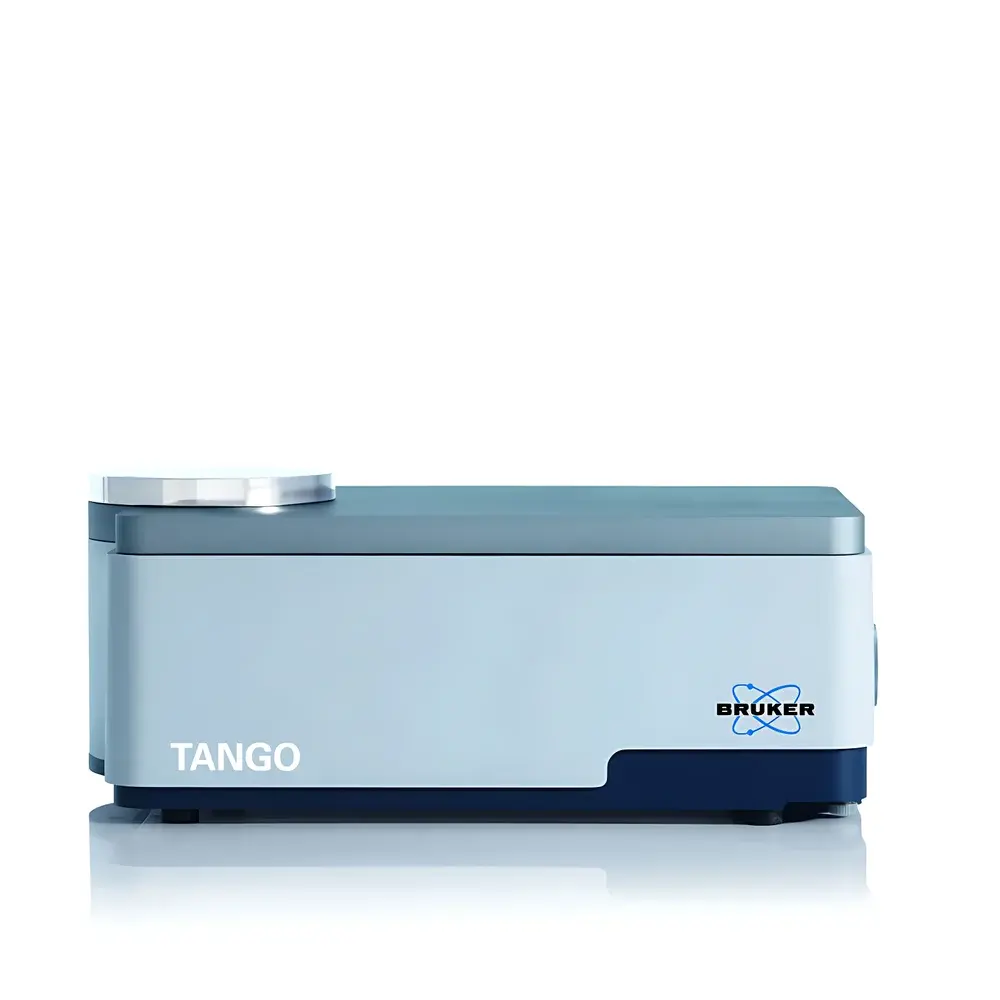
Bruker TANGO Miniaturized Fourier Transform Near-Infrared Spectrometer
| Brand | Bruker |
|---|---|
| Origin | Germany |
| Manufacturer Type | Authorized Distributor |
| Origin Category | Imported |
| Model | TANGO |
| Instrument Type | Laboratory |
| Principle | Fourier Transform (FT) |
| Wavelength Range | 11,500–4,000 cm⁻¹ |
| Scan Speed | 8 scans/sec |
| Data Sampling Interval | 4 cm⁻¹ |
| Measurement Modes | Diffuse Reflectance / Transmission |
| Chemometrics Software | OPUS |
Overview
The Bruker TANGO is the world’s first miniaturized Fourier Transform Near-Infrared (FT-NIR) spectrometer engineered for uncompromised analytical performance in a compact, robust footprint. Leveraging Bruker’s three-decade heritage in FT spectroscopy and proprietary RockSolid™ interferometer technology, the TANGO delivers laboratory-grade spectral fidelity without requiring optical realignment, environmental stabilization, or expert operator intervention. Its core measurement principle relies on Michelson-type interferometry with a three-dimensional corner-cube mirror assembly, ensuring permanent optical alignment, exceptional vibration resistance, and long-term signal stability—critical for quantitative analysis in regulated environments. Designed explicitly for routine quality control and process support, the TANGO operates across the standard NIR region (11,500–4,000 cm⁻¹) with a fixed resolution of 4 cm⁻¹ and rapid acquisition (8 scans per second), enabling high-throughput screening of raw materials, intermediates, and finished products in feed, pharmaceutical, food, and chemical manufacturing.
Key Features
- RockSolid™ Interferometer: Patented monolithic corner-cube design eliminates dynamic alignment drift; guarantees spectral reproducibility over time and across instruments.
- DigiTect™ Digital Detector: Fully integrated detector module featuring 24-bit analog-to-digital conversion, embedded signal amplification, and digital output—minimizing electronic noise and enabling seamless model transfer between Bruker FT-NIR systems.
- Gold-Coated Optics: All reflective surfaces are vacuum-deposited with high-purity gold, delivering >98% reflectivity across the NIR range and superior oxidation resistance compared to aluminum-coated optics—ensuring consistent throughput and extended service life.
- Integrated IVU Calibration Unit & PerformanceGuard™ Diagnostics: Automated internal verification using certified reference materials and filter wheels; real-time health monitoring of laser, source, detector, and interferometer components via OPUS software.
- Modular Sample Interfaces: TANGO-R configuration includes a gold-integrated sphere for diffuse reflectance (10 mm spot size, motorized sample rotation); TANGO-T integrates a thermostatted transmission cell holder (20–80 °C, ±0.2 °C control) with integrated temperature sensing at the sample vial.
- Field-Serviceable Consumables: Pre-aligned, long-life laser and broadband source modules—replaceable without tools or optical recalibration.
Sample Compatibility & Compliance
The TANGO supports heterogeneous sample matrices without pretreatment: solids (e.g., granulated feed, powders, tablets) via diffuse reflectance; liquids (e.g., oils, solvents, aqueous solutions) via temperature-controlled transmission. Its compact dimensions (W × D × H: 32 × 37 × 24 cm) allow deployment inside fume hoods, gloveboxes, or on mobile carts—enabling direct-at-point-of-use analysis. The system complies with international regulatory frameworks including ISO/IEC 17025, USP , Ph. Eur. 2.2.40, and ASTM E1655 for NIR method validation. Built-in OVP (OPUS Verification Program) automates instrument qualification per FDA, USP, and Ph. Eur. requirements, generating auditable reports for IQ/OQ/PQ documentation.
Software & Data Management
OPUS software serves as the unified platform for instrument control, spectral acquisition, chemometric modeling (PLS, PCA, SVM), and data governance. It features role-based user management, immutable audit trails, electronic signatures compliant with 21 CFR Part 11, and secure non-editable data archiving—all aligned with GLP/GMP workflows. Customizable validation protocols support site-specific SOPs; preconfigured packages are available for feed nutrient analysis (crude protein, moisture, fiber), pharmaceutical assay, and excipient identification. Models developed on any Bruker FT-NIR platform are directly portable to the TANGO without mathematical reprocessing—enabling cross-site method harmonization.
Applications
Primary use cases include rapid quantification of moisture, protein, starch, fat, and fiber in animal feed formulations; real-time monitoring of blend uniformity in solid dosage form manufacturing; identity testing of incoming raw materials; and stability-indicating assays in liquid formulations. Its portability and ruggedness make it suitable for warehouse QA checkpoints, pilot plant trials, and field-based supplier audits—reducing reliance on centralized wet chemistry labs and accelerating decision cycles.
FAQ
Is the TANGO compliant with 21 CFR Part 11?
Yes—OPUS software includes full electronic signature capability, audit trail logging, and user access controls meeting FDA requirements for electronic records.
Can calibration models built on other Bruker FT-NIR instruments be deployed on the TANGO without modification?
Yes—DigiTect™ architecture and RockSolid™ interferometer stability ensure direct model transfer across Bruker FT-NIR platforms.
What temperature control accuracy does the TANGO-T transmission module provide?
±0.2 °C over the 20–80 °C range, with direct thermistor feedback from the sample vial position.
Does the TANGO require external cooling or compressed air?
No—it operates passively with ambient air convection; no auxiliary utilities are needed.
How is instrument performance verified between scheduled maintenance?
Via automated OVP routines using internal NIST-traceable standards and filter wheels—executed on-demand or scheduled through OPUS.
Related Products




