
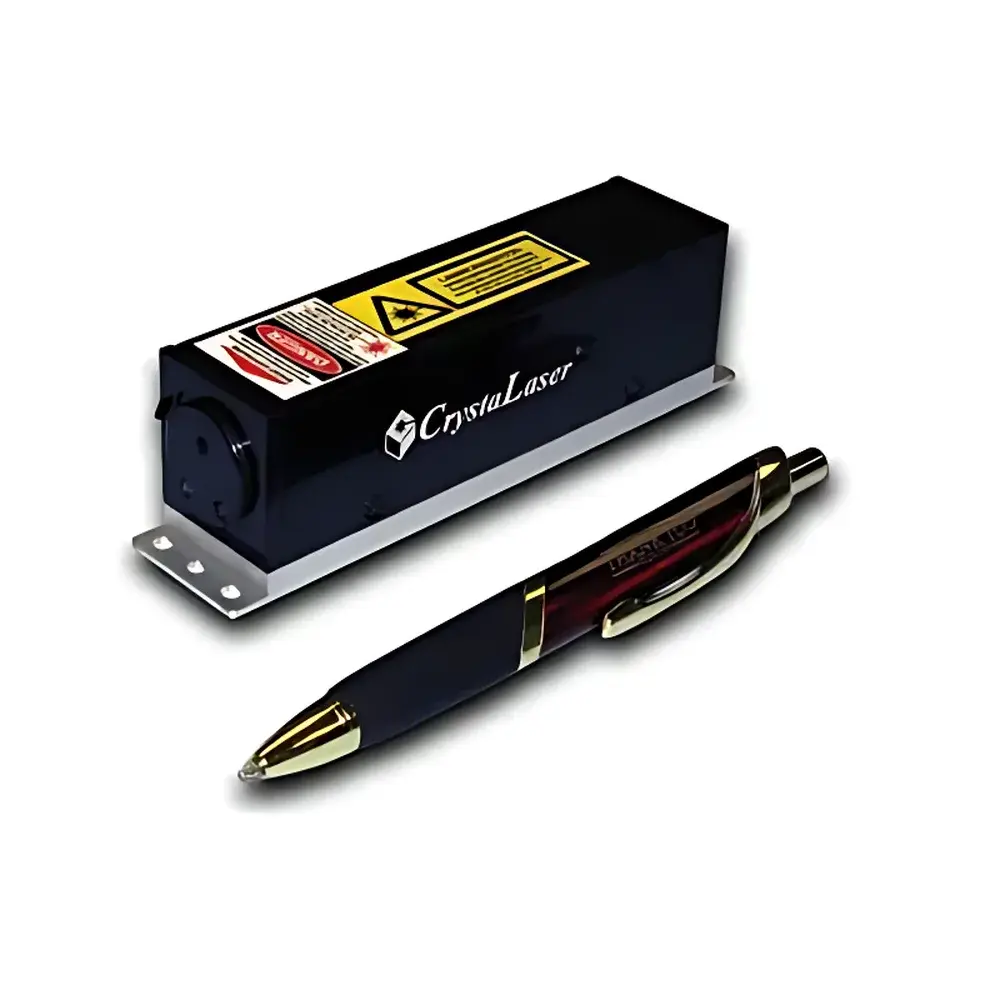
CrystaLaser CL946–CL1342 Continuous-Wave Diode-Pumped Solid-State Infrared Laser Series
| Brand | CrystaLaser |
|---|---|
| Origin | USA |
| Manufacturer Type | Authorized Distributor |
| Product Origin | Imported |
| Models | CL946, CL1030, CL1047, CL1053, CL1064, CL1080, CL1122, CL1313, CL1319, CL1342 |
| Output Power Options | 25 mW – 4 W (model- and wavelength-dependent) |
| Beam Diameter (1/e²) | 0.3–0.5 mm |
| Beam Divergence (full angle) | 3–5 mrad |
| Transverse Mode | TEM₀₀, M² < 1.1 |
| RMS Intensity Noise | < 0.5% (10 Hz – 20 MHz) |
| Linewidth | < 1×10⁻⁵ nm (SLM version) |
| Coherence Length | > 300 m (SLM version) |
| Power Stability (rms) | < 2% over 8 h |
| optional ultra-stable | ≤ 0.5% or ≤ 0.25% over 24 h |
| Beam Pointing Stability | < 0.02 mrad (temperature-stabilized environment) |
| Polarization | Linear, extinction ratio ≥ 100:1 (≥ 300:1 optional) |
Overview
The CrystaLaser CL946–CL1342 series comprises continuous-wave (CW), diode-pumped solid-state (DPSS) infrared lasers engineered for high-reliability scientific, industrial, and metrological applications requiring stable, narrow-linewidth, diffraction-limited output in the 946 nm to 1342 nm spectral range. Unlike gas-based or fiber-coupled IR sources, these lasers employ Nd-doped vanadate (Nd:YVO₄) or yttrium orthovanadate (Nd:YAG) gain media with intracavity frequency-doubling suppression, enabling direct fundamental emission without nonlinear conversion artifacts. Each model is thermally optimized for passive or active temperature control, ensuring minimal mode-hopping and long-term amplitude stability—critical for interferometry, spectroscopic pump-probe setups, cavity ring-down absorption, and optical trapping where phase coherence and beam quality directly impact measurement fidelity.
Key Features
- Multi-wavelength platform covering ten discrete IR lines—from 946 nm (Nd:YAG fourth harmonic fundamental) to 1342 nm (Nd:YVO₄ ⁴F3/2 → ⁴I13/2 transition)—with consistent TEM₀₀ spatial profile and M² < 1.1 across all power levels.
- Two performance tiers: Standard (LM) versions optimized for low-amplitude noise (< 0.5% rms, 10 Hz–20 MHz) and Single-Longitudinal-Mode (SLM) variants delivering sub-10⁻⁵ nm linewidth and coherence lengths exceeding 300 meters—enabling kilometer-scale heterodyne detection and precision Doppler velocimetry.
- Thermally robust monolithic cavity architecture with integrated TEC stabilization and low-drift mechanical mounts, achieving beam pointing stability of < 0.02 mrad under constant ambient conditions—essential for alignment-sensitive optical assemblies such as Michelson interferometers or LIGO-style gravitational wave sensor prototypes.
- Linear polarization maintained at ≥ 100:1 extinction ratio (upgradeable to ≥ 300:1), supporting polarization-resolved ellipsometry, magneto-optic Kerr effect (MOKE) measurements, and quantum optics experiments requiring well-defined spin-photon coupling axes.
- Compliant with IEC 60825-1:2014 Class 3B/4 laser safety requirements; includes interlock-ready TTL-compatible enable/disable port, analog power modulation input (0–5 V), and RS-232 serial interface for remote configuration and real-time monitoring of diode current, crystal temperature, and output power feedback.
Sample Compatibility & Compliance
This laser series interfaces natively with standard optomechanical breadboards (e.g., Thorlabs, Newport), OEM integration modules (including fiber-pigtailed collimators and free-space isolators), and vacuum-compatible optical tables. All units undergo factory calibration traceable to NIST-certified photodiode standards and are supplied with full test reports including power-vs-current curves, beam profile scans (ISO 11146-compliant), and spectral characterization (via high-resolution scanning Fabry–Pérot interferometry). The design supports operation in ISO Class 5 cleanroom environments and meets electromagnetic compatibility requirements per FCC Part 15 Subpart B and CE Directive 2014/30/EU. For regulated laboratories, firmware logs support audit trails compliant with FDA 21 CFR Part 11 when paired with validated data acquisition software.
Software & Data Management
CrystaLaser provides the CL-LaserControl GUI (Windows/Linux/macOS) for comprehensive device management—including setpoint ramping, thermal lock acquisition, noise spectrum analysis (FFT-based), and automated power stabilization routines. Raw telemetry (diode current, TEC voltage, photodiode feedback) is exportable in CSV and HDF5 formats. API libraries (C/C++, Python, LabVIEW) enable seamless integration into custom automation frameworks—particularly valuable for high-throughput semiconductor wafer inspection systems or adaptive optics wavefront correction loops. Optional firmware upgrades introduce GLP/GMP-aligned features: electronic signature authentication, user role-based access control, and immutable session logs with UTC timestamps.
Applications
- High-resolution absorption spectroscopy targeting rovibrational transitions of greenhouse gases (e.g., CO₂ at 1342 nm, CH₄ near 1313 nm) and isotopic tracers (¹³CO₂ at 1319 nm).
- Pump source for optical parametric oscillators (OPOs) and difference-frequency generation (DFG) stages extending coverage into mid-IR (3–12 µm) for standoff chemical detection.
- Stabilized reference beams in dual-comb interferometry, atomic clock interrogation (Rb/Dy optical lattices), and gravitational wave detector prototype alignment systems.
- Material processing of polymers and thin-film coatings where 1-µm–1.3-µm photons offer superior absorption vs. 10.6-µm CO₂ lasers—enabling low-heat-input micromachining of PET, PI, and ITO layers.
- Quantum memory protocols using rare-earth-doped crystals (e.g., Pr:YSO at 606 nm via 1047 nm pumping), where long coherence length ensures efficient photon-echo storage fidelity.
FAQ
What distinguishes the SLM version from the low-noise (LM) version?
The SLM variant incorporates intra-cavity etalons and extended cavity length control to enforce single-frequency operation with linewidth 300 m. The LM version prioritizes amplitude stability and low broadband intensity noise (< 0.5% rms) but operates on multiple longitudinal modes (typical linewidth ~0.3 nm).
Can these lasers be fiber-coupled?
Yes—CrystaLaser offers factory-installed single-mode PM fiber pigtails (SMF-28 or polarization-maintaining Panda fiber) with FC/APC connectors and guaranteed coupling efficiency ≥ 65% (higher with custom AR coatings). Collimated free-space output remains standard.
Is external temperature control required?
No—each unit integrates a precision thermoelectric cooler (TEC) and PID-controlled thermal management system. Ambient operation is supported from 15 °C to 30 °C; for sub-milliradian pointing stability, enclosure within a temperature-stabilized optical bench is recommended.
Do you provide wavelength calibration certificates?
Yes—every unit ships with a NIST-traceable wavelength calibration report generated using a High-Finesse WS6-200 wavemeter (accuracy ±0.2 pm), along with beam quality (M²) and divergence validation per ISO 11146-1.
What is the typical warm-up time to achieve rated power stability?
Full thermal equilibrium and < 2% rms power stability are achieved within 15 minutes of cold start; ultra-stable configurations (< 0.25% over 24 h) require 45–60 minutes for optimal TEC settling and cavity mode locking.



