
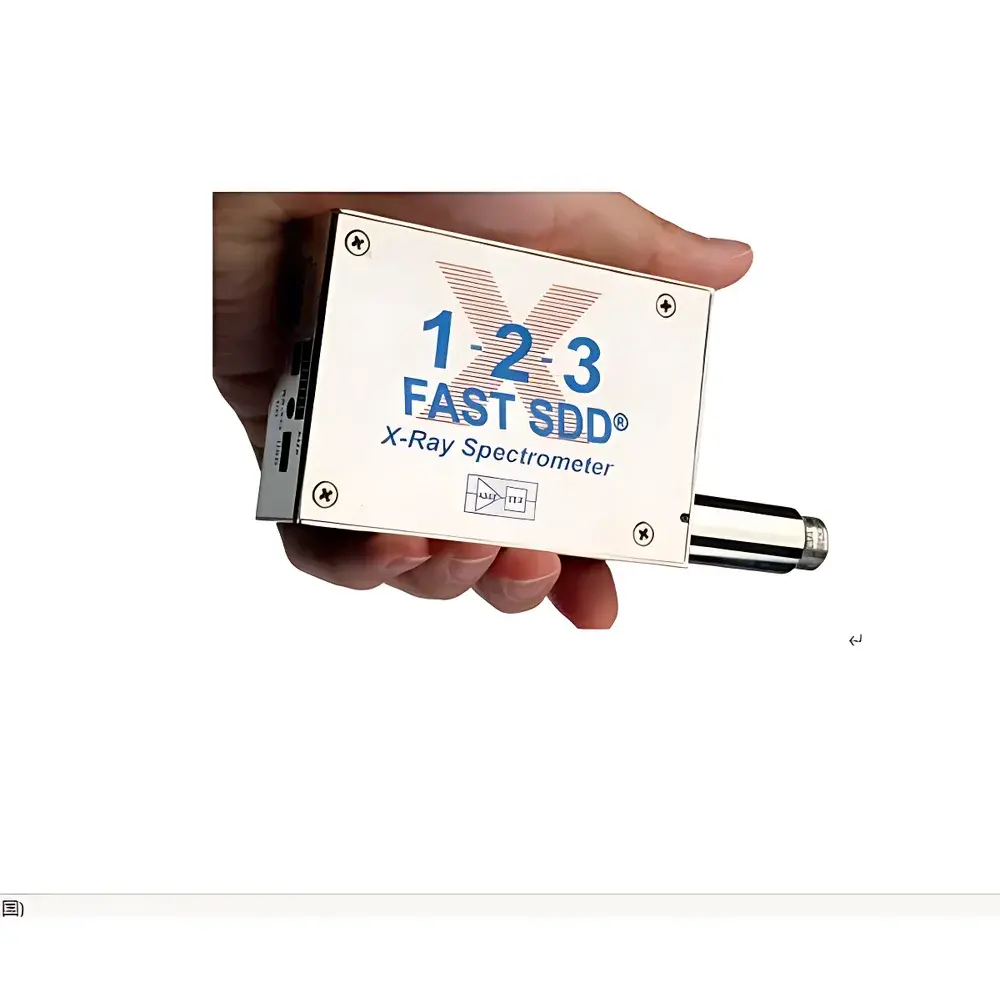
Amptek XR-100FastSDD-70 Silicon Drift Detector (SDD)
| Brand | Amptek |
|---|---|
| Origin | USA |
| Model | XR-100FastSDD-70 |
| Active Area | 70 mm² (effective to 50 mm²) |
| Energy Resolution | 123 eV FWHM @ 5.9 keV |
| Max Count Rate | >2,000,000 cps |
| Peak-to-Background Ratio | >26,000:1 |
| Window Options | Be (12.5 µm) or Si₃N₄ (C₂) |
| Detector Thickness | 500 µm |
| Cooling ΔT | >85 K |
| Preamplifier Rise Time | <60 ns |
| Package | TO-8 |
| Certifications | UL 61010-1:2009, CAN/CSA C22.2 No. 61010-1, TUV CU 72101153 01 |
Overview
The Amptek XR-100FastSDD-70 is a high-performance silicon drift detector (SDD) engineered for demanding X-ray spectroscopy applications requiring both large active area and ultra-high count-rate capability. Based on Amptek’s proprietary fast-signal processing architecture, this detector leverages a 70 mm² geometric silicon surface—optimized to deliver ≥50 mm² effective detection area—with low-noise CMOS preamplification and integrated thermoelectric cooling. Its measurement principle relies on the collection of electron-hole pairs generated by incident X-ray photons in high-purity silicon, with charge centroid determination enabling precise energy discrimination. Designed for integration into compact, high-throughput systems, the XR-100FastSDD-70 delivers up to three times the maximum usable count rate of conventional 25 mm² SDDs while maintaining sub-125 eV energy resolution at the Mn-Kα line (5.9 keV), making it ideal for time-resolved elemental analysis where statistical precision and spectral fidelity are critical.
Key Features
- 70 mm² geometric silicon area with ≥50 mm² effective detection area—enabling higher solid-angle acceptance and improved detection efficiency for low-flux or low-Z element analysis
- Energy resolution of 123 eV FWHM at 5.9 keV (⁵⁵Fe source), verified per ASTM E1399–22 standard test methods for semiconductor X-ray detectors
- Sustained count-rate performance exceeding 2 × 10⁶ counts per second (cps) without significant resolution degradation or pulse pile-up distortion
- Peak-to-background ratio >26,000:1 (measured as ratio of 5.9 keV peak integral to background counts in 1 keV window), supporting trace-level quantification in complex matrices
- Integrated multi-layer collimator and ultra-low-noise charge-sensitive preamplifier (rise time <60 ns; gain stability <20 ppm/°C)
- TO-8 hermetic package with dual window options: 12.5 µm beryllium (Be) for general-purpose use or 100 nm silicon nitride (Si₃N₄) for enhanced soft-X-ray transmission (down to ~100 eV)
- Thermoelectric cooler achieving ΔT >85 K below ambient—ensuring stable operation from –35 °C to +80 °C ambient, with long-term baseline drift <0.5 eV over 24 h under GLP-compliant conditions
Sample Compatibility & Compliance
The XR-100FastSDD-70 supports direct coupling to vacuum-, air-, or He-purged sample chambers without modification. Its radiation-hardened design meets IEC 62596:2012 requirements for sustained operation in environments with cumulative ionizing dose up to 10⁴ rad(Si). The detector complies with electromagnetic compatibility (EMC) directives per EN 61326-1:2013 and safety standards UL 61010-1:2009 (R10.08), CAN/CSA C22.2 No. 61010-1, and carries TÜV certification CU 72101153 01. For regulated laboratories, the detector supports audit-ready data acquisition when paired with Amptek’s X-123 or DP5 digital pulse processors, enabling full 21 CFR Part 11 compliance—including electronic signatures, user access controls, and immutable audit trails—when deployed within validated OEM instrument platforms.
Software & Data Management
Native integration is supported via Amptek’s DPPMCA software suite (v4.5+), which provides real-time spectrum acquisition, automatic peak identification using NIST X-ray database libraries, and quantitative analysis using fundamental parameters (FP) or empirical calibration modes. Raw pulse-height data is streamed via USB 2.0 or Ethernet (with optional PX5 processor) at up to 10 MB/s, preserving full spectral integrity for post-acquisition deconvolution. All firmware and configuration parameters are stored in non-volatile memory with CRC-32 checksum validation. When used with Amptek’s DP5 digital processor, the system enables on-board dead-time correction, pile-up rejection, and real-time background subtraction—critical for online process control applications requiring sub-second response latency and ISO/IEC 17025 traceable uncertainty budgets.
Applications
- Rapid desktop and handheld XRF analyzers for alloy verification, RoHS screening, and mining exploration
- High-speed EDS mapping in scanning electron microscopes (SEM), including live elemental distribution imaging at frame rates up to 30 fps
- In-line elemental monitoring in industrial sorting systems (e.g., scrap metal, plastics, battery recycling) operating under IEC 61508 SIL-2 functional safety constraints
- Portable X-ray fluorescence spectrometers for field-deployed environmental soil and sediment analysis per EPA Method 6200
- OEM integration into synchrotron beamline end-stations, micro-XRF scanners, and space-qualified planetary instruments (radiation tolerance validated per MIL-STD-883H Method 1019.8)
FAQ
What is the recommended bias voltage range for stable operation?
The XR-100FastSDD-70 requires a stabilized high-voltage supply of –100 V to –180 V at ≤25 µA, with voltage stability better than ±0.1% over 8 hours to maintain optimal depletion depth and energy calibration.
Can this detector be operated without active cooling?
No. Continuous thermoelectric cooling is mandatory to achieve specified resolution and count-rate performance. Operation above –10 °C ambient without cooling results in >30% resolution degradation and increased leakage current beyond 1 nA.
Is the Si₃N₄ window compatible with vacuum environments?
Yes—the C₂ (silicon nitride) window is rated for differential pressures up to 1 atm and is routinely used in UHV-compatible XRF and EDS configurations down to 10⁻⁹ Torr base pressure.
Does Amptek provide calibration certificates traceable to NIST?
Yes. Factory calibration includes energy scale verification using ⁵⁵Fe, ¹⁰⁹Cd, and ²⁴¹Am sources, with uncertainty budgets documented per ISO/IEC 17025:2017 Annex A. Certificates include serial-number-matched detector response curves and temperature-dependent gain coefficients.
What is the expected lifetime under continuous operation at 2 × 10⁶ cps?
Based on accelerated life testing per JEDEC JESD22-A108F, median operational lifetime exceeds 7 years at 25 °C ambient and 80% max rated count rate, assuming adherence to specified thermal management and voltage stability limits.




