
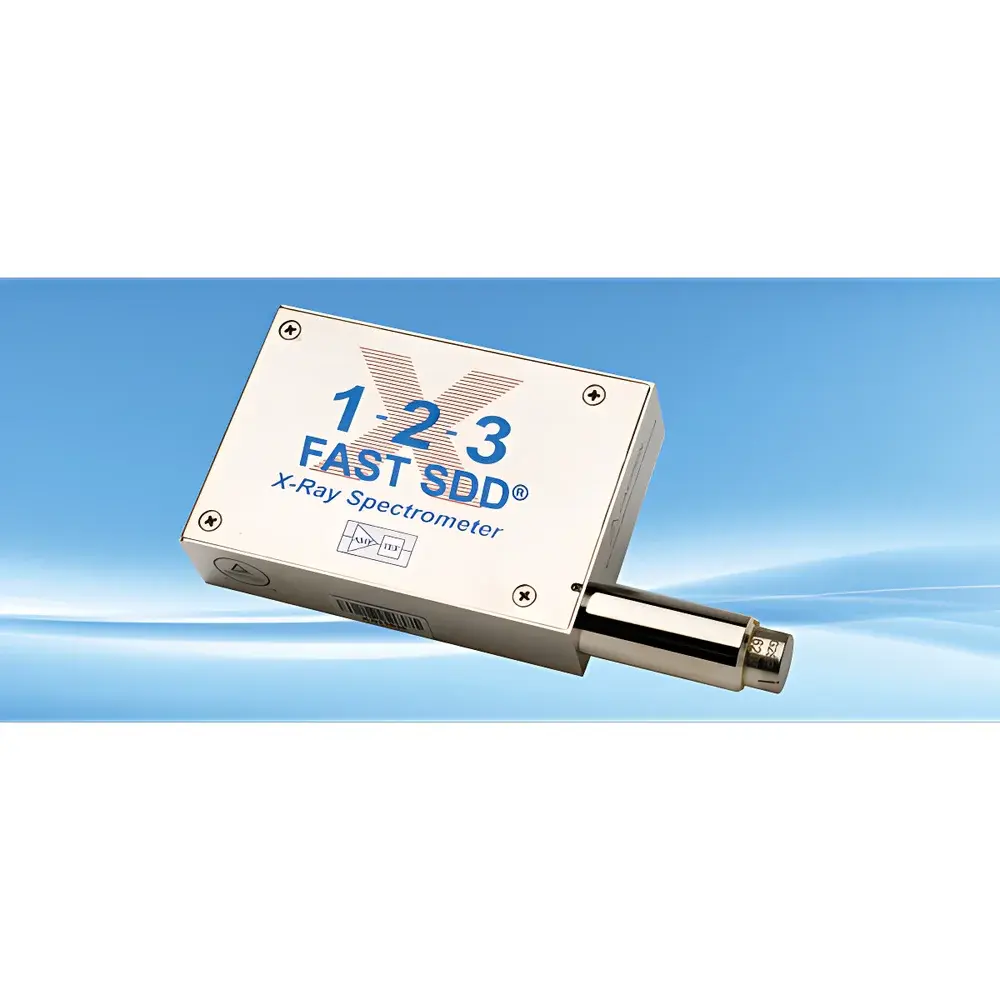
Amptek 1mm FASTSDD Silicon Drift Detector (SDD) for Energy Dispersive X-Ray Fluorescence Spectrometry
| Brand | Amptek |
|---|---|
| Origin | USA |
| Detector Active Area | 25 mm² (standard) or 70 mm² (optional) |
| Thickness | 1 mm |
| Element Range | Na (Z=11) to U (Z=92) |
| Detection Limit | 1 ppm |
| Quantification Range | 1 ppm – 99.99 wt% |
| Energy Resolution | <140 eV at Mn Kα (5.89 keV) |
| Count Rate Capability | High-throughput fast pulse processing |
| Repeatability | ±0.1% RSD (relative standard deviation) |
| Package | TO-8 metal can, pin-compatible with legacy 0.5 mm SDDs |
| Operating Voltage | Standard ±5 V bias |
| Transmission Efficiency | Enhanced above 15 keV vs. thinner detectors |
| Detector Type | Silicon Drift Detector (SDD) |
Overview
The Amptek 1mm FASTSDD is a high-performance silicon drift detector engineered specifically for energy dispersive X-ray fluorescence (EDXRF) spectrometry systems requiring enhanced high-energy photon detection efficiency without compromising spectral resolution or count-rate capability. Unlike conventional 0.5 mm thick SDDs optimized for low-to-mid energy ranges (1–10 keV), the 1mm FASTSDD employs a precisely controlled 1 mm active silicon layer—fabricated using Amptek’s proprietary drift field architecture—to significantly improve quantum efficiency for X-rays above 15 keV, including K-lines of heavy elements such as Ba, Ce, Pb, and U, as well as L- and M-lines of actinides. Its TO-8 hermetic metal package ensures mechanical robustness, thermal stability, and compatibility with standard vacuum or He-purged XRF sample chambers. The detector operates with industry-standard ±5 V bias and interfaces seamlessly with Amptek’s A111 (low-noise charge-sensitive preamplifier) and A225 (shaping amplifier + ADC) signal chain modules, enabling plug-and-play integration into OEM benchtop and floor-standing EDXRF platforms.
Key Features
- 1 mm thick silicon active layer optimized for high-transmission detection of X-rays ≥15 keV while maintaining <140 eV FWHM resolution at Mn Kα (5.89 keV)
- PIN-compatible drop-in replacement for existing 0.5 mm TO-8 SDDs—identical footprint, pinout, bias voltage, and analog output characteristics
- Two standard active area options: 25 mm² (baseline performance) and 70 mm² (higher solid angle and count rate capacity)
- Fast pulse processing architecture supporting sustained input count rates >500 kcps with minimal pile-up distortion
- Integrated thermoelectric cooling (Peltier) maintains stable detector temperature (–15°C typical), critical for long-term energy calibration stability
- Low electronic noise design enables reliable detection of trace elements down to 1 ppm in homogeneous matrixes under optimized excitation conditions
Sample Compatibility & Compliance
The 1mm FASTSDD is deployed in both air-path and vacuum/He-flushed EDXRF configurations, supporting analysis of solids, powders, thin films, and liquids across diverse industrial and regulatory environments. It meets the physical and electrical interface requirements specified in ASTM E1621–22 (Standard Guide for X-Ray Emission Spectrometry) and ISO 22053:2022 (X-ray fluorescence spectrometry — Calibration of wavelength dispersive and energy dispersive instruments). When integrated into validated analytical systems, the detector supports GLP-compliant workflows and satisfies data integrity prerequisites under FDA 21 CFR Part 11 when paired with audit-trail-enabled software platforms. Its stable gain and linearity over time reduce recalibration frequency, contributing to consistent conformance with ISO/IEC 17025 quality management system requirements for testing laboratories.
Software & Data Management
The detector outputs analog pulses compatible with all major EDXRF digital signal processors (DSPs), including Amptek’s DP5, ORTEC’s DSPEC jr.2, and Bruker’s ESPRIT platform. Spectral acquisition, peak deconvolution, matrix correction (e.g., Fundamental Parameters, Empirical Coefficients), and quantitative reporting are performed via vendor-neutral software frameworks that support IUPAC-recommended peak fitting algorithms (e.g., Gaussian-Lorentzian hybrid models) and certified reference material (CRM)-based calibration validation. Raw spectrum files adhere to the standardized .spc and .rtd formats, ensuring interoperability with LIMS and ELN systems. Firmware updates and real-time diagnostics—including leakage current monitoring, temperature logging, and resolution tracking—are accessible through Amptek’s DPPM (Digital Pulse Processor Manager) utility, facilitating preventive maintenance planning.
Applications
- High-precision quantification of heavy metals (Pb, Hg, Cd, Cr(VI)) in RoHS/WEEE-compliant electronics and polymers
- Geological exploration and mining QA/QC: rapid in-situ assay of rare earth elements (REEs), base metals (Cu, Zn, Ni), and precious metals (Au, Pt) in drill core and soil samples
- Catalyst characterization in petrochemical R&D, including Pt/Pd/Rh distribution in automotive three-way catalysts
- Forensic glass and paint chip analysis leveraging high-energy L-line discrimination (e.g., Ba, Sr, Zr)
- Archaeometric provenance studies of ceramics and pigments utilizing U–Th–K natural radioisotope signatures
- Pharmaceutical excipient screening for elemental impurities per ICH Q3D guidelines, especially As, Cd, Pb, and Hg
FAQ
Is the 1mm FASTSDD compatible with my existing EDXRF system designed for a 0.5 mm SDD?
Yes—the TO-8 package, pin assignment, bias voltage requirements, and analog output impedance are identical, enabling direct hardware substitution without mechanical or electrical modification.
Does increased thickness compromise energy resolution at low energies?
No—advanced field shaping and ultra-low-noise front-end electronics preserve <140 eV resolution at Mn Kα while delivering measurable gains in detection efficiency above 15 keV.
What vacuum or purge gas specifications are recommended?
For optimal transmission of light elements (Na–Al), helium flush or high-vacuum (<10⁻² mbar) is advised; for heavy-element analysis only, air-path operation is sufficient.
Can this detector be used in handheld XRF analyzers?
It is not rated for shock/vibration profiles typical of handheld devices; it is intended for laboratory-grade benchtop and floor-standing systems with stable thermal and mechanical environments.
How often does energy calibration drift require correction?
Under stable ambient conditions and continuous Peltier cooling, energy calibration remains within ±0.5 eV over 8-hour acquisitions—typically requiring verification only at start-of-shift or after extended idle periods.





