
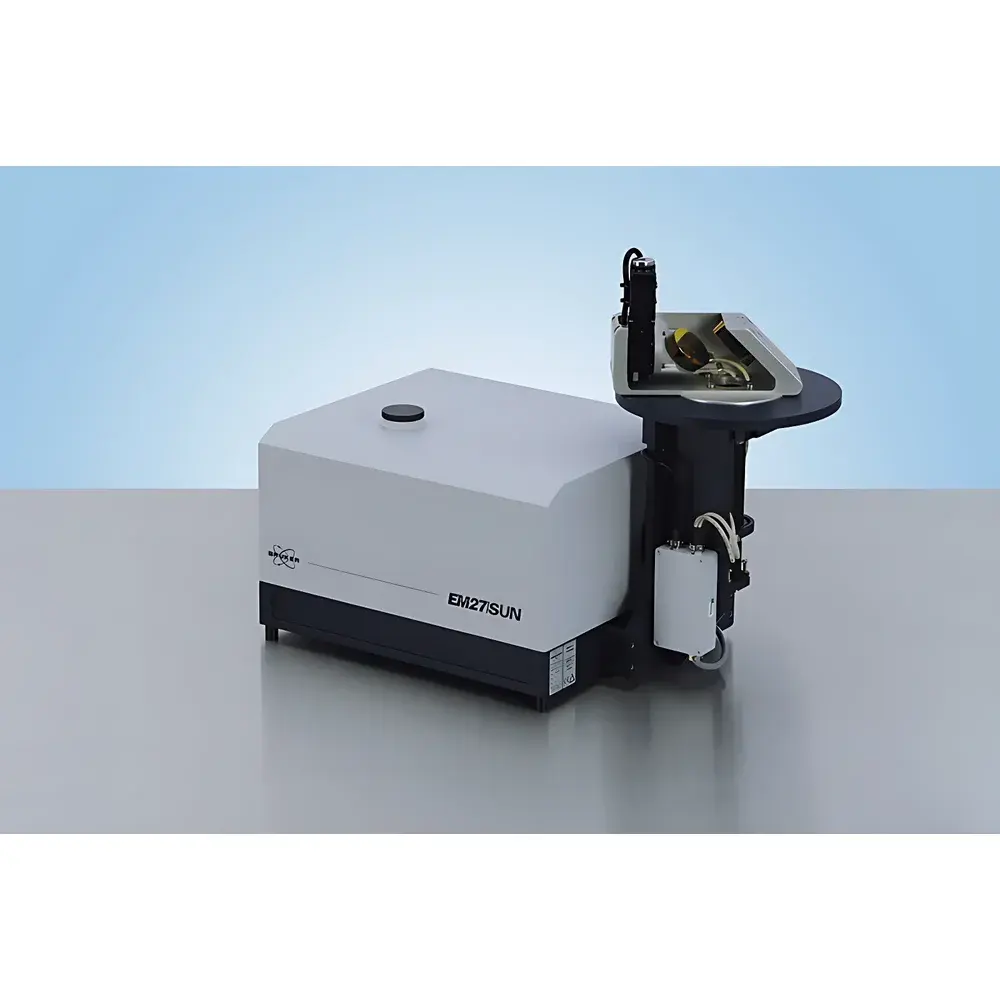
Bruker EM27/SUN Fourier Transform Infrared Solar Absorption Spectrometer
| Brand | Bruker |
|---|---|
| Origin | Germany |
| Model | EM27/SUN |
| Spectral Range (NIR) | 5000–14500 cm⁻¹ |
| Spectral Range (MIR) | 750–5200 cm⁻¹ |
| Spectral Resolution (MIR, optional) | 0.2 cm⁻¹ (standard: 0.5 cm⁻¹) |
| Application | Ground-based solar absorption spectroscopy for atmospheric trace gas monitoring |
| Compliance | Designed for field-deployable, long-term unattended operation in remote environments |
| Software Interface | Integrated CAMTracker solar tracking control with real-time alignment feedback |
Overview
The Bruker EM27/SUN is a field-deployable, high-stability Fourier Transform Infrared (FTIR) spectrometer engineered specifically for ground-based solar absorption spectroscopy. It operates on the principle of measuring high-resolution infrared absorption spectra of direct solar radiation after atmospheric transmission—enabling precise quantification of column-averaged dry-air mole fractions (XCO₂, XCH₄, XCO, XN₂O, and other key greenhouse gases) via retrieval algorithms such as PROFFIT or GFIT. Unlike laboratory FTIR systems, the EM27/SUN integrates a co-aligned optical path with the CAMTracker solar pointing system, ensuring continuous, passive, and self-calibrating alignment to the solar disk without mechanical drift or manual intervention. Its monolithic interferometer design, combined with thermally stabilized optics and robust vibration-damping housing, delivers exceptional long-term spectral stability—critical for multi-year time-series analysis in atmospheric monitoring networks (e.g., TCCON, COCCON, and ICOS).
Key Features
- Integrated CAMTracker solar tracker with real-time image-based closed-loop feedback—ensures sub-arcminute pointing accuracy and automatic reacquisition after cloud cover or diurnal motion.
- Compact, lightweight, and weather-resistant enclosure (IP54-rated), optimized for transport and rapid deployment in infrastructure-limited sites including mountain stations, Arctic tundra, boreal forests, and tropical wetlands.
- Optically pre-aligned interferometer with permanent alignment retention—eliminates need for periodic collimation or internal recalibration during extended unattended operation.
- Dual spectral configuration options: NIR module (5000–14500 cm⁻¹) for strong fundamental bands of H₂O, O₂, and weak overtone/combination bands; MIR module (750–5200 cm⁻¹) for high-sensitivity detection of fundamental vibrational transitions of CO₂, CH₄, N₂O, and CO.
- Optional high-resolution MIR configuration (0.2 cm⁻¹ apodized resolution) supports advanced spectral fitting of overlapping line structures and improved separation of isotopologues (e.g., ¹³CO₂ vs. ¹²CO₂).
- Low-power consumption (<35 W typical), compatible with solar-battery hybrid power systems for year-round autonomous operation.
Sample Compatibility & Compliance
The EM27/SUN does not require physical sample collection or preparation—its measurement medium is natural solar irradiance transmitted through the atmospheric column. It complies with internationally recognized protocols for total column gas retrieval, including TCCON standard operating procedures (SOPs) and ICOS atmospheric station certification requirements. Data generated are traceable to NIST-certified reference spectra and validated against co-located in situ analyzers (e.g., Picarro G2301, Los Gatos RMT-200). The instrument’s hardware and firmware architecture support audit-ready metadata logging (time stamp, solar zenith angle, pressure, temperature, humidity) essential for GLP-compliant data processing pipelines. While not FDA-regulated, its operational consistency meets ISO/IEC 17025 criteria for environmental testing laboratories engaged in climate-relevant atmospheric composition monitoring.
Software & Data Management
Instrument control, solar tracking, and raw interferogram acquisition are managed through Bruker’s proprietary EM27/SUN Control Suite, running on embedded Linux. Real-time diagnostics—including detector signal-to-noise ratio, mirror velocity stability, and solar centroid deviation—are continuously logged. Raw interferograms (in Bruker OPUS format) are automatically timestamped and archived with full ancillary metadata. Export formats include NETCDF-4 (CF-compliant) and ASCII for seamless integration into atmospheric inversion frameworks. Optional add-ons include automated daily calibration validation using internal blackbody references and remote SSH-based monitoring via secure VPN tunnels—supporting centralized network management across distributed observatories. All software modules adhere to reproducible computing standards and support version-controlled configuration files for method transfer between instruments.
Applications
The EM27/SUN serves as a core observational platform in both regional emission attribution studies and global atmospheric monitoring infrastructures. It has been deployed in urban flux experiments (e.g., Berlin, Tokyo, Paris) to quantify anthropogenic CO₂ and CH₄ enhancements relative to background levels. In remote ecosystems—including Siberian permafrost zones, Amazonian peatlands, and Indonesian mangrove forests—it enables detection of localized emission hotspots from thawing soils, biomass burning, and microbial methanogenesis. When deployed in coordinated arrays (≥3 units), differential absorption measurements permit two-dimensional source localization and quantitative flux estimation using inverse modeling techniques (e.g., Bayesian inversion, mass balance approaches). Its portability also supports mobile campaigns aboard research vessels or light aircraft-mounted configurations (with appropriate mounting adapters and thermal stabilization).
FAQ
What gases can the EM27/SUN quantify with validated accuracy?
The system is routinely used to retrieve XCO₂, XCH₄, XCO, and XN₂O with typical precisions of <0.1% for CO₂ and <0.3% for CH₄ under clear-sky conditions, following TCCON-level calibration and retrieval protocols.
Is the EM27/SUN suitable for fully autonomous operation over multiple seasons?
Yes—field deployments exceeding 18 months have been documented in polar and alpine environments, supported by passive thermal management, sealed optical paths, and watchdog-timer firmware recovery.
Can the NIR and MIR modules be interchanged in the field?
No—the NIR and MIR variants are distinct hardware configurations requiring factory alignment; however, both share identical mechanical mounting interfaces and software control architecture.
Does the system meet requirements for inclusion in international monitoring networks?
Yes—EM27/SUN instruments are certified components of COCCON (Collaborative Carbon Column Observing Network) and contribute validated data to the World Data Centre for Greenhouse Gases (WDCGG) under WMO/GAW guidelines.
What maintenance is required during long-term deployment?
None beyond periodic cleaning of the external quartz window (recommended every 3–6 months depending on dust/salt exposure) and annual verification of tracker motor lubrication—no optical realignment or interferometer recalibration is necessary.







