
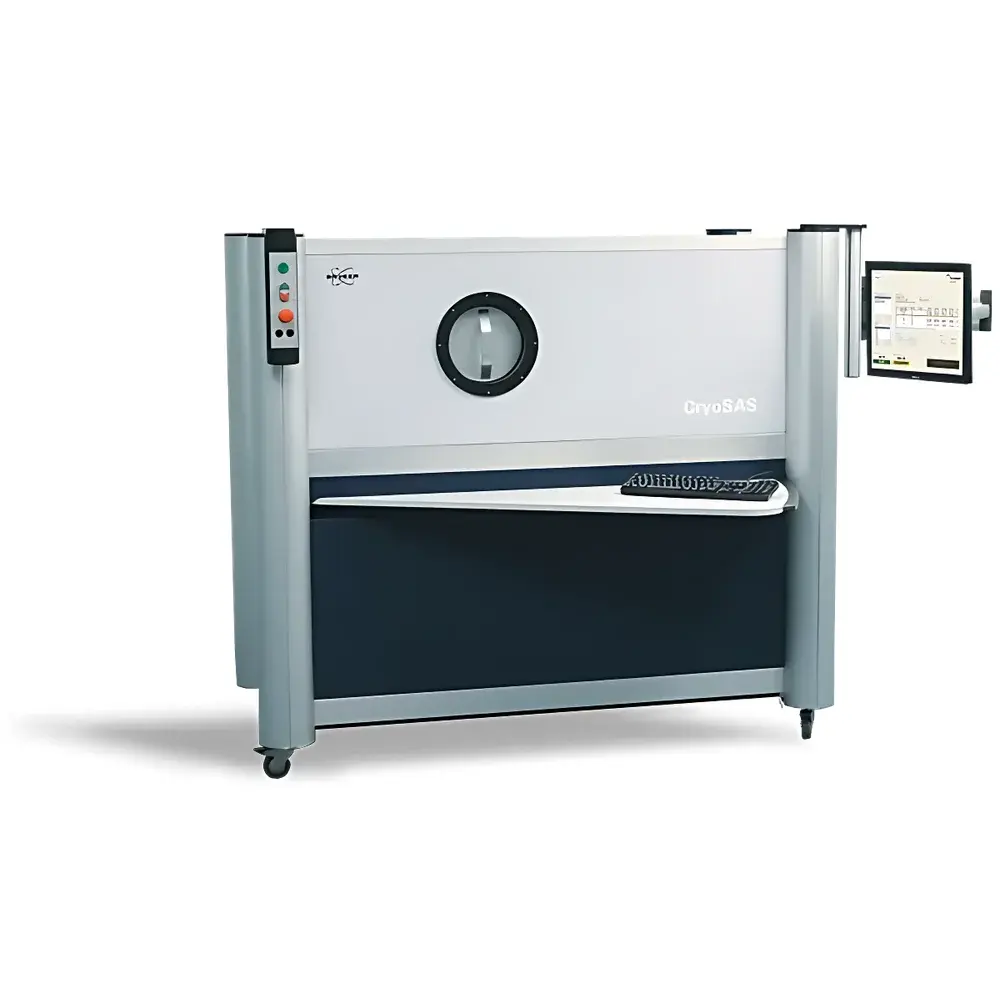
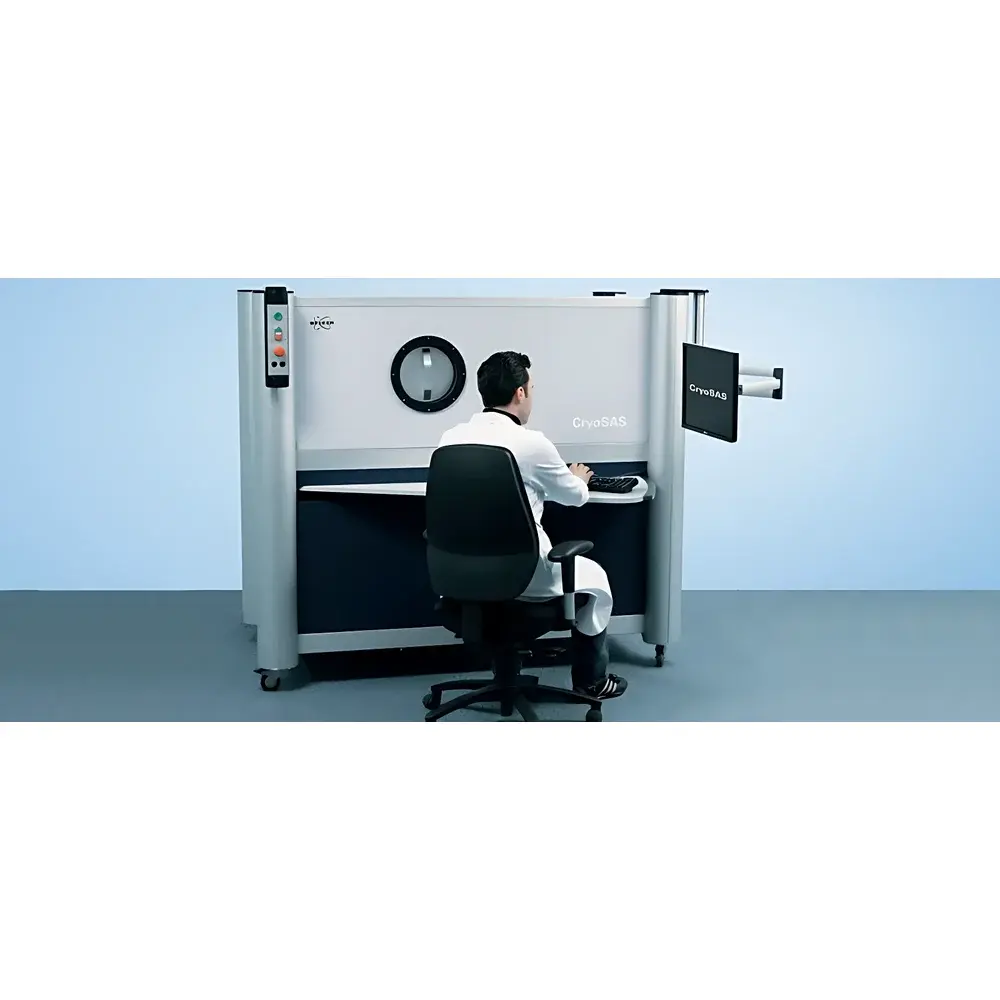
Bruker CryoSAS Cryogenic Silicon Analysis System
| Brand | Bruker |
|---|---|
| Origin | Germany |
| Manufacturer Type | Authorized Distributor |
| Origin Category | Imported |
| Model | CryoSAS |
| Instrument Type | Laboratory FTIR Spectrometer |
| Wavenumber Range | 280–1500 cm⁻¹ |
| Cooling Method | Closed-Cycle Cryocooler (No Liquid Helium Required) |
| Detection Temperature | <15 K |
| Compliance | ASTM/SEMI MF1630 (B, P), ASTM/SEMI MF1391 (C, O) |
| Sensitivity | Boron/Phosphorus down to ppta |
| Vacuum System | Dual-Stage (Mechanical + Turbo Molecular Pump) |
| Sample Capacity | 9-Position Precision Stepper Motor Stage |
| Sample Holder | Gold-Plated OFHC Copper for Thermal Uniformity |
| Software | Dedicated Industrial QC Interface with Touchscreen Control & Automated Reporting |
Overview
The Bruker CryoSAS Cryogenic Silicon Analysis System is a purpose-built, fully integrated Fourier-transform infrared (FTIR) spectrometer engineered for ultra-trace impurity quantification in silicon wafers and ingots under cryogenic conditions (<15 K). Unlike conventional room-temperature FTIR systems, CryoSAS leverages low-temperature spectral sharpening—where lattice vibrations are suppressed and impurity-related vibrational modes become spectrally resolved—to enable detection of substitutional and interstitial dopants (e.g., B, P) and light-element contaminants (C, O) at sub-part-per-trillion atomic (ppta) and part-per-quadrillion atomic (ppba) levels. Designed specifically for polysilicon production lines and semiconductor material qualification labs, the system operates as a turnkey analytical platform combining high-stability interferometry, closed-cycle cryogenics, and industrial-grade vacuum architecture—all compliant with SEMI and ASTM standards for photovoltaic and microelectronics-grade silicon certification.
Key Features
- High-sensitivity cryogenic FTIR detection optimized for silicon lattice phonon-impurity coupling below 15 K
- Closed-cycle helium cryocooler eliminating dependency on liquid helium—reducing annual operational costs by ≥€50,000 versus LHe-based systems
- Stainless-steel sample chamber with large internal volume and precision optical alignment for reproducible beam path stability
- Dual-stage vacuum system: oil-free mechanical roughing pump paired with a turbo molecular pump achieving ≤1×10⁻⁷ mbar base pressure in <30 minutes
- 9-position automated sample stage driven by a high-resolution stepper motor and rigid mechanical transfer platform
- Gold-plated oxygen-free high-conductivity (OFHC) copper sample holder ensuring thermal uniformity across the measurement area (ΔT < ±0.1 K)
- Industrial touchscreen interface with role-based access control and audit-trail-enabled operation logs
Sample Compatibility & Compliance
CryoSAS accepts standard 100–300 mm diameter silicon wafers, sliced ingots, and crystalline fragments without requiring polishing or coating. Its optical design accommodates both transmission and reflection geometries for bulk and near-surface analysis. All measurement protocols adhere to internationally recognized standards: ASTM/SEMI MF1630 for shallow-level dopant (B, P) quantification via localized vibrational mode absorption, and ASTM/SEMI MF1391 for interstitial oxygen and substitutional carbon determination using fundamental stretching bands at ~1107 cm⁻¹ and ~605 cm⁻¹, respectively. The system supports GLP-compliant workflows, including electronic signature capture, instrument calibration traceability (NIST-traceable reference wafers), and 21 CFR Part 11–ready audit trails for regulated environments.
Software & Data Management
The CryoSAS Control Suite is a dedicated industrial QC application built on a real-time Linux kernel, offering deterministic timing for synchronized cooling, vacuum ramping, and spectral acquisition. It features method-driven workflow automation: users select pre-validated SOPs (e.g., “O-Content_MF1391_v4”), enter batch ID and wafer coordinates, and initiate full sequence execution—including cooldown to target temperature, vacuum stabilization, background collection, sample scan, baseline correction, peak integration, concentration calculation, and PDF report generation. Raw interferograms and processed spectra are stored in HDF5 format with embedded metadata (timestamp, operator ID, environmental sensor logs, calibration checksums). Export options include CSV, ASTM E1382-compliant ASCII, and direct integration with MES/SPC platforms via OPC UA.
Applications
- Quantitative verification of boron and phosphorus doping profiles in Czochralski-grown monocrystalline silicon
- Trace oxygen and carbon contamination screening in float-zone refined silicon for power device substrates
- In-line quality gate for polysilicon feedstock prior to crystal pulling—ensuring compliance with IEC 62788-5-1 purity thresholds
- Root-cause analysis of minority carrier lifetime degradation linked to thermal donor formation
- Validation of gettering efficiency in epitaxial layer processes through pre- and post-anneal impurity mapping
- Supporting ISO/IEC 17025-accredited testing laboratories performing silicon material certification
FAQ
Does CryoSAS require liquid nitrogen or liquid helium for operation?
No. It uses a two-stage closed-cycle cryocooler capable of reaching and maintaining <15 K continuously without consumable cryogens.
Can CryoSAS analyze patterned or device-processed wafers?
Yes—its collimated beam geometry and adjustable focus permit measurements on structured surfaces, though quantitative accuracy requires validation against planar reference standards.
Is spectral calibration traceable to national standards?
Yes. Wavenumber calibration is performed using NIST-traceable polystyrene film and certified silicon reference wafers; intensity calibration employs blackbody sources calibrated per ISO 15529.
How is data integrity ensured during long-term deployment in manufacturing?
All user actions, system states, and spectral acquisitions are logged with cryptographic hashing. The software enforces electronic signatures, version-controlled SOPs, and immutable audit trails compliant with FDA 21 CFR Part 11 Annex 11 requirements.
What maintenance intervals are recommended for the vacuum and cooling subsystems?
Mechanical pump oil change every 6 months; turbo pump bearing inspection every 24 months; cryocooler cold head service every 5 years—documented in the preventive maintenance logbook included with each system shipment.
Related Products






