
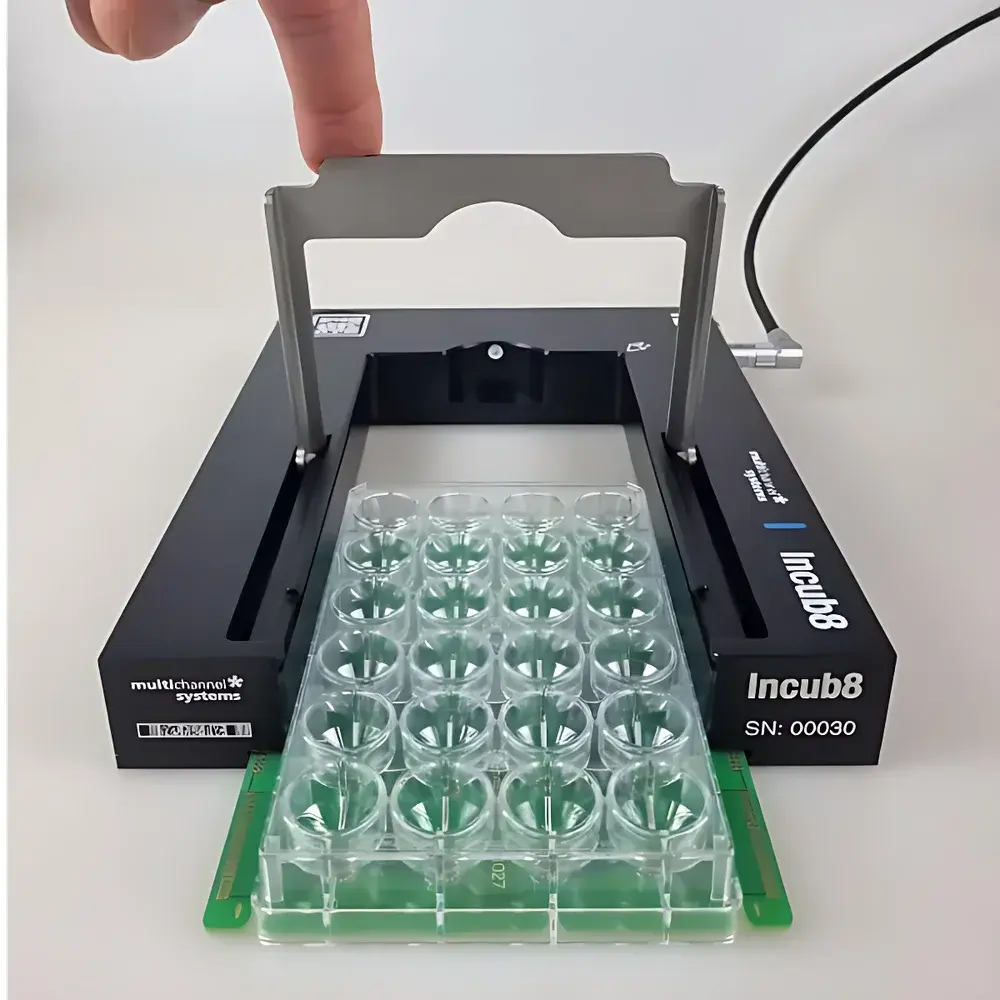
Multi Channel Systems Incub8 High-Throughput Multi-Well Microelectrode Array System
| Brand | Multi Channel Systems |
|---|---|
| Origin | Germany |
| Manufacturer Type | Manufacturer |
| Origin Category | Imported |
| Model | Incub8 |
| Instrument Type | Multi-Well |
| Application | In Vitro |
| Electrode Spacing | 300 µm |
| Electrode Diameter | 30 µm |
| Electrode Count | 288 |
| Throughput Configuration | Supports 24-well and 96-well MEA plates |
| Amplifier Modules | Up to 8 simultaneously connected |
| Total Recording Channels | Up to 768 channels |
Overview
The Multi Channel Systems Incub8 is a purpose-engineered, high-throughput microelectrode array (MEA) platform designed for long-term, label-free, in vitro electrophysiological monitoring under physiologically controlled conditions. Unlike conventional benchtop MEA systems, the Incub8 integrates seamlessly into standard humidified CO₂ incubators—enabling uninterrupted extracellular recording from cultured neural, cardiac, or iPSC-derived tissues over days or weeks. Its core measurement principle relies on extracellular field potential detection via planar titanium-nitride (TiN) microelectrodes embedded in sterile, cell-compatible multi-well substrates. Each electrode captures local voltage fluctuations generated by synchronous network activity, delivering millisecond-scale temporal resolution while preserving native cellular morphology and functional integrity. This architecture supports rigorous experimental reproducibility, particularly for sensitive primary cultures and organoid models where environmental perturbation must be minimized.
Key Features
- Incubator-integrated design: Fully compatible with standard 5% CO₂, 37°C, >95% RH environments—no external perfusion or gas mixing required.
- Modular scalability: Supports both 24-well and 96-well MEA plates; up to eight 96-channel preamplifier modules can be daisy-chained for parallel acquisition across 768 electrodes.
- Automated time-lapse acquisition: Programmable recording schedules allow unattended data collection at user-defined intervals (e.g., hourly baseline sweeps + triggered burst capture), minimizing manual intervention.
- Electrode specifications: 288 TiN electrodes per well (96-well format), 30 µm diameter, 300 µm center-to-center spacing—optimized for single-cell and small-network resolution without compromising signal-to-noise ratio.
- Integrated barcode-based sample tracking: Software automatically logs plate insertion/removal events, associates metadata (passage number, treatment group, operator ID), and enforces audit trails compliant with GLP and FDA 21 CFR Part 11 requirements.
Sample Compatibility & Compliance
The Incub8 system accommodates a broad spectrum of in vitro biological preparations, including dissociated primary neurons, stem cell–derived cardiomyocytes, cortical spheroids, and vascularized organoids. Its low-noise analog front-end (< 2.5 µV RMS input-referred noise, 0.1–5 kHz bandwidth) ensures fidelity across diverse firing patterns—from spontaneous bursting in hippocampal networks to rhythmic calcium-coupled action potentials in human iPSC-cardiomyocytes. All MEA substrates are sterilized, endotoxin-tested, and certified for ISO 10993-5 cytocompatibility. The system complies with IEC 61000-4 electromagnetic immunity standards and meets essential requirements of the EU Medical Device Regulation (MDR 2017/745) for research-use-only instrumentation.
Software & Data Management
Acquisition and analysis are managed through MC_Rack v5.x, a validated, modular software suite supporting real-time visualization, offline spike sorting (using template-matching and PCA-based clustering), network burst detection (based on inter-spike interval thresholds and synchrony indices), and cross-modal alignment with synchronized optical inputs (e.g., calcium imaging timestamps). Raw data is stored in HDF5 format with embedded metadata (sampling rate, gain, filter settings, environmental logs), enabling FAIR (Findable, Accessible, Interoperable, Reusable) data practices. Audit trails record all parameter modifications, user logins, and export actions—critical for regulatory submissions in safety pharmacology studies aligned with ICH S7B and S7B Annex guidelines.
Applications
- Cardiac electrophysiology: Assessment of field potential duration (FPD), beat-to-beat variability, and arrhythmic event incidence in response to hERG-blocking compounds.
- Neurotoxicity screening: Detection of synaptic dysfunction, network desynchronization, and excitatory/inhibitory imbalance following chronic exposure to environmental toxins or therapeutic candidates.
- Chronobiology: Circadian modulation of neuronal firing rates and network synchrony over multi-day recordings without media exchange or handling artifacts.
- Optogenetic-electrophysiological correlation: Precise temporal alignment of light-evoked responses (e.g., ChR2 activation) with downstream network propagation kinetics.
- Organoid maturation profiling: Longitudinal tracking of functional network emergence and stability during differentiation timelines—supporting translational validation of disease models.
FAQ
Can the Incub8 be used outside of a CO₂ incubator?
Yes—while optimized for incubator operation, the system includes ambient-mode firmware and thermal compensation algorithms enabling short-term recordings in non-humidified environments, though long-term viability of sensitive cultures is not guaranteed.
Is optical stimulation hardware integrated?
No—the Incub8 does not include built-in light sources, but its synchronization port (TTL/USB) supports precise timing coordination with third-party LED/laser systems for optogenetics or photostimulation protocols.
What data formats are supported for export?
Raw time-series data exports to HDF5, MATLAB (.mat), and CSV; processed metrics (burst frequency, synchrony index, FPD) are exportable as Excel (.xlsx) or JSON for LIMS integration.
Does the system support real-time closed-loop stimulation?
Yes—via optional MC_Stimulus module, users can define conditional triggers (e.g., “if burst rate exceeds X Hz, deliver 5-ms biphasic pulse”) with sub-millisecond latency.
How is calibration performed?
Factory-calibrated electrode impedance and amplifier gain are verified annually using NIST-traceable reference signals; end-users perform daily baseline checks via on-board test signal injection and noise-floor verification.





