
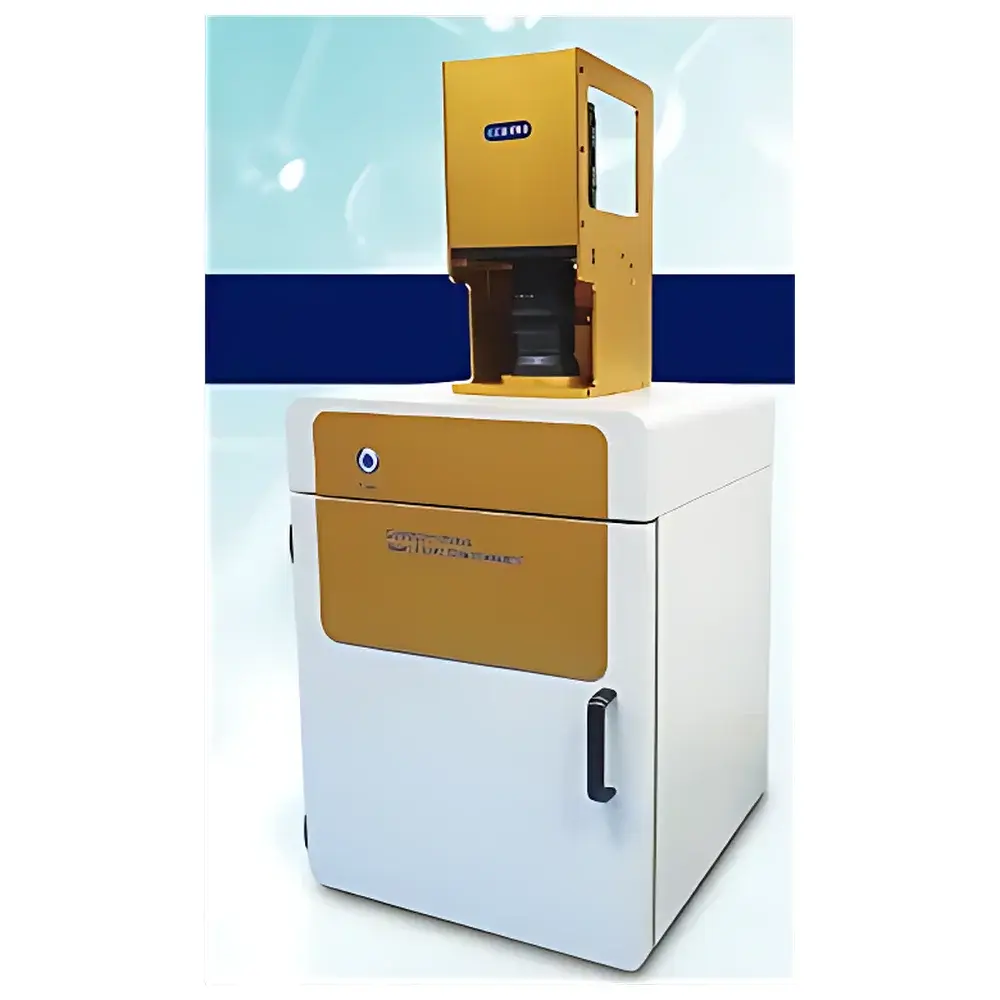
DavinchQ UINV-420 Ultra-Photon Small Animal In Vivo Imaging System
| Brand | DavinchQ |
|---|---|
| Origin | South Korea |
| Manufacturer Type | Authorized Distributor |
| Import Status | Imported Instrument |
| Model | UINV-420 |
| Price | USD 1,850,000 (FOB Seoul) |
Overview
The DavinchQ UINV-420 Ultra-Photon Small Animal In Vivo Imaging System is a high-sensitivity optical imaging platform engineered for quantitative bioluminescence and fluorescence detection in live rodents. Based on cooled back-illuminated scientific CMOS sensor architecture with thermoelectric cooling to −90 °C, the system achieves single-photon-level detection sensitivity essential for low-light molecular imaging. It operates on the principle of photon capture from biological light emission (bioluminescence) or exogenous probe excitation (fluorescence), enabling non-invasive, longitudinal monitoring of biological processes at the whole-animal level. Designed specifically for preclinical research laboratories, the UINV-420 supports dual-modality acquisition—simultaneous or sequential bioluminescent and fluorescent imaging—with spatial registration accuracy ≤50 µm across modalities. Its optical path incorporates a motorized, high-transmission filter wheel (up to 8 positions) and precision excitation/emission optics optimized for spectral separation of multiple fluorophores.
Key Features
- Cooled scientific CMOS detector with quantum efficiency >95% at 600–800 nm and dark current <0.001 e⁻/pixel/sec at −90 °C
- Automated dual-mode imaging workflow: bioluminescence (BLI) and fluorescence (FLI) with synchronized exposure control and auto-focus calibration
- Integrated narrow-band emission filters (FWHM ≤15 nm) covering 480–850 nm, including custom options for NIR-II probes (e.g., 1000–1350 nm)
- Quantitative radiance calibration traceable to NIST-certified standards; supports absolute photon flux reporting in photons/sec/cm²/sr
- High-throughput animal chamber accommodating 1–10 mice (up to 30 g each) with individual LED-based excitation zones and real-time temperature/humidity monitoring
- Modular optical design compliant with ISO 13485 manufacturing controls; CE-marked and FDA-listed as Class II medical research device
Sample Compatibility & Compliance
The UINV-420 accommodates standard mouse/rat imaging protocols using commercially available luciferin substrates (D-luciferin, coelenterazine), near-infrared dyes (e.g., IRDye 800CW, Cy7), and quantum dot or polymer-based nanoparticles. It supports anesthesia integration via isoflurane-compatible nose-cone ports and optional gas scavenging. All imaging workflows adhere to ARRIVE 2.0 guidelines and are compatible with GLP-compliant study documentation. The system meets ISO/IEC 17025 requirements for measurement uncertainty estimation in quantitative optical imaging, and its software audit trail functionality satisfies FDA 21 CFR Part 11 electronic record integrity criteria.
Software & Data Management
Acquisition and analysis are managed through DavinchQ ImageStudio Pro v5.2—a validated, password-protected application supporting multi-user role permissions (Administrator, Operator, Reviewer). The software includes automated background subtraction, spectral unmixing algorithms for ≥4-channel fluorescence separation, ROI-based kinetic curve generation, and batch processing for longitudinal studies. Export formats include DICOM-SR, TIFF (16-bit), CSV, and HDF5. Raw image metadata embeds instrument configuration, calibration timestamps, and environmental logs. Data backups integrate with institutional LIMS via secure SFTP or RESTful API endpoints.
Applications
The UINV-420 serves as a core platform in academic and pharmaceutical preclinical research for: tumor xenograft growth and metastasis tracking; stem cell homing and engraftment quantification; pathogen load assessment in infection models (e.g., Salmonella, MRSA); neuroinflammatory response mapping using TSPO-targeted tracers; evaluation of gene therapy vector biodistribution; pharmacokinetic/pharmacodynamic modeling of antibody-drug conjugates; and metabolic flux analysis via FRET-based biosensors. Its quantitative output is routinely cited in publications indexed in journals requiring MIARE-compliant imaging reporting standards.
FAQ
What is the minimum detectable photon flux for bioluminescence imaging?
The system achieves a theoretical limit of detection of 10² photons/sec/cm²/sr under optimal conditions (10-min exposure, −90 °C sensor, 1 f/# lens).
Can the UINV-420 perform tomographic reconstruction (FMT)?
No—it is a planar 2D imaging system. For 3D fluorescence molecular tomography, DavinchQ recommends integration with the companion UINV-Tomo module (sold separately).
Is remote operation supported for BSL-2/3 facilities?
Yes—fully functional web-based remote client allows acquisition control, real-time preview, and basic analysis from outside the imaging suite.
Does the system support IACUC-approved anesthesia delivery?
Yes—the integrated isoflurane port complies with USP and ISO 8573-7 for medical-grade gas delivery; full documentation package provided for protocol submission.
How often does the system require recalibration?
Radiance calibration is performed automatically before each imaging session; annual factory recalibration is recommended and traceable to NIST SRM 2242.





