
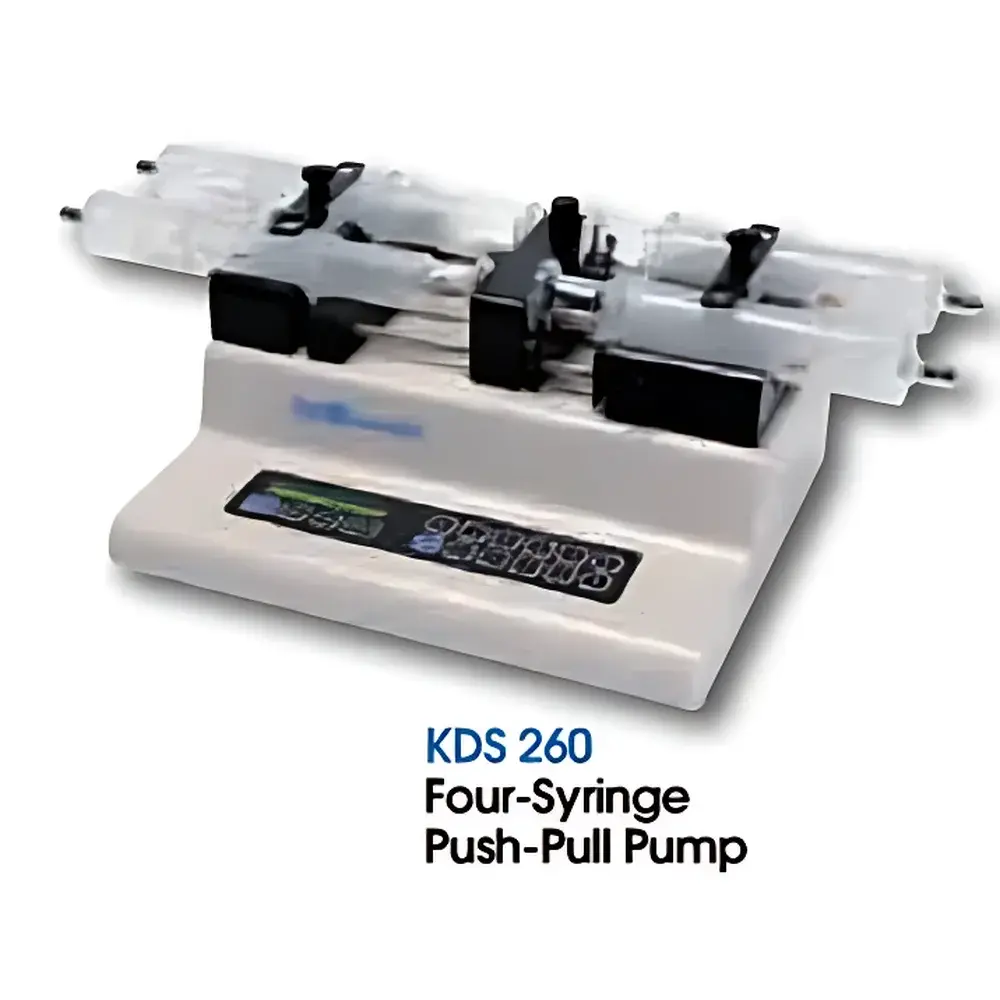
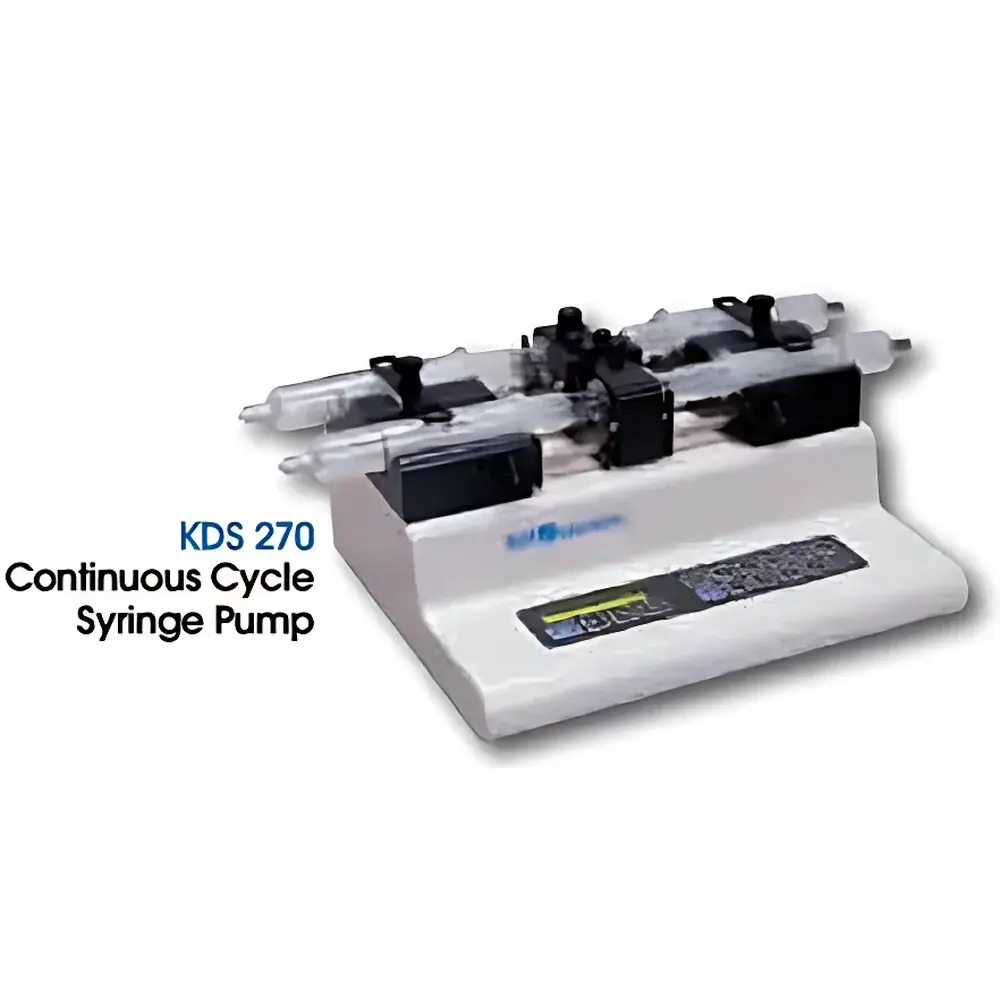
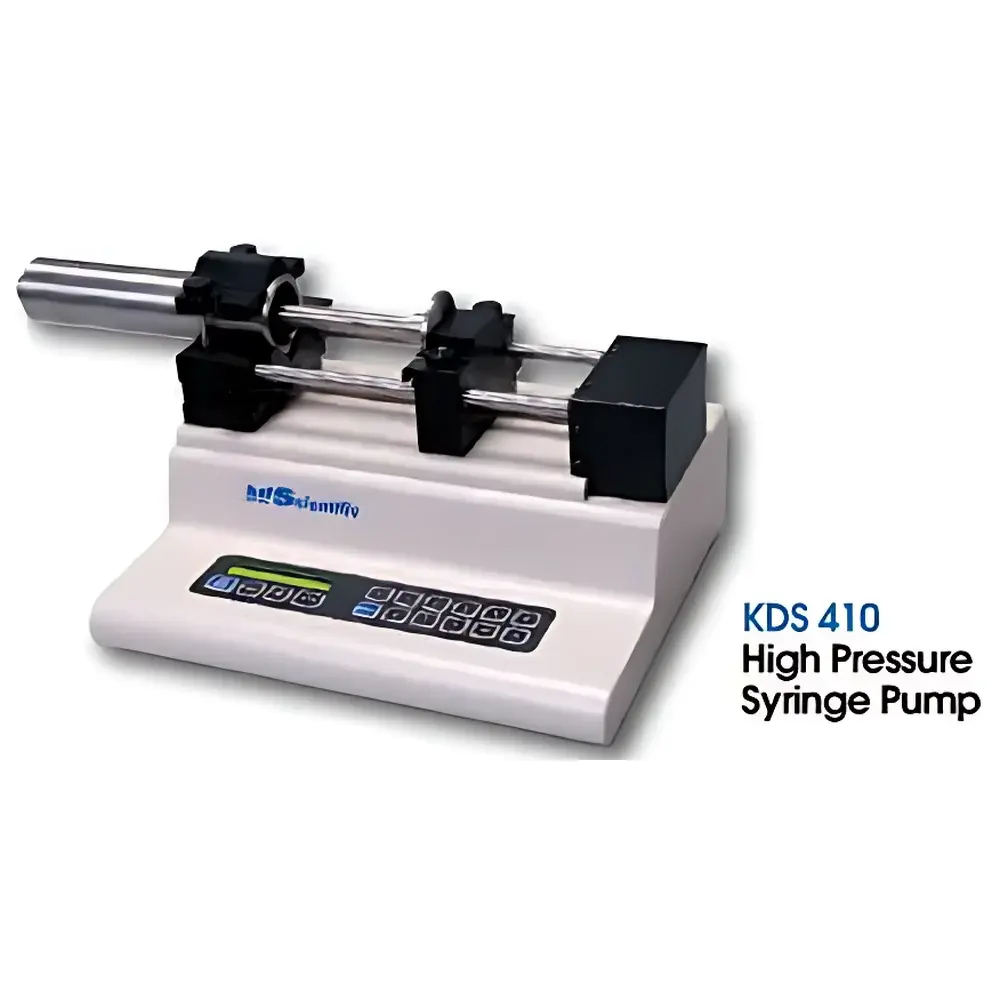
KD Scientific KDS Series Programmable Syringe Pumps
| Brand | KD Scientific |
|---|---|
| Origin | USA |
| Manufacturer Type | Original Equipment Manufacturer (OEM) |
| Product Category | Imported Laboratory Instrument |
| Model | KDS120 / KDS260 / KDS270 / KDS410 / KDS310 Plus Remote |
| Flow Range | 0.001 µL/hr to 1270 mL/hr |
| Syringe Capacity | 0.5 µL to 140 mL |
| Accuracy | ± <1% |
| Repeatability | ± 0.1% |
| Max Linear Force | 0.9–45 kg |
| Interface | RS232 (KDS260/KDS270/KDS410/KDS310 Plus), Standalone (KDS120) |
| Syringe Configuration | Single, Dual, or Quad Channel Options |
Overview
The KD Scientific KDS Series programmable syringe pumps are precision-engineered constant-flow fluid delivery systems designed for demanding laboratory and industrial applications requiring high-resolution volumetric control. Based on the fundamental principle of linear motor-driven plunger displacement within calibrated glass or plastic syringes, these pumps operate under closed-loop microstepping control to ensure stable, pulseless flow across an exceptionally wide dynamic range—from sub-nanoliter-per-hour infusion rates to high-volume dispensing at over 1270 mL/hr. Unlike peristaltic or gear-based pumps, syringe pumps eliminate fluid path variability by directly actuating the syringe barrel, enabling trace-level dosing accuracy critical for microfluidics, analytical sample introduction, chromatography calibration, and long-term pharmacokinetic studies. Each model in the KDS family—KDS120, KDS260, KDS270, KDS410, and KDS310 Plus Remote—is purpose-built for distinct operational profiles, including push/pull bidirectional operation, continuous unidirectional pumping, high-pressure delivery, and remote-controllable multi-channel coordination.
Key Features
- Programmable flow profiles with up to 100-step sequences, supporting ramped, stepped, and segmented infusion protocols
- Multi-syringe compatibility: accommodates standard Luer-lock syringes from 0.5 µL (e.g., Hamilton 1001T) to 140 mL (e.g., BD 140 mL) with automatic stroke-length calibration
- High-force linear actuators: models deliver up to 45 kg of push force (KDS410), enabling use with viscous media, high-backpressure HPLC columns, or microfluidic chips with integrated filters
- RS232 serial interface standard on KDS260, KDS270, KDS410, and KDS310 Plus variants—fully compatible with LabVIEW, MATLAB, Python (PySerial), and custom SCADA environments
- Dual- and quad-channel configurations available (KDS260 Push/Pull, KDS310 Plus Remote) for synchronized or independent parallel delivery—ideal for reagent mixing, gradient generation, or multi-analyte calibration
- Front-panel keypad and LCD display with real-time status feedback (flow rate, elapsed time, remaining volume, error codes)
- Robust aluminum chassis and IP20-rated enclosure suitable for Class 1000 cleanroom-adjacent benchtop use and ISO 17025-accredited laboratories
Sample Compatibility & Compliance
The KDS Series supports a broad spectrum of chemically compatible fluids—including aqueous buffers, organic solvents (e.g., acetonitrile, THF), polymer solutions, cell suspensions, and nanoparticle dispersions—when paired with appropriate syringe materials (glass, polypropylene, PTFE-coated). All models comply with IEC 61010-1:2010 for electrical safety in laboratory equipment. When integrated into regulated workflows (e.g., pharmaceutical QC, clinical assay development), the RS232-enabled models support audit-trail-capable software interfaces that meet FDA 21 CFR Part 11 requirements for electronic records and signatures—provided the host system implements appropriate user authentication, data integrity controls, and change management protocols. The pumps are routinely validated per ASTM E2656-21 (Standard Guide for Validation of Automated Liquid Handling Systems) and referenced in USP Analytical Instrument Qualification frameworks.
Software & Data Management
KD Scientific provides the free KDS Software Suite (Windows-compatible), offering intuitive graphical programming, real-time monitoring, and export of timestamped CSV logs containing flow rate, volume delivered, and system status. For enterprise integration, the native ASCII command protocol allows deterministic control via third-party platforms. All communication includes CRC checksum validation and timeout-handling logic to prevent command loss during extended runs. Data files generated adhere to FAIR principles (Findable, Accessible, Interoperable, Reusable) when stored with metadata such as syringe ID, calibration date, operator ID, and environmental conditions. Optional firmware upgrades provide enhanced protocol memory, improved low-flow stability algorithms, and expanded error diagnostics—including occlusion detection via motor current profiling.
Applications
- Chromatography: Precise mobile phase delivery for LC method development, column equilibration, and post-column derivatization
- Microfluidics: Controlled reagent injection into PDMS chips, droplet generation, and organ-on-chip perfusion
- Electrophysiology: Slow, stable drug application to neuronal cultures or brain slices
- Materials science: Layer-by-layer deposition, sol-gel infusion, and nanomaterial ink dispensing
- Environmental testing: Continuous leaching simulations and controlled eluent addition in column breakthrough studies
- Biotechnology: Fed-batch bioreactor feed control, antibody conjugation reactions, and automated ELISA wash steps
FAQ
What syringe sizes are supported across the KDS Series?
Syringes ranging from 0.5 µL (e.g., Hamilton 1001T) to 140 mL (e.g., BD 140 mL) are supported; exact compatibility depends on model-specific lead screw pitch and motor torque—refer to the KDS Syringe Compatibility Matrix (Rev. 4.2) for validated part numbers.
Is GLP-compliant data logging available?
Yes—when used with validated host software implementing 21 CFR Part 11 controls (e.g., Thermo Fisher SampleManager LIMS or custom Python-based acquisition with digital signature), full audit trails, electronic signatures, and immutable data archives are achievable.
Can KDS pumps operate in vacuum or pressurized environments?
The pumps are rated for ambient laboratory conditions (15–35°C, 20–80% RH, non-condensing); operation inside environmental chambers requires optional thermal shielding and feedthrough-rated cabling—contact KD Scientific Applications Engineering for chamber-integration schematics.
How is accuracy verified during qualification?
Accuracy is confirmed using gravimetric testing per ISO 8655-3:2022, employing certified analytical balances (±0.01 mg resolution) and temperature-controlled fluid baths; typical test duration: 3×30-minute intervals at 1%, 50%, and 95% of maximum rated flow.
Do KDS pumps support TTL or analog input triggers?
No native TTL/analog inputs are provided; however, external trigger synchronization is possible via RS232 command polling or host-software event scripting—e.g., initiating a pump step upon receipt of a “START” flag from a mass spectrometer’s digital output line.



