
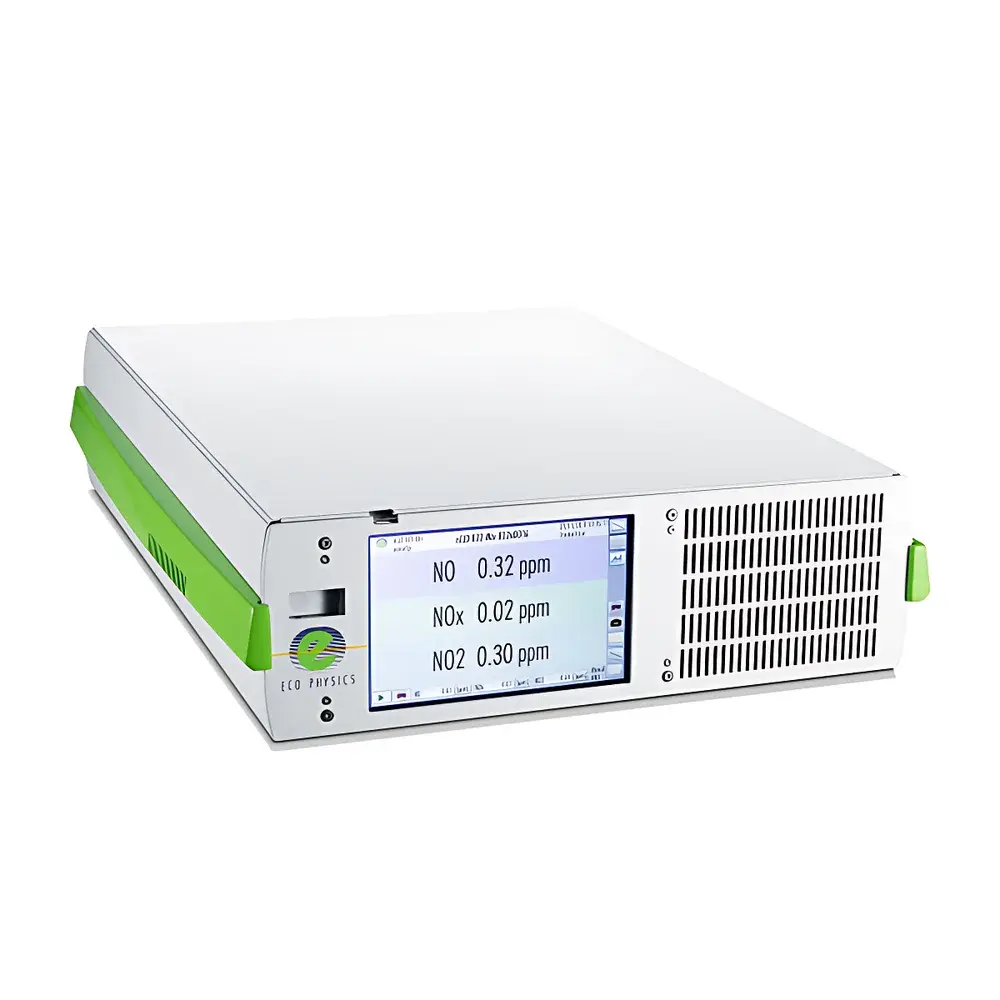
ECO nCLD63 High-Precision Chemiluminescence Nitrogen Oxides Analyzer
| Origin | Switzerland |
|---|---|
| Manufacturer Type | Authorized Distributor |
| Origin Category | Imported |
| Model | ECO nCLD63 |
| Price Range | USD 14,000 – 42,000 |
Overview
The ECO nCLD63 is a high-precision, chemiluminescence-based nitrogen oxides (NOx) analyzer engineered for demanding environmental and industrial emission monitoring applications. It operates on the principle of gas-phase chemiluminescent reaction between nitric oxide (NO) and ozone (O3), generating light proportional to NO concentration; NO2 is quantified via catalytic reduction to NO using a high-efficiency stainless-steel converter. This dual-channel, real-time measurement architecture enables simultaneous, independent quantification of NO, NO2, and total NOx with exceptional specificity and minimal cross-sensitivity. Designed for deployment in harsh sampling environments—including flue gas ducts, incinerator stacks, boiler exhausts, and combustion process streams—the nCLD63 integrates corrosion-resistant wetted-path materials and thermal management to ensure long-term stability under high-acidity, high-humidity, and particulate-laden conditions.
Key Features
- Four selectable measurement ranges (0.5–500 ppm NOx) with automatic range switching to optimize signal-to-noise ratio and minimize quantification uncertainty
- Integrated high-voltage ozone generator delivering stable, high-concentration O3 output (>100 µg/s), enhancing reaction kinetics and improving detection sensitivity
- Patented high-temperature ozone destruct unit (operating >250 °C), eliminating reliance on consumable activated carbon traps and enabling zero-maintenance ozone abatement
- Ultra-low sample gas flow requirement: only 35 mL/min—reducing vacuum pump load, minimizing pressure drop across sampling lines, and lowering risk of condensate-induced blockage
- Fast response performance: <1 s rise time, T90 ≤ 3 s for full-scale step changes—critical for transient emission profiling and dynamic combustion control
- Modular stainless-steel NO2 converter with field-replaceable design; compatible with both metal (for high-temperature stability) and molybdenum catalyst options (for ambient-range applications)
- DC power option (12–24 V) supports mobile and roadside monitoring deployments, including vehicle exhaust characterization and fugitive emission surveys
Sample Compatibility & Compliance
The nCLD63 is validated for continuous operation with corrosive, high-moisture, and particulate-laden gas matrices typical of waste incineration, cement kiln exhaust, and coal-fired boiler flue gas. Its inert sampling path—comprising PTFE-lined tubing, Hastelloy C-276 reaction chamber components, and ceramic flow restrictors—resists acid attack from HCl, HF, and SO3. The analyzer meets EN 15267-3 (QAL1 certification readiness), complies with EPA Method 7E and ISO 11565 for NOx determination, and supports data integrity requirements per FDA 21 CFR Part 11 when integrated with compliant software platforms. Optional heated sample line and Nafion dryer modules enable robust ambient air and boundary monitoring in compliance with EU Directive 2008/50/EC and US EPA 40 CFR Part 58.
Software & Data Management
Embedded firmware supports full remote operation via Ethernet (TCP/IP) with secure HTTP/HTTPS and Modbus TCP protocols. The web-based interface provides real-time waveform visualization, calibration history logging, alarm configuration (e.g., flow loss, O3 fault, converter temperature deviation), and audit-trail-enabled user access control. Data export is compliant with CSV, XML, and EPA Compendium A-1 formats. When paired with ECO’s optional Data Acquisition & Reporting Suite (DARS), the system generates automated QA/QC reports aligned with GLP and ISO/IEC 17025 documentation standards—including drift correction logs, span validation records, and multi-point calibration certificates.
Applications
- Continuous Emission Monitoring Systems (CEMS) for regulatory reporting at thermal waste treatment facilities
- Combustion optimization and NOx abatement control in utility boilers and industrial furnaces
- Ambient air quality networks requiring sub-ppm resolution for urban background and traffic-impacted site monitoring
- Mobile source emissions testing—including roadside diesel fleet screening and RDE (Real Driving Emissions) campaign support
- Research-grade laboratory studies on atmospheric chemistry, catalyst deactivation, and low-temperature NO2 conversion kinetics
- Process gas monitoring in chemical synthesis, nitric acid production, and semiconductor fabrication exhaust streams
FAQ
What is the minimum detectable concentration (MDC) for NOx on the nCLD63?
The instrument achieves a minimum detectable concentration of 0.05 ppm NOx (3σ of zero baseline noise), with a measured noise floor of 0.02 ppm RMS over 60 seconds.
Does the nCLD63 require external ozone generation or scrubbing equipment?
No—it incorporates an integrated high-voltage ozone generator and a high-temperature catalytic ozone destruct unit, eliminating external ozone supply and consumable carbon filters.
Can the nCLD63 be used for ambient air monitoring at ppb-level concentrations?
While optimized for 0.5–500 ppm operation, the nCLD63 can be configured with optional low-flow dilution and enhanced signal processing for reliable sub-ppm ambient measurements; for dedicated ppb/ppt applications, the ECO nCLD64 or nCLD66 models are recommended.
Is the stainless-steel NO2 converter suitable for long-term exposure to high-NO2 flue gas?
Yes—the converter is rated for continuous operation up to 500 °C and demonstrates stable conversion efficiency (>95%) even after 6 months in incinerator stack gas with NO2/NO ratios exceeding 3:1.
How does the nCLD63 handle moisture and acidic condensates in hot-wet sampling?
The analyzer includes a heated sample manifold (maintained at 180 °C), PTFE-coated internal surfaces, and a thermally isolated reaction chamber to prevent condensation and minimize wall adsorption effects.
Related Products







