
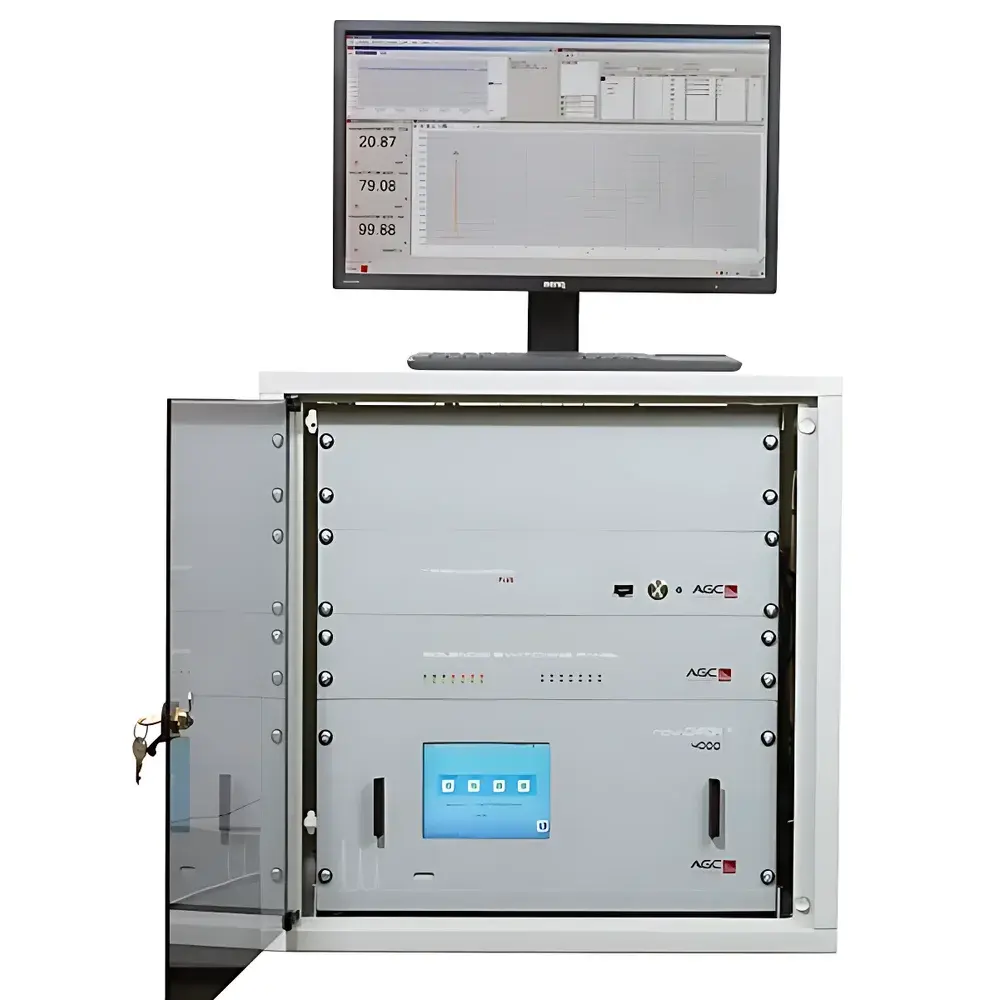
AGC NovaCHROM AGC100 Series Helium Ionization Detector Gas Chromatograph
| Brand | AGC |
|---|---|
| Origin | Ireland |
| Model | AGC100 Series |
| Instrument Type | Laboratory Gas Chromatograph |
| Application | High-Purity Gas Analysis |
| Oven Temperature Range | +5–450 °C |
| Oven Ramp Rate | 0.1–40 °C/min (0.1 °C increment) |
| Cooling Rate | 300–50 °C in ~5 min |
| Carrier Gas Flow Control Range | 0–500 mL/min |
| Carrier Gas Pressure Control Range | 0–700 kPa |
| Injector Max Temp | 450 °C |
| Injector Pressure Setting Range | 0–700 kPa |
| Injector Total Flow Setting Range | 10–500 mL/min |
| DID Operating Temp | 30–45 °C |
| Ambient Temp Requirement | 10–30 °C |
| Response Time (90%) | 0.5 s |
| Warm-up Time | 60 min |
| Display | 6.5″ color LCD with LED backlight and resistive touchscreen |
| Carrier Gas | Ultra-high-purity helium (He, N6.0), 20–60 mL/min |
| Sample Gas Flow | 10–500 mL/min (recommended: 200 mL/min) |
| Drive Gas | Clean, dry air at 300 kPa |
| Electronic Gas Control | Input 5–10 bar, output control 0–5 bar |
| Output Signal | 0–1 V analog |
| Communication | 4–20 mA, Profibus, Modbus RTU, RS-485 via TrendVision PLUS |
| Power Supply | 220 V AC |
| Dimensions (W×H×D) | 483 mm × 219 mm × 564 mm (19″ rack, 5U) |
| Weight | 25 kg |
Overview
The AGC NovaCHROM AGC100 Series Helium Ionization Detector (DID) Gas Chromatograph is a purpose-engineered analytical platform designed for ultra-trace impurity profiling in high-purity industrial gases—including hydrogen, nitrogen, oxygen, argon, helium, and synthetic air. Leveraging the physical principle of helium metastable ionization, the DID detector achieves exceptional sensitivity across the ppb to % concentration range without chemical quenching or catalytic interference. Unlike electron capture or flame-based detectors, the DID operates on a non-destructive, universal ionization mechanism: metastable helium atoms (He*) generated in a sealed discharge cell collide with analyte molecules, inducing ionization proportional to their ionization potential. This yields linear, reproducible response for permanent gases and light hydrocarbons—critical for semiconductor-grade gas certification, cryogenic plant monitoring, and electronic specialty gas QC.
Key Features
- Independent multi-zone column oven with precision ±0.1 °C temperature control per column—enabling simultaneous analysis of diverse impurities requiring distinct thermal elution profiles.
- Regenerable dual-stage purifier core system for carrier gas conditioning, maintaining He purity ≥99.99999% (N6.0) over extended operational cycles without consumable replacement.
- 19″ rack-mountable 5U chassis (483 × 219 × 564 mm) engineered for integration into centralized process control environments—compatible with DCS, PLC, and SCADA systems via standardized digital interfaces.
- Modular detector architecture supporting field-swappable configurations: DID (standard), ADD (Argon Discharge Detector), FID, TCD, or FPD—allowing method flexibility without hardware requalification.
- Integrated real-time diagnostic engine with configurable alarm thresholds for detector status, column flow deviation (>±3%), oven/ injector temperature drift (>±2 °C), pressure instability, and scheduled maintenance intervals.
- Resistive touchscreen interface (6.5″ color LCD, LED-backlit) with intuitive workflow navigation—no external PC required for method setup, sequence initiation, or basic data review.
Sample Compatibility & Compliance
The NovaCHROM AGC100 is validated for analysis of permanent gases (O₂, N₂, H₂, CO, CO₂, CH₄, Ar, Kr, Xe, Ne, He), reactive species (NH₃, H₂S, PH₃, AsH₃, B₂H₆), and volatile halocarbons (CF₄, C₂F₆, SF₆) at trace levels down to 10 ppb. Its pneumatic architecture complies with ISO 8573-1:2010 Class 1 compressed air specifications for drive gas supply and meets ASTM D1946–22 requirements for gaseous fuel analysis. The system supports audit-ready operation under GLP and GMP frameworks: all method parameters, calibration events, and alarm logs are timestamped and stored locally with optional export to LIMS via Modbus TCP. Firmware adheres to IEC 61508 SIL 2 functional safety principles for critical alarm outputs.
Software & Data Management
TrendVision PLUS firmware provides embedded chromatographic data acquisition, peak integration (tangent skim, valley-to-valley), and quantitative reporting compliant with USP General Chapter <621> and EP 2.2.46. Raw signal data (0–1 V analog output) is digitized at 10 Hz resolution with 16-bit ADC fidelity. Calibration curves support multi-point linear/non-linear regression with forced zero intercept where appropriate. All method files include metadata fields for analyst ID, sample lot number, and instrument verification status. Audit trail functionality records user actions—including parameter edits, calibration injections, and report generation—with immutable timestamps and operator authentication (PIN-based). Data export formats include CSV, PDF, and XML for regulatory submission or third-party statistical analysis.
Applications
- Ultra-high-purity (UHP) gas certification for semiconductor fabrication—monitoring ppb-level O₂, H₂O, CO, and total hydrocarbons in bulk N₂ or Ar delivery lines.
- Hydrogen fuel quality assurance per ISO 14687–2:2019—quantifying CO, CO₂, THC, NH₃, and halides in PEM electrolyzer output streams.
- Cryogenic air separation plant optimization—real-time tracking of argon/oxygen/nitrogen ratios and neon/helium impurities in distillation columns.
- Pharmaceutical inerting gas validation—verifying residual O₂ and moisture in nitrogen blankets used during lyophilization or API synthesis.
- Environmental monitoring of landfill biogas—measuring CH₄, CO₂, H₂S, and siloxanes prior to upgrading to pipeline-grade biomethane.
FAQ
What is the minimum detectable level for oxygen using the DID detector?
The system achieves a method detection limit (MDL) of 10 ppb for O₂ under optimized conditions (200 mL/min sample flow, 40 mL/min He carrier, 35 °C DID temperature), verified per EPA Method TO-15 Annex A protocols.
Can the AGC100 operate unattended for extended periods?
Yes—the platform supports fully automated sequences including valve actuation, column backflushing, and detector regeneration cycles. Scheduled maintenance alerts and predictive diagnostics reduce unscheduled downtime.
Is the DID detector sensitive to moisture or particulate contamination?
The integrated dual-stage purifier and stainless-steel, electropolished gas path minimize moisture adsorption and particle shedding. However, inlet filters (0.5 µm sintered stainless) and regular purifier core regeneration are mandatory for sustained ppb-level performance.
Does the system comply with FDA 21 CFR Part 11 requirements?
TrendVision PLUS supports electronic signatures, role-based access control, and full audit trail logging—meeting foundational Part 11 criteria. Full compliance requires site-specific validation documentation and network security configuration.
What validation documentation is provided with the instrument?
Each unit ships with Factory Acceptance Test (FAT) reports, as-installed configuration records, DID linearity verification data (5-point curve, R² ≥ 0.999), and IOQ protocol templates aligned with ASTM E2656–20.
Related Products






