
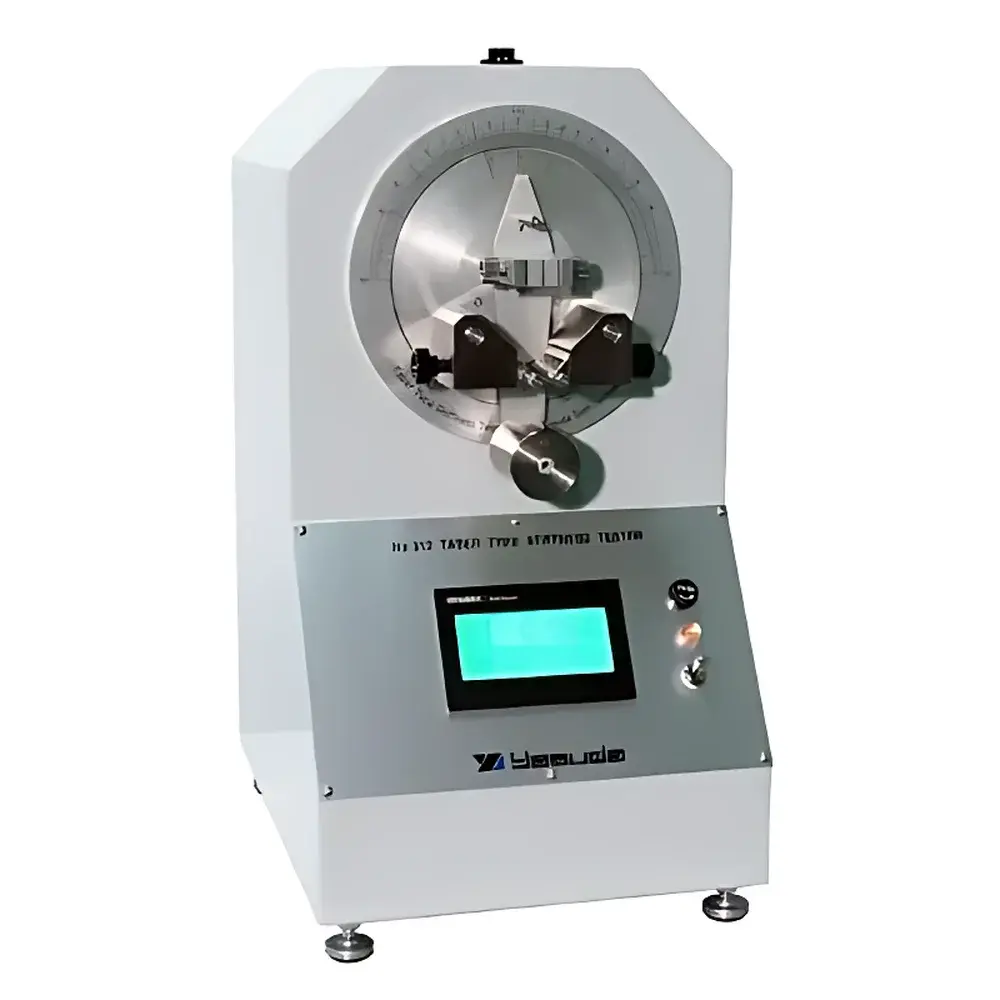
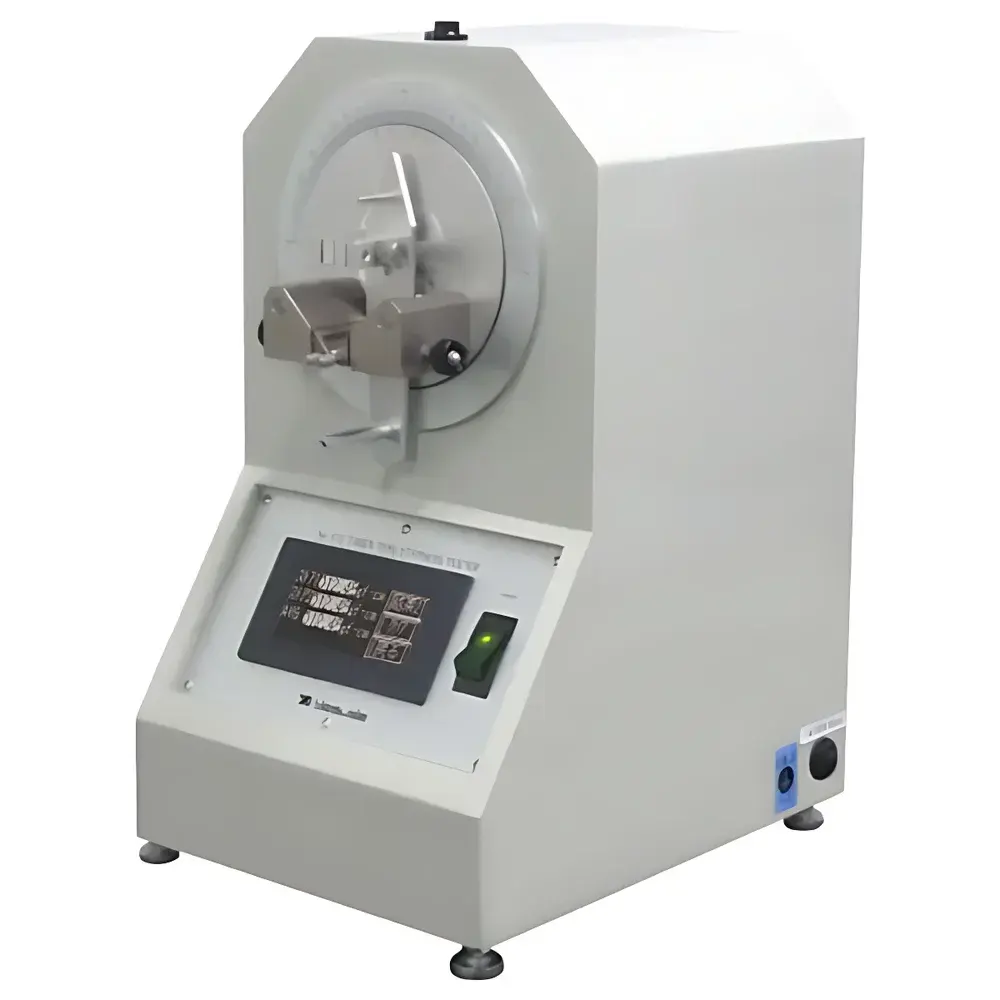
Yasuda No.312-D Digital Taber-Type Stiffness Tester
| Brand | Yasuda |
|---|---|
| Origin | Japan |
| Model | No.312-D |
| Test Standards | JIS P8125, TAPPI T489, ISO 2493 |
| Maximum Torque | 490 mN·m (5,000 gf·cm) |
| Load Scale | 0–100 (dual-side) |
| Applied Loads | 100 gf, 200 gf, 500 gf |
| Load Arm Distance from Rotation Axis | 100 mm |
| Deflection Angles | ±15° and ±7.5° |
| Angular Speed | 180 ± 40°/min |
| Specimen Width | 30–40 mm (standard: 38.0 ± 0.2 mm) |
| Specimen Length | 70 mm |
| Max. Specimen Thickness | ≤3.2 mm |
| Testing Roller Diameter (for test) | φ8.60 ± 0.05 mm |
| Adjustment Roller Diameter | φ8.93 ± 0.05 mm |
| Power Supply | AC 100 V, single-phase, 3 A, 50/60 Hz |
| Dimensions (W×D×H) | ~300 × 350 × 520 mm |
| Weight | ~25 kg |
Overview
The Yasuda No.312-D Digital Taber-Type Stiffness Tester is a precision mechanical instrument engineered for the quantitative evaluation of bending stiffness in paperboard and corrugated fiberboard materials. It operates on the fundamental principle of the Taber method—applying a controlled torque to a clamped specimen while measuring angular deflection under standardized loading conditions. This torsional bending approach conforms rigorously to internationally recognized standards including JIS P8125, TAPPI T489, and ISO 2493, ensuring measurement traceability and inter-laboratory comparability. Unlike optical or dynamic resonance methods, the No.312-D delivers direct, static mechanical response data rooted in classical beam theory, making it especially suitable for QC laboratories requiring repeatable, operator-independent results in high-volume paper packaging testing environments.
Key Features
- Digital display interface providing real-time readout of stiffness values in millinewton-meters (mN·m) and derived bending resistance indices
- Fixed-load configuration with three calibrated weights (100 gf, 200 gf, 500 gf), mounted at a precisely defined 100 mm moment arm from the rotational axis
- Dual-angle deflection capability (±7.5° and ±15°) enabling compliance with both low-stiffness (e.g., lightweight board) and high-stiffness (e.g., solid bleached sulfate) test protocols
- Constant-speed oscillation drive system operating at 180 ± 40°/min, mechanically stabilized to minimize vibration-induced noise in torque measurement
- Interchangeable rollers: a φ8.60 ± 0.05 mm test roller for standard compliance and a φ8.93 ± 0.05 mm adjustment roller for fine-tuning specimen contact geometry
- Robust cast-aluminum frame and precision-ground bearing assembly ensuring long-term dimensional stability and minimal hysteresis across repeated cycles
Sample Compatibility & Compliance
The No.312-D accepts specimens measuring 70 mm in length, 30–40 mm in width (with 38.0 ± 0.2 mm recommended as standard), and up to 3.2 mm in thickness—covering the full range of commercial paperboard grades from linerboard to folding boxboard. Its mechanical design inherently supports manual specimen insertion and centering, eliminating need for complex fixturing while maintaining alignment repeatability within ±0.3 mm. All operational parameters—including load application sequence, angular displacement limits, and dwell timing—are fully aligned with the procedural requirements of JIS P8125 (2021 edition), TAPPI T489 om-22, and ISO 2493:2010. The instrument does not require software-based calibration validation; however, its mechanical zero point and scale linearity are verifiable using NIST-traceable torque standards per ISO 17025-accredited procedures.
Software & Data Management
The No.312-D is a standalone electromechanical tester with no embedded microprocessor or digital data logging. All measurements are displayed directly on a high-contrast LCD screen with 0.1 mN·m resolution. While it lacks native USB or Ethernet connectivity, analog output (0–5 V DC proportional to torque) is available via rear-panel terminals for integration with external DAQ systems or PLC-controlled test stations. Laboratories implementing GLP or GMP workflows may document results manually in bound logbooks or transfer values into LIMS platforms using standardized templates compliant with FDA 21 CFR Part 11 (when paired with validated electronic entry systems). Routine verification checks—including load weight calibration, roller diameter verification, and angular encoder drift assessment—are specified in the user manual and align with ISO/IEC 17025 clause 6.4.10 on equipment monitoring.
Applications
- Quality control of folding cartons and retail packaging substrates during incoming raw material inspection
- Correlation studies between stiffness, caliper, and fiber furnish composition in R&D settings
- Validation of creasing and scoring performance in post-printing operations
- Benchmarking against competitor board specifications for procurement qualification
- Supporting ISO 12782-2 (paperboard stiffness classification) and ASTM D7269 (bending resistance of paperboard)
FAQ
Does the No.312-D comply with current ISO 2493:2010 requirements?
Yes—the mechanical configuration, roller tolerances, specimen dimensions, and angular speed tolerance (180 ± 40°/min) fully satisfy Clause 5 and Annex A of ISO 2493:2010.
Can the instrument be used for testing corrugated board with flute orientations?
It is designed exclusively for flat, unfluted paperboard specimens. Corrugated board requires specialized edge-wise or flute-directional testers such as the MIT-type or custom four-point bending rigs.
Is periodic recalibration required by accredited standards bodies?
Per ISO/IEC 17025, mechanical testers must undergo functional verification before each shift or daily—using certified reference weights and angle gauges—not full recalibration unless physical damage or out-of-spec performance is observed.
What maintenance intervals are recommended for sustained accuracy?
Lubrication of the main shaft bearing every 6 months and annual verification of roller surface finish (Ra ≤ 0.4 µm) and diameter tolerance are advised per Yasuda’s Technical Bulletin TB-312D-REV4.



