
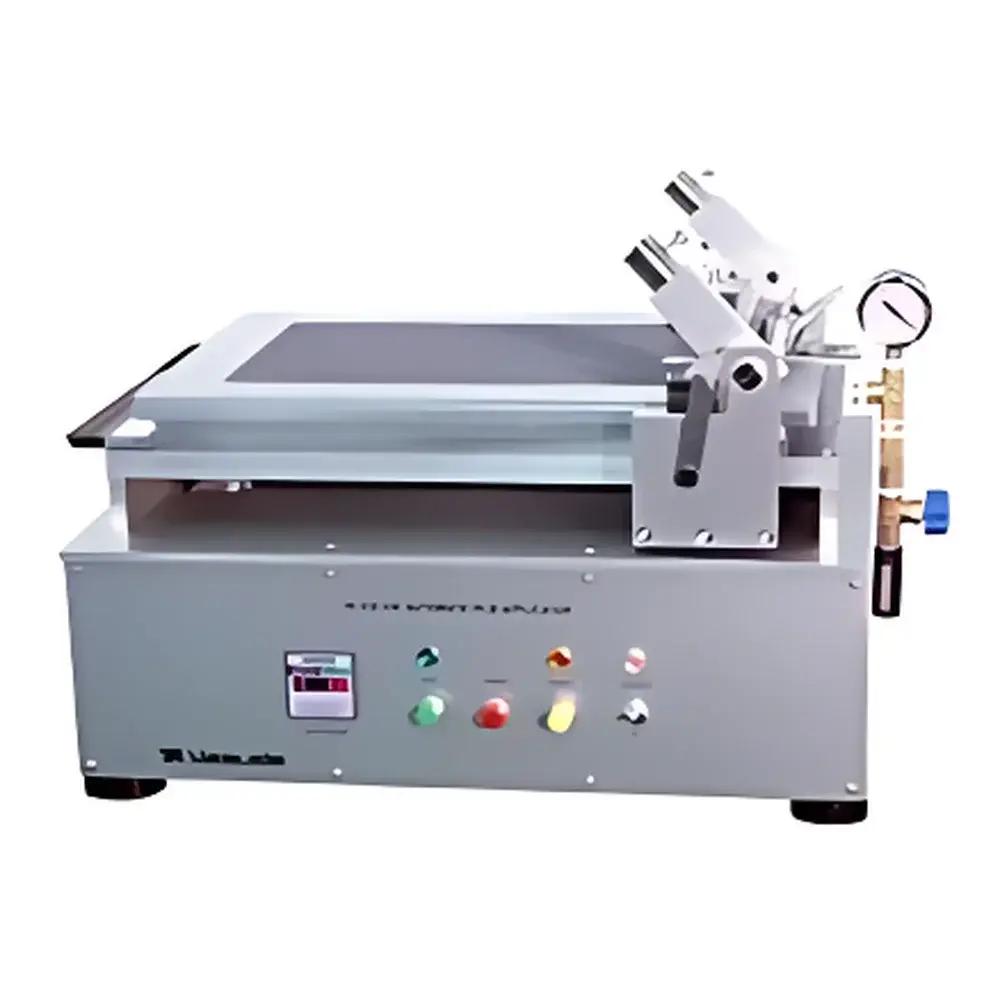
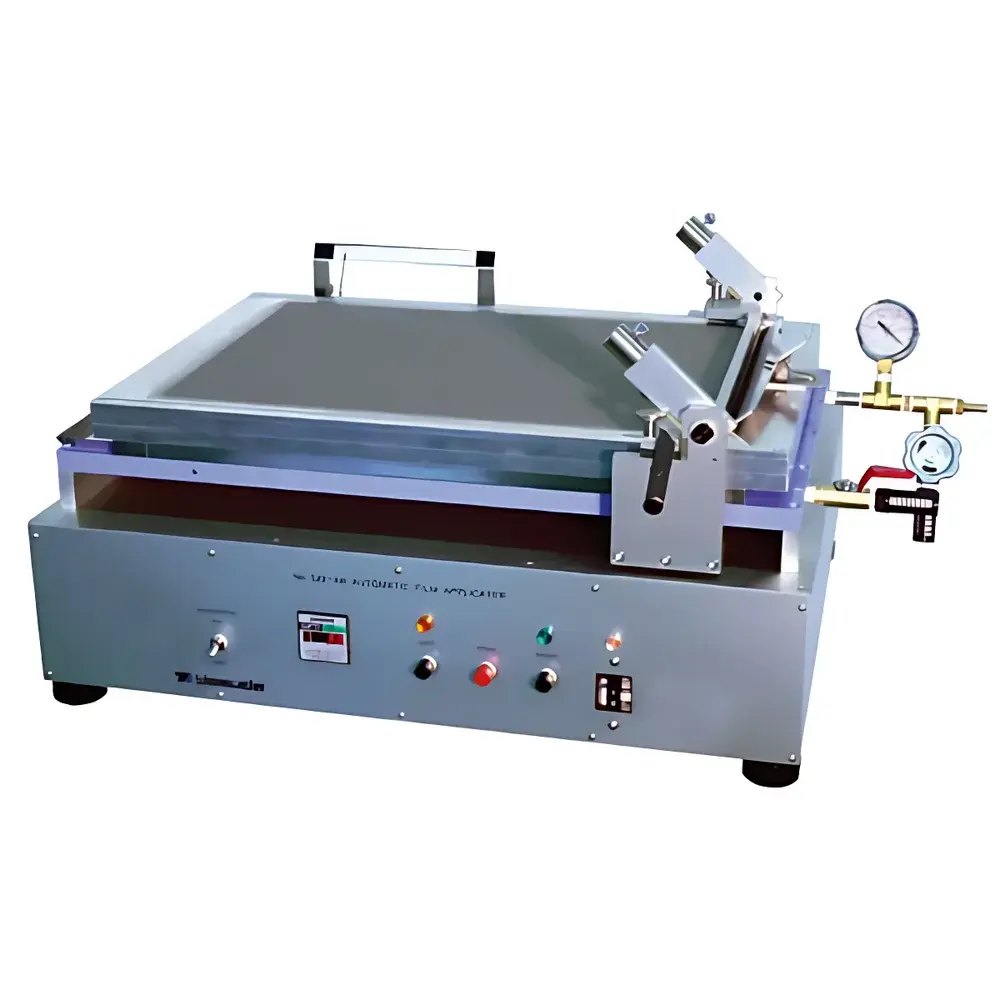
Yasuda No.542-CR Automatic Film Applicator with Heated Platen
| Brand | Yasuda |
|---|---|
| Origin | Japan |
| Model | No.542-CR |
| Compliance | JIS K 5101, JIS K 5400, ASTM D823 |
Overview
The Yasuda No.542-CR Automatic Film Applicator with Heated Platen is an engineered precision instrument designed for reproducible, standardized film deposition in quality control and R&D laboratories. It operates on the principle of motorized drawdown—where a precisely controlled, linearly moving applicator bar (e.g., wire-wound rod or adjustable blade) spreads liquid coating material uniformly across a substrate under defined mechanical parameters. Unlike manual methods, the No.542-CR eliminates operator-induced variability in film thickness, edge uniformity, and surface continuity by enforcing consistent speed, pressure, and dwell time. Its integrated heated platen enables temperature-controlled film formation—critical for evaluating thermosensitive resins, solvent-evaporation kinetics, and crosslinking behavior during early-stage drying. The system is purpose-built for compliance-driven environments requiring traceable, repeatable film preparation per internationally recognized test standards.
Key Features
- Motor-driven linear carriage with adjustable drawdown speed (typically 1–100 mm/s, programmable in 1 mm/s increments) to support both rapid screening and slow-drying formulations.
- Heated aluminum platen with PID-controlled temperature regulation (range: ambient +10°C to 120°C, ±0.5°C stability), enabling real-time thermal modulation during film formation.
- Vacuum-assisted substrate fixation via perforated platen surface (vacuum port compatible with standard lab vacuum pumps; holding force ≥60 kPa at 20 kPa suction pressure).
- Modular applicator interface supporting ISO-standard wire-wound rods (e.g., 8 µm to 250 µm wet film thickness), adjustable doctor blades, and custom fixtures for non-standard substrates.
- Stainless-steel frame and anodized aluminum components ensure long-term dimensional stability and resistance to solvent exposure and cleaning agents.
- CE-marked electrical architecture with emergency stop, overtemperature cutoff, and interlocked safety cover for operator protection during heated operation.
Sample Compatibility & Compliance
The No.542-CR accommodates rigid and semi-flexible substrates up to 300 × 400 mm, including coated paper (e.g., art paper, copperplate), PET and PVC films, aluminum foil, glass slides, and primed metal panels. Its vacuum retention system ensures flatness and positional fidelity—even for low-surface-energy plastics prone to curling or slippage. The instrument meets functional requirements of JIS K 5101 (paints and varnishes—determination of film thickness), JIS K 5400 (testing methods for paint films), and ASTM D823 (standard practice for producing films of uniform thickness of organic coatings on laboratory panels). While not a measuring device itself, its output films are directly suitable for downstream analysis per ISO 2808 (paints and varnishes—determination of film thickness), ASTM D1186 (non-magnetic coatings on ferrous metals), or gravimetric mass/thickness correlation protocols.
Software & Data Management
The No.542-CR operates as a standalone electromechanical system without embedded firmware or digital interface. All operational parameters—including drawdown speed, platen temperature setpoint, vacuum activation timing, and dwell duration—are configured manually via front-panel dials and toggle switches. This analog architecture ensures electromagnetic compatibility (EMC) in labs housing sensitive instrumentation (e.g., FTIR, XRD, or ellipsometers) and eliminates software validation burdens under FDA 21 CFR Part 11 or EU Annex 11. Process settings are documented in laboratory notebooks or LIMS-integrated SOPs. For GLP/GMP environments, users implement change-controlled calibration logs for speed verification (using optical tachometer) and temperature mapping (per ICH Q5C guidelines) across the platen surface at defined intervals.
Applications
- Preparation of reference films for gloss, haze, colorimetry (ASTM D2244), and adhesion testing (ASTM D3359).
- Evaluation of leveling, sag resistance, and orange peel under controlled thermal gradients.
- Accelerated drying studies—monitoring solvent loss rate via gravimetry or in situ FTIR while maintaining constant substrate temperature.
- Formulation screening of waterborne acrylics, UV-curable oligomers, and high-solids industrial coatings where film integrity is sensitive to substrate temperature.
- Production of standardized test panels for corrosion resistance (ASTM B117 salt spray) and weathering (ASTM G154 UV exposure).
FAQ
Is the No.542-CR compliant with ISO/IEC 17025 calibration requirements?
Yes—while the unit itself does not require calibration certification, its critical parameters (drawdown speed and platen temperature) are verifiable using traceable metrology tools. Laboratories may establish internal calibration procedures aligned with ISO/IEC 17025 Clause 6.5.
Can it be used with volatile organic solvents?
Yes, provided the lab ventilation system meets local occupational exposure limits (e.g., OSHA PEL or ACGIH TLV) and the vacuum exhaust is routed externally. The heated platen surface is sealed and non-porous to prevent solvent ingress.
What maintenance is required for long-term accuracy?
Monthly inspection of vacuum seal integrity, annual verification of speed linearity using a calibrated optical encoder, and biannual temperature uniformity mapping across the platen surface using NIST-traceable RTD probes.
Does Yasuda supply application-specific rods or blades?
Yes—Yasuda offers certified wire-wound rods (DIN 6120, ISO 23603) and hardened stainless-steel doctor blades with documented wet-film thickness tolerances (±2% of nominal value), supplied with individual calibration certificates.






