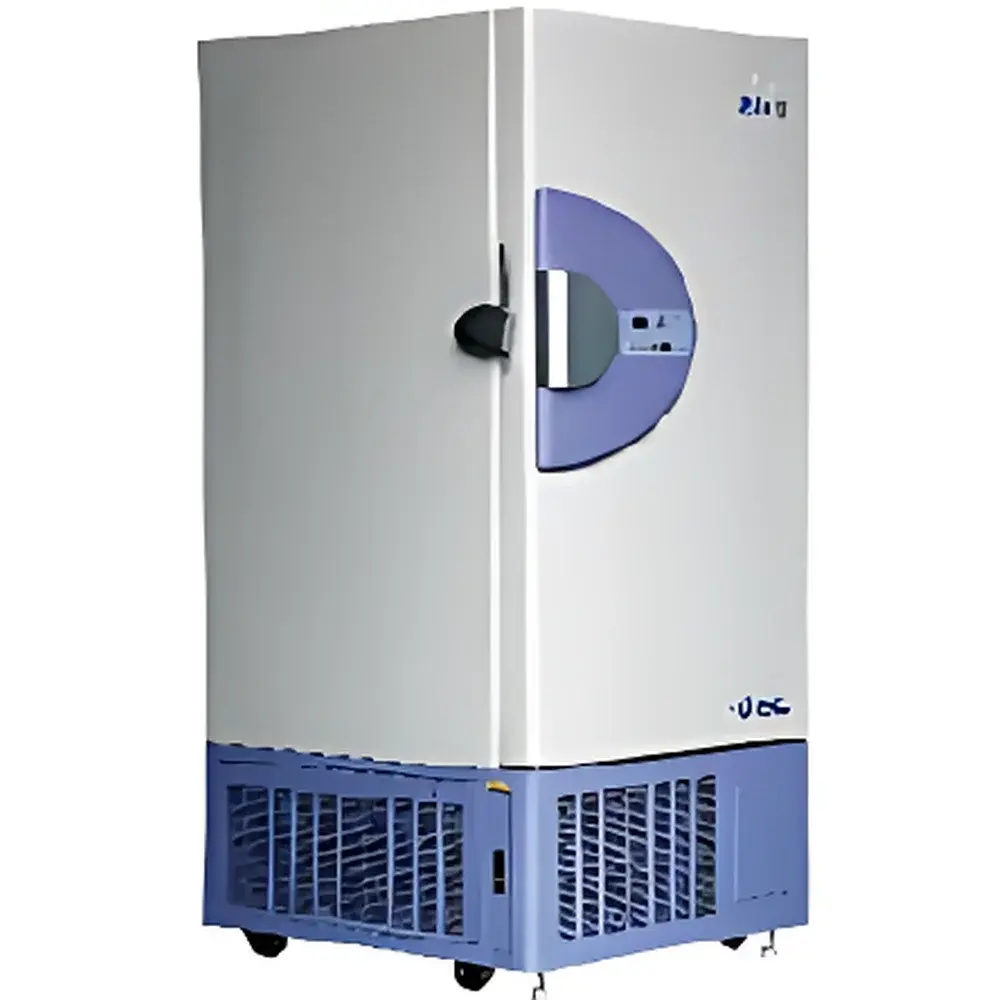
AUCMA DW-86L390 Ultra-Low Temperature Freezer
| Brand | AUCMA |
|---|---|
| Origin | Shanghai, China |
| Model | DW-86L390 |
| Capacity | 390 L |
| Internal Dimensions (mm) | 620 × 515 × 1200 |
| External Dimensions (mm) | 900 × 885 × 1940 |
| Power Supply | 220 V / 50 Hz |
| Rated Power | 1000 W |
| Temperature Range | −40 °C to −86 °C |
| Cabinet Type | Upright |
| Insulation | High-density polyurethane foam, dual-door seal system |
| Compressor | Dual-stage cascade refrigeration with imported compressors and EBM fans |
| Refrigerant | Eco-friendly, non-CFC/non-HCFC blend |
| Compliance | Designed for GLP-compliant environments |
Overview
The AUCMA DW-86L390 Ultra-Low Temperature Freezer is an upright, high-capacity cryogenic storage system engineered for long-term preservation of temperature-sensitive biological materials at stable temperatures between −40 °C and −86 °C. Utilizing a dual-stage cascade refrigeration architecture, the unit achieves rapid cooldown and exceptional thermal stability across its 390 L internal volume. Its design prioritizes energy efficiency, operational safety, and regulatory readiness—making it suitable for use in accredited research laboratories, biobanks, clinical diagnostic centers, blood banks, public health institutions, and pharmaceutical development facilities where sample integrity, traceability, and audit compliance are mission-critical.
Key Features
- Microprocessor-based temperature control with digital LED display and adjustable setpoint resolution of ±0.1 °C, enabling precise thermal management across the full operating range.
- Multi-level alarm system with real-time monitoring of cabinet temperature, ambient temperature, power failure, compressor status, condenser fouling, sensor integrity, and battery voltage—each configurable with user-defined thresholds.
- Triple-stage audible/visual remote alarm interface: local buzzer, flashing LED indicators, and dry-contact output compatible with building management systems (BMS) or centralized lab monitoring platforms.
- Cascade refrigeration system incorporating internationally certified compressors and high-efficiency EBM axial fans, delivering rapid pull-down (≤3.5 hours from 25 °C to −80 °C) and low acoustic emission (<52 dB(A) at 1 m).
- Structural insulation comprising ≥120 mm thick, CFC-free polyurethane foam with vacuum-degassed pour process, combined with dual-gasketed, lockable double-door assembly and pressure-equalization valve for reduced door-opening effort and minimized cold loss.
- Integrated security features including keypad lockout with password protection, delayed start-up logic, voltage fluctuation compensation (±15% input tolerance), and tamper-resistant drawer locks for individual storage compartments.
- Ergonomic service design: slide-out dust filter with patented mounting mechanism, accessible calibration port for external probe validation, heavy-duty casters with locking screws, and modular drawer configuration supporting standardized cryoboxes (e.g., 10 × 10 format).
Sample Compatibility & Compliance
The DW-86L390 maintains thermal uniformity within ±3 °C across all load conditions (per IEC 61000-4-2 and ISO 14644-1 Class 8 cleanroom-compatible airflow modeling). It is routinely deployed for storage of primary human tissues (e.g., hematopoietic stem cells, PBMCs, corneal grafts), microbial cultures (including anaerobic and fastidious strains), viral vectors, monoclonal antibodies, cryopreserved oocytes/embryos, and reference standards for QC/QA programs. The freezer meets essential requirements for ISO/IEC 17025-accredited testing laboratories and aligns with Good Laboratory Practice (GLP) and Good Manufacturing Practice (GMP) environmental control expectations. Optional temperature mapping validation kits and 21 CFR Part 11–compliant electronic loggers (with audit trail, user authentication, and electronic signature support) are available to fulfill FDA, EMA, and MHRA documentation mandates.
Software & Data Management
While the base unit operates via embedded firmware without proprietary software dependency, optional connectivity modules enable integration with enterprise-wide cold chain monitoring ecosystems. These include RS-485 Modbus RTU and Ethernet-enabled controllers supporting SNMP v3 and MQTT protocols. Logged parameters—cabinet temperature, alarm events, door-open duration, compressor cycle count, and ambient sensor readings—are timestamped and exportable in CSV or XML formats. All data records comply with ALCOA+ principles (Attributable, Legible, Contemporaneous, Original, Accurate, Complete, Consistent, Enduring, Available) when paired with validated time-synchronized logging hardware.
Applications
- Long-term archival of genomic DNA, RNA, and tissue lysates under validated −80 °C conditions per ISO 20387:2018 biobanking standards.
- Cryostorage of clinical-grade cell therapies, including CAR-T products, prior to release testing and infusion.
- Stabilization of thermolabile reagents such as restriction enzymes, reverse transcriptases, and lyophilized vaccines during distribution logistics.
- Environmental stress testing of electronic components and polymer substrates under controlled deep-cold exposure per ASTM F1509 and MIL-STD-810H methods.
- Marine bioprospecting workflows requiring preservation of deep-sea microbial isolates and metabolite libraries at −86 °C.
FAQ
What is the typical temperature uniformity across the chamber volume?
Measured uniformity is ≤±2.5 °C at −80 °C under static load conditions (IEC 60068-3-5 methodology), verified using NIST-traceable thermocouples at nine spatial locations.
Does the unit support validation for IQ/OQ/PQ protocols?
Yes—the mechanical design, sensor layout, and alarm architecture conform to Annex 15 of the EU GMP Guide and WHO TRS 961 Annex 6, facilitating straightforward qualification by third-party vendors.
Can the freezer be integrated into a central laboratory monitoring system?
Standard RS-485 interface enables connection to SCADA or LabVantage; optional Ethernet gateway adds TLS 1.2 encryption and HTTPS API access for cloud-based dashboards.
Is the refrigerant compliant with current global environmental regulations?
The system uses R508B/R23 blended refrigerant with zero ozone depletion potential (ODP = 0) and global warming potential (GWP) below 150, satisfying Kigali Amendment phase-down schedules and EU F-Gas Regulation (EU) No 517/2014.
What maintenance intervals are recommended for optimal performance?
Condenser cleaning every 3 months, door gasket inspection quarterly, and annual calibration verification using certified reference probes are advised per manufacturer’s technical bulletin TB-DW86-2023 Rev. 2.