
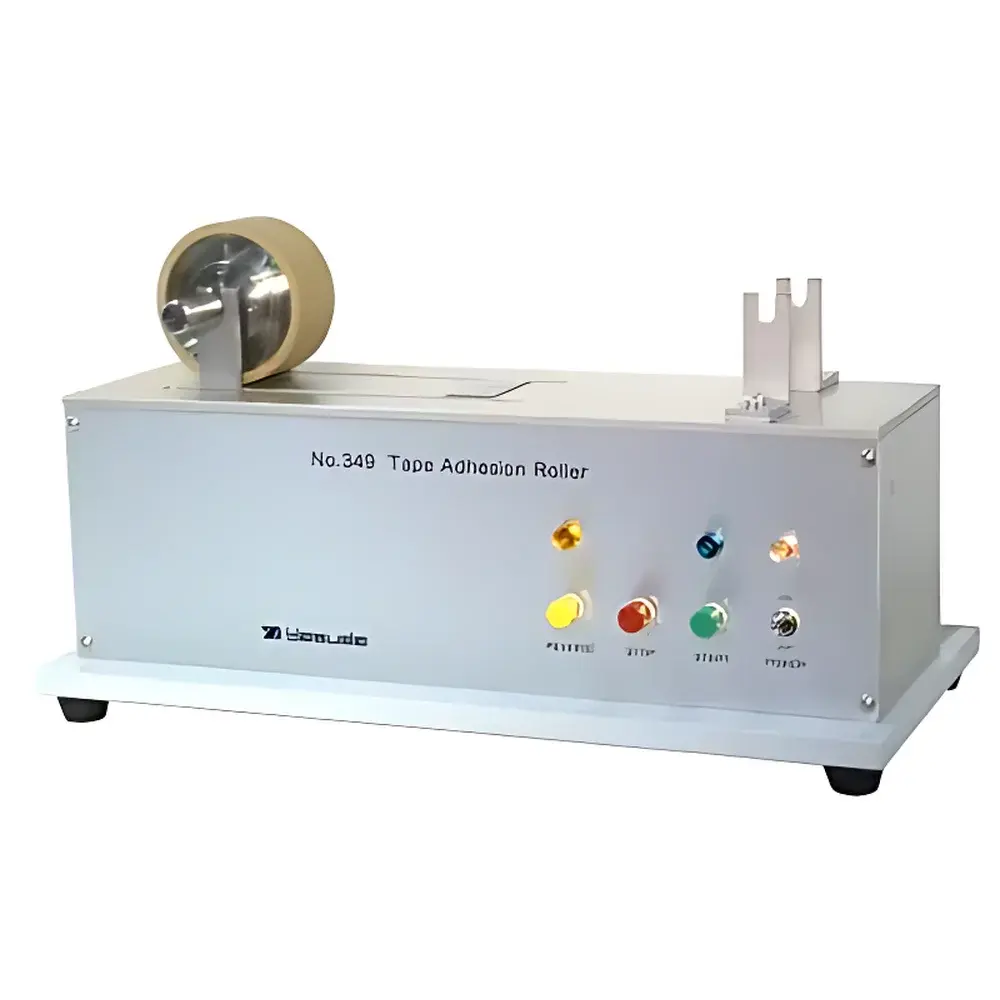
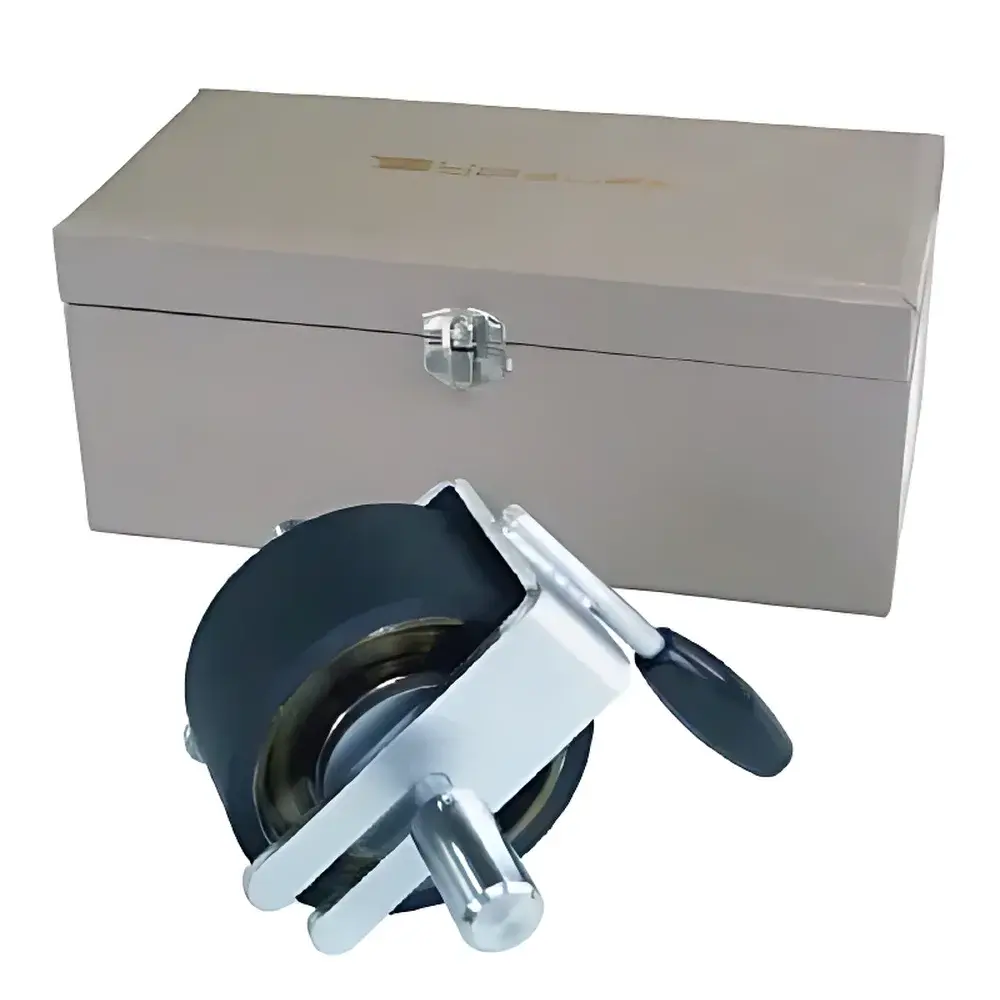
Yasuda No.349 Tape Adhesion Roller Tester
| Brand | Yasuda |
|---|---|
| Origin | Japan |
| Model | No.349 |
| Standard Compliance | JIS C 2107, JIS Z 2237 |
| Operation Mode | Manual and Motorized Options Available |
| Rolling Load | Self-weight only (no auxiliary pressure applied) |
| Application | Static roller-based adhesion conditioning for pressure-sensitive tapes and adhesive films |
Overview
The Yasuda No.349 Tape Adhesion Roller Tester is a precision-engineered mechanical device designed to standardize the application of controlled rolling pressure during adhesion performance evaluation of pressure-sensitive tapes, adhesive films, and laminated sheets. Based on the fundamental principle of uniform linear contact under defined gravitational loading, the instrument delivers repeatable, traceable sample conditioning prior to peel or shear testing. Unlike pneumatic or servo-controlled rollers, the No.349 relies exclusively on the calibrated mass of its cylindrical roller — ensuring compliance with gravimetric loading requirements specified in JIS C 2107 (Electrical Insulating Tapes) and JIS Z 2237 (Adhesive Tapes — Test Methods). This passive loading architecture eliminates variability introduced by actuator hysteresis, air pressure fluctuations, or operator-dependent force application, thereby supporting high reproducibility across laboratories operating under GLP or ISO/IEC 17025 frameworks.
Key Features
- Interchangeable roller configurations: Standard roller diameter (80 mm) and width (100 mm) conform to JIS geometrical specifications; optional stainless-steel or anodized aluminum rollers available for corrosion resistance or surface energy control.
- Dual-mode operation: Manual lever-actuated carriage enables precise low-speed rolling (0.3–0.5 m/min typical), while the motorized version provides programmable constant-speed rolling (0.1–1.0 m/min, ±2% speed stability) via brushless DC drive.
- Roller weight calibration: Factory-certified roller mass (2.000 ± 0.005 kg) ensures consistent nominal line load of 19.6 N per 100 mm width — directly satisfying JIS Z 2237 Clause 6.2.1 requirements.
- Rigid cast-iron base with machined granite reference surface (flatness ≤ 5 µm/m²) minimizes deflection during rolling and maintains parallelism between roller axis and test substrate.
- Adjustable sample holder clamping system accommodates specimens up to 150 mm wide × 300 mm long, with positive edge registration pins for lateral alignment repeatability.
Sample Compatibility & Compliance
The No.349 supports standardized specimen formats defined in JIS C 2107 (e.g., 25 mm × 100 mm tape strips on stainless steel or aluminum test plates) and JIS Z 2237 (including double-coated tapes, transfer adhesives, and foam-core laminates). It is routinely deployed in QC laboratories validating ASTM D3330 (Peel Adhesion of Pressure-Sensitive Tape), ISO 29862:2021 (Adhesives — Determination of peel resistance), and internal specifications aligned with automotive OEM standards (e.g., GMW14872, Ford FLTM BO 116-01). All mechanical components comply with RoHS Directive 2011/65/EU. Device documentation includes traceable calibration certificates for roller mass and carriage travel accuracy (±0.2 mm over full stroke), supporting audit readiness for ISO 9001 and IATF 16949 environments.
Software & Data Management
While the base No.349 operates as a stand-alone mechanical tester, the motorized variant integrates with optional PC-based control software (Yasuda TAPE-Link v3.2) supporting configurable rolling profiles, real-time speed monitoring, and digital log export (CSV/Excel). Software modules include audit trail functionality compliant with FDA 21 CFR Part 11 requirements — featuring user authentication, electronic signatures, and immutable event logging for all parameter changes and test executions. Raw data files retain metadata including ambient temperature/humidity (via optional external sensor input), roller serial number, and calibration expiry date — facilitating full traceability in regulated pharmaceutical or medical device manufacturing settings.
Applications
- Pre-conditioning of PSA tapes prior to 90° or 180° peel testing per ASTM D6252 and JIS Z 0237.
- Standardized lamination of thin-film substrates (e.g., PET, PI, copper foil) onto rigid carriers for flex circuit qualification.
- Quality control of die-cut adhesive parts used in consumer electronics assembly (e.g., camera module mounting, display bezel bonding).
- Research-grade correlation studies between rolling dwell time, substrate roughness (Ra < 0.8 µm), and interfacial void formation observed via cross-sectional SEM.
- Validation of adhesive aging effects under accelerated thermal cycling protocols (e.g., 85°C/85% RH for 1000 h), where consistent initial bond formation is critical to failure mode interpretation.
FAQ
Does the No.349 meet FDA or ISO 13485 requirements for medical adhesive testing?
Yes — when operated within documented SOPs and paired with calibrated metrology tools, the No.349 satisfies the equipment qualification criteria for adhesive process validation under ISO 13485:2016 Clause 7.5.2.1 and FDA Guidance for Industry: Process Validation.
Can the roller be recalibrated onsite?
Roller mass calibration requires certified mass standards (Class E2) and must be performed in an accredited metrology lab; however, users may verify roller geometry and carriage linearity using supplied gauge blocks and dial indicators per maintenance manual Section 4.3.
Is there a version compliant with ASTM D1000?
The No.349’s mechanical design and loading profile are fully compatible with ASTM D1000 Annex A1 (Rolling Ball Tack Test Preparation), though it is not marketed as a tack tester — it serves strictly as a conditioning stage preceding tack measurement.
What environmental conditions are recommended during operation?
Testing shall be conducted in a conditioned laboratory per ASTM D618: temperature 23 ± 2°C, relative humidity 50 ± 5%, with acclimation of specimens ≥ 4 hours prior to rolling.
How often does the roller require surface reconditioning?
Under normal use (≤ 50 cycles/day), stainless-steel rollers maintain surface finish (Ra ≤ 0.2 µm) for ≥ 12 months; visual inspection and profilometer verification are recommended quarterly per preventive maintenance schedule.



