
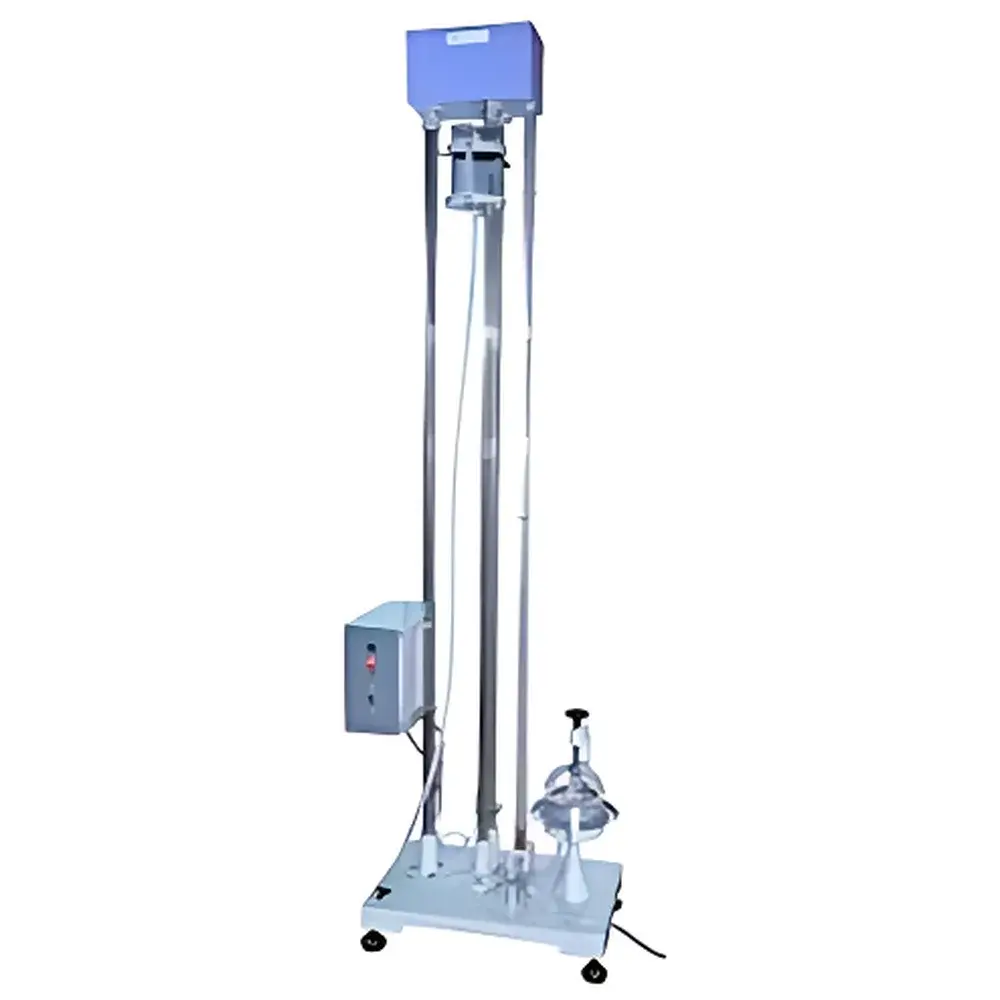
Yasuda No.409 Water Penetration Resistance Tester for Textiles
| Brand | Yasuda |
|---|---|
| Origin | Japan |
| Model | No.409 |
| Complies with | JIS L 1092 (Method A – Low-Pressure Rise), ISO 811 |
| Test Principle | Hydrostatic Pressure Resistance Measurement via Controlled Water Column Rise |
| Operation Modes | Dynamic Water Level Rise (Standard A Method), Fixed-Pressure Hold, and Leakage Detection Mode |
| Sample Clamping | Dual-Ring Mechanical Clamp with Uniform Sealing Force |
| Maximum Test Height | ≥ 200 cm H₂O (typical range for textile hydrostatic head evaluation) |
| Resolution | 1 mm water column |
| Repeatability | ≤ ±2 cm H₂O (per ASTM D751 / ISO 811 inter-laboratory consensus) |
Overview
The Yasuda No.409 Water Penetration Resistance Tester for Textiles is a precision-engineered instrument designed to quantify the hydrostatic pressure resistance of woven, knitted, nonwoven, and laminated fabric structures. It operates on the fundamental principle of controlled hydrostatic head application—where a vertically oriented water column exerts increasing pressure against a horizontally clamped fabric specimen until penetration occurs at three discrete points on the reverse side. This method aligns strictly with the gravimetric hydrostatic pressure test defined in JIS L 1092 (Method A: Low-Pressure Rise) and ISO 811, both of which are internationally recognized standards for evaluating water repellency in technical textiles, outdoor apparel, protective workwear, and medical barrier fabrics. Unlike spray or impact-based water resistance assessments, the No.409 delivers quantitative, reproducible data expressed in centimeters of water column (cm H₂O), enabling direct comparison across material batches, finishing treatments (e.g., fluorocarbon or silicone coatings), and developmental iterations.
Key Features
- Compliance-certified mechanical design adhering to dimensional and procedural requirements of JIS L 1092 and ISO 811 for Method A testing.
- Dual-ring clamping system ensures uniform sealing pressure across the 100 mm diameter test area, minimizing edge leakage and eliminating operator-induced variability.
- Manually calibrated vertical water column with millimeter-scale graduations and stable reservoir geometry for precise hydrostatic head control.
- Three-point penetration detection protocol: automatic termination trigger upon visual confirmation of water breakthrough at three designated locations on the fabric’s underside—ensuring objective pass/fail determination per standard criteria.
- Multi-mode operational flexibility: supports dynamic water level rise (standard), fixed-pressure hold (for time-to-penetration analysis), and continuous leakage monitoring (for semi-permeable membranes or coated substrates).
- Stainless steel construction and corrosion-resistant fluid pathways ensure long-term dimensional stability and compatibility with deionized or tap water under laboratory environmental conditions.
Sample Compatibility & Compliance
The No.409 accommodates flat fabric specimens up to 150 mm in diameter, with thicknesses ranging from 0.1 mm (lightweight voile) to 3.0 mm (reinforced laminates). It is validated for use with natural fibers (cotton, wool), synthetic filaments (polyester, nylon), blends, and coated composites—including microporous membranes used in breathable rainwear. All test procedures conform to the sampling, conditioning (ISO 139:2005), and reporting requirements specified in JIS L 1092 and ISO 811. Data generated meets traceability expectations for internal quality control, third-party certification (e.g., OEKO-TEX® STANDARD 100, bluesign®), and regulatory documentation supporting CE marking or FDA-regulated PPE dossiers.
Software & Data Management
As a benchtop mechanical tester, the No.409 operates without embedded firmware or digital interfaces—intentionally designed to eliminate software validation overhead in GLP/GMP environments. Test records are documented manually using standardized lab notebooks or LIMS-integrated forms. The absence of electronic data capture ensures full compliance with 21 CFR Part 11 where handwritten, witnessed, and dated entries are required. Optional accessories include calibrated height gauges, digital calipers (for pre-test thickness verification), and certified reference fabrics for daily system verification—supporting audit-ready workflows in textile QC laboratories operating under ISO/IEC 17025 accreditation.
Applications
- Quality assurance of waterproof/breathable membranes in outdoor gear manufacturing.
- Evaluation of durable water repellent (DWR) finish efficacy and wash-fastness per AATCC TM195 and ISO 6330.
- R&D screening of nanocoated textiles, electrospun nanofiber layers, and hydrophobic yarn architectures.
- Regulatory submission support for EN 343 (protective clothing against rain) and ISO 22612 (medical gowns).
- Comparative benchmarking of hydrostatic head performance across fiber architecture, weave density, and post-finishing parameters.
FAQ
What standards does the Yasuda No.409 explicitly support?
It is engineered and verified for JIS L 1092 Method A (low-pressure rise) and ISO 811 hydrostatic pressure testing protocols.
Can it be used for ISO 811 Method B (fixed pressure)?
Yes—the instrument allows manual stabilization at any selected water column height for duration-based penetration observation.
Is calibration traceable to national standards?
Height scale graduation is manufactured to ±0.5 mm tolerance; users may verify against NIST-traceable depth gauges during periodic equipment qualification.
Does it require electrical power or compressed air?
No—it is a fully passive, gravity-driven mechanical system requiring only a stable lab bench and water supply.
How is operator variability minimized during testing?
Through rigid clamping geometry, standardized specimen conditioning (24 h at 20°C/65% RH), and unambiguous three-point breakthrough criteria defined in the referenced standards.






