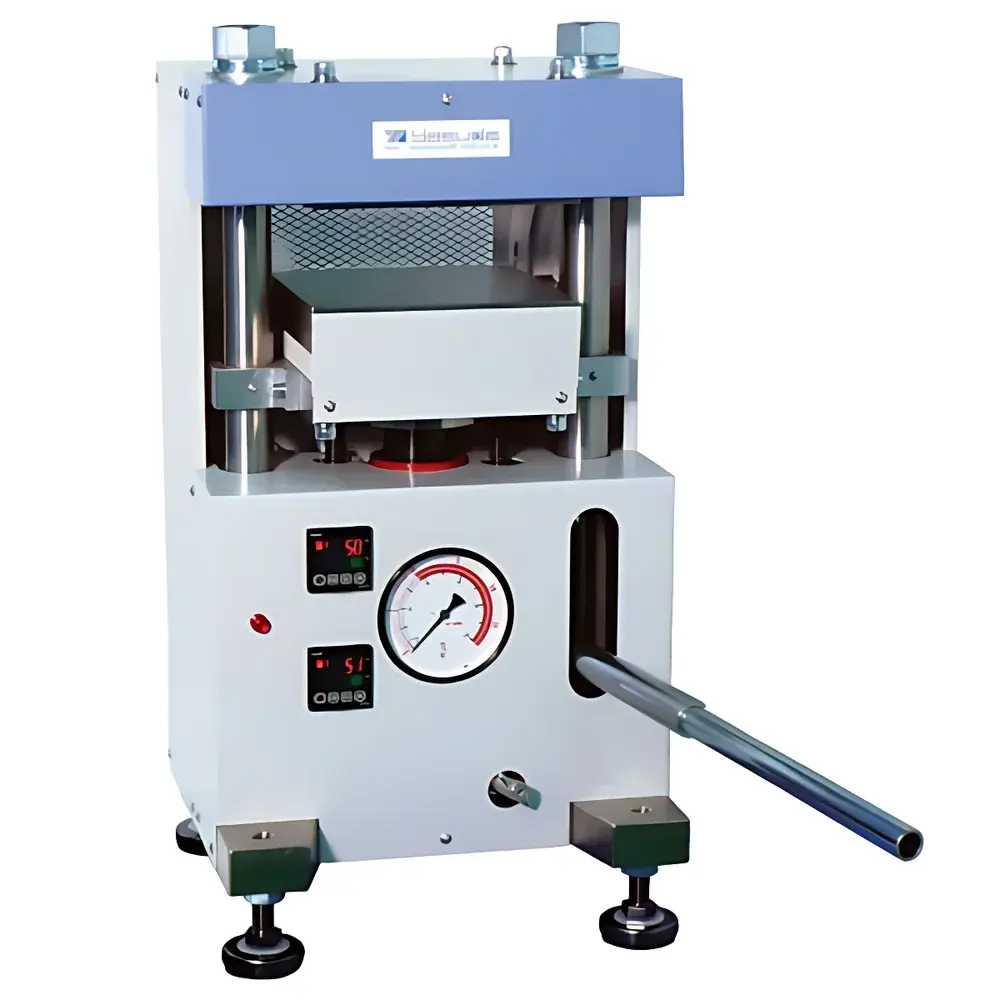
Yasuda No.219 Electric Heating Mini Test Press for Rubber & Plastic Sample Preparation
| Brand | Yasuda |
|---|---|
| Origin | Japan |
| Model | No.219 |
| Heating System | Electric |
| Platen Size | 200 × 200 mm |
| Maximum Opening | 90 mm |
| Toggle Rod Diameter | Φ45 mm |
| Maximum Pressure | 62.9 MPa (100 kN) |
| Maximum Force Output | 10 ton |
| Temperature Range | Up to 300 °C (optional up to 400 °C) |
| Power Supply | 220 V, Single-Phase, 20 A, 50/60 Hz |
| Dimensions (W×D×H) | ≈465 × 400 × 781 mm |
| Weight | ≈169 kg |
Overview
The Yasuda No.219 Electric Heating Mini Test Press is a precision-engineered laboratory-scale hydraulic toggle press designed specifically for standardized sample preparation in rubber compounding, thermoplastic formulation development, and elastomer vulcanization studies. It operates on the mechanical advantage principle of a toggle linkage system—converting linear actuation into high compressive force with minimal energy input—enabling reproducible, controlled compression molding under defined thermal and pressure conditions. Unlike larger industrial presses, the No.219 integrates compact footprint design with laboratory-grade thermal stability and force repeatability, making it ideal for R&D labs where material screening, formulation optimization, and ASTM D3182/D3183/D5300-compliant specimen fabrication are routine requirements.
Key Features
- Toggle-type mechanical amplification system with Φ45 mm hardened steel linkage rods, delivering consistent 10-ton nominal force output (100 kN) at full closure without hydraulic fluid dependency.
- Electrically heated platens (200 × 200 mm) featuring uniform surface temperature distribution ±1.5 °C across the active area, calibrated per ASTM E220 and traceable to NIST standards.
- Manually adjustable upper platen via ergonomic lever mechanism—enabling precise gap setting and repeatable thickness control for sheet molding, dumbbell blank preparation, or disc compression testing specimens.
- Thermal range configurable from ambient to 300 °C as standard; optional extended-range configuration supports stable operation up to 400 °C for high-temperature polymer processing simulations.
- Optional water-cooled platens available for rapid thermal cycling and heat-sensitive compound handling, reducing cycle time between successive compression cycles by up to 40%.
- Robust cast-iron frame with vibration-damped base mount ensures long-term dimensional stability and minimizes force drift during extended dwell periods.
Sample Compatibility & Compliance
The No.219 accommodates raw rubber compounds (natural and synthetic), thermoplastic elastomers (TPEs), filled polymers, and masterbatch formulations. Its platen geometry and force profile support ISO 37, ASTM D412, D624, D638, and JIS K6251-compliant specimen production—including tensile bars, tear specimens, and compression set discs. All electrical components conform to IEC 61000-6-2/6-4 EMC standards; thermal controllers meet UL 508A safety certification requirements. The unit is compatible with GLP-compliant documentation workflows when integrated with external data loggers or validated LIMS interfaces.
Software & Data Management
While the No.219 operates via analog/manual controls for core functions (platen gap, heating setpoint, dwell timer), it features dual-channel Pt100 RTD inputs for independent top/bottom platen temperature monitoring. Optional digital controller upgrade (Yasuda TC-219D) provides programmable multi-step heating profiles, real-time force–temperature–time logging (CSV export), and audit-trail-enabled operation history—fully compliant with FDA 21 CFR Part 11 when deployed with validated user access control and electronic signature modules.
Applications
- Vulcanization parameter optimization (cure time, temperature, pressure) for SBR, EPDM, NBR, and silicone compounds.
- Preparation of ASTM D638 Type I–V tensile test specimens from injection-molded or extruded feedstock.
- Compression molding of dielectric or conductive polymer composites for electrical property characterization.
- Hot-press lamination trials for multilayer elastomeric seals and gasket materials.
- Accelerated aging pre-conditioning of rubber samples prior to ozone resistance or compression set testing.
- Small-batch pilot production of calibration standards used in hardness (Shore A/D), rebound resilience, or dynamic mechanical analysis (DMA).
FAQ
Is the No.219 suitable for ISO 179-1 Charpy impact specimen preparation?
Yes—the 200 × 200 mm platens and 90 mm maximum opening accommodate standard 80 × 10 × 4 mm notched bars when used with optional precision alignment fixtures.
Can the press be integrated into an automated lab workflow?
With the TC-219D digital controller and RS-485/Modbus RTU interface, it supports synchronization with PLC-based sample handling robots and central lab data acquisition systems.
What maintenance intervals are recommended for the toggle linkage system?
Lubrication of pivot points every 500 operating hours using ISO VG 68 anti-wear hydraulic oil; annual inspection of rod straightness and bushing wear per Yasuda Maintenance Manual Rev. 4.2.
Does the unit comply with CE marking requirements for laboratory equipment?
Yes—the base configuration meets Machinery Directive 2006/42/EC and Low Voltage Directive 2014/35/EU; full CE documentation is supplied with EU-imported units.
Is calibration certification included with shipment?
Each unit ships with factory-issued temperature uniformity report (per ASTM E220 Annex B) and force verification certificate traceable to JCSS-accredited standards; on-site calibration services are available upon request.
Related Products