
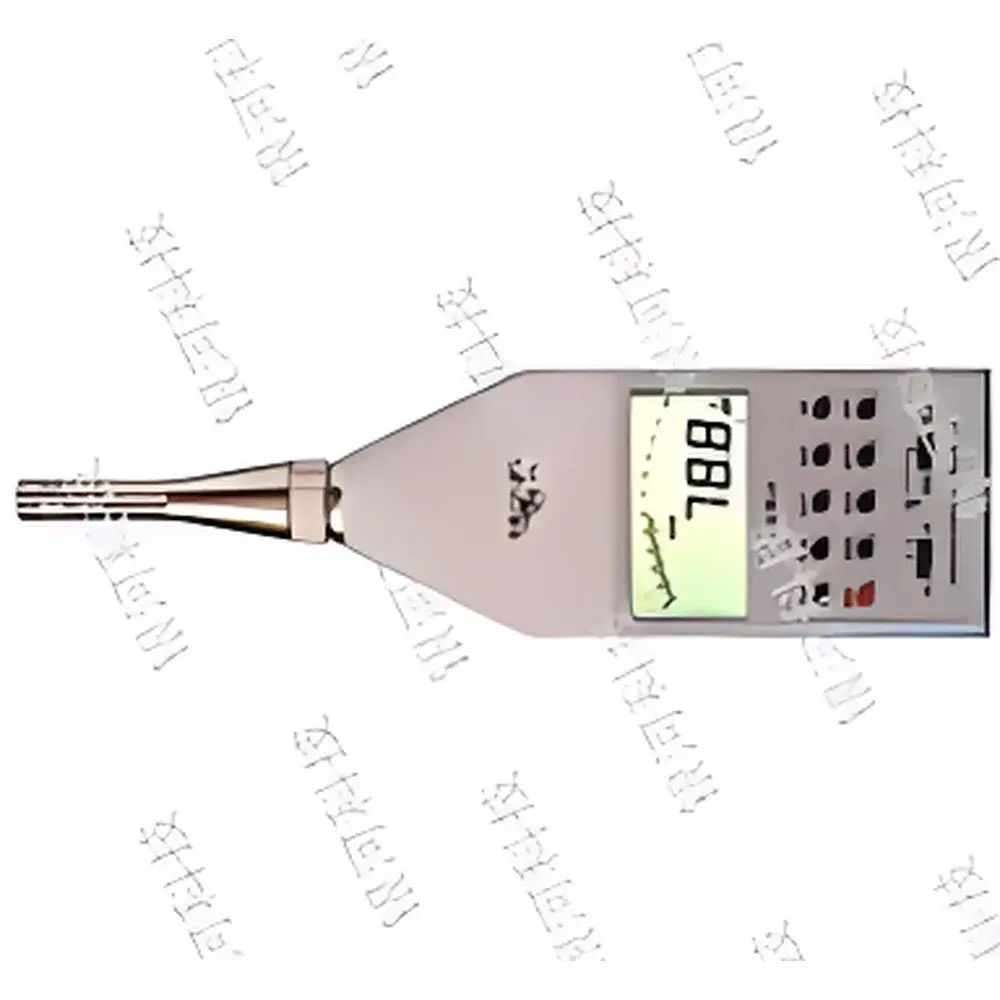
HS5670B Pulse-Integrating Precision Sound Level Meter
| Origin | Jiangsu, China |
|---|---|
| Manufacturer Type | Authorized Distributor |
| Country of Origin | China |
| Model | HS5670B |
| Pricing | Available Upon Request |
| Sound Pressure Level Range | 25–135 dB(A), 35–135 dB(C), 45–135 dB(Lin) |
| Frequency Weighting | A, C, and Linear (Lin) |
| Frequency Response | 10 Hz – 20 kHz |
| Time Weighting | Fast (F), Slow (S), Max Hold |
| Measurement Functions | Leq, LAE, SD, Lmin, L95, L90, L50, L10, L5, Lmax, T60, Lepn |
| Spectral Analysis | 1/1-octave & 1/3-octave (with external filter set) |
| Display | 40 mm × 70 mm LCD, 4-digit resolution, 0.1 dB step |
| Data Output | RS232C serial interface, AC/DC analog outputs, external power input |
| Measurement Duration Options | Manual, 10 s, 1–30 min, 1–24 h |
| Real-time Clock | Year/Month/Day/Hour/Minute/Second |
| Compliance | IEC 60804:2000 & GB/T 17181–1997 Class 1 |
Overview
The HS5670B Pulse-Integrating Precision Sound Level Meter is a Class 1 compliant acoustic measurement instrument engineered for high-accuracy environmental and occupational noise assessment. It operates on the principle of electret condenser microphone transduction coupled with digital signal processing (DSP) to deliver real-time, time-weighted, and statistically integrated sound pressure level (SPL) measurements. Designed as an evolution of the HS5670XA automated noise monitoring platform, the HS5670B integrates pulse-integration capability—enabling robust capture and quantification of transient, impulsive, and non-stationary noise events such as aircraft flyovers, construction impacts, or industrial hammering. Its wide dynamic range (25–135 dB in A-weighting), flat frequency response from 10 Hz to 20 kHz, and support for both A- and C-weighting make it suitable for regulatory compliance testing under international standards including IEC 60804:2000 and GB/T 17181–1997.
Key Features
- Class 1 accuracy per IEC 60804:2000 and GB/T 17181–1997 — validated for legal metrology and enforcement-grade environmental noise surveys.
- Pulse-integrated measurement architecture optimized for impulsive noise characterization, including effective perceived noise level (Lepn) calculation per ISO 5071 and FAA AC 150/5050-1D protocols.
- Four-digit LCD display (40 mm × 70 mm) with 0.1 dB resolution and backlight for low-light field operation.
- Comprehensive statistical analysis suite: Leq, LAE, Lmax, Lmin, L10, L50, L90, standard deviation (SD), and percentile-based metrics (L5, L95).
- Configurable measurement durations—from 10 seconds to 24 hours—with embedded real-time clock (RTC) supporting timestamped data logging (YYYY-MM-DD HH:MM:SS).
- Dual analog outputs (AC/DC) plus RS232C serial interface for bidirectional communication with PC-based acquisition software; supports real-time SPL streaming and post-processed spectral reconstruction.
- Expandable spectral analysis via external 1/1-octave and 1/3-octave filter sets—enabling octave-band energy distribution mapping for source identification and noise control engineering.
Sample Compatibility & Compliance
The HS5670B is calibrated and verified for use with standardized 1/2-inch electret condenser microphones (e.g., PCB Piezotronics 377B02 or equivalent), and maintains traceability to national acoustic standards through factory calibration certificates. It meets the performance requirements for occupational health assessments under ISO 9612:2009 and environmental noise monitoring per ISO 1996-1:2016 and EU Directive 2002/49/EC. While not inherently FDA 21 CFR Part 11 compliant (as it lacks electronic signature and audit trail functionality at firmware level), its raw data export via RS232 enables integration into validated laboratory information management systems (LIMS) where full GLP/GMP traceability is required. The device is routinely deployed in factory floor noise mapping, airport community noise monitoring, urban traffic noise studies, and classroom acoustics evaluation—contexts demanding repeatable, auditable, and metrologically defensible measurements.
Software & Data Management
Data acquisition and post-processing are supported through proprietary Windows-compatible software (supplied on USB drive), which provides synchronized time-series visualization, statistical summary reports, Lepn computation for aircraft noise events, and T60 reverberation time estimation using decay curve fitting algorithms. All measurement sessions are stored internally with timestamps and configuration metadata (weighting, time constant, range, duration). Export formats include CSV (for Excel or MATLAB import), PDF report generation, and binary log files compatible with third-party acoustic analysis platforms. The RS232C interface supports ASCII command protocol for remote triggering, parameter configuration, and live data polling—facilitating integration into SCADA or IoT-enabled environmental monitoring networks.
Applications
- Environmental noise impact assessment near airports, highways, railways, and industrial zones.
- Ongoing compliance monitoring for OSHA 29 CFR 1910.95 and EU Physical Agents (Noise) Directive 2003/10/EC.
- Acoustic characterization of machinery, HVAC systems, and power generation equipment per ISO 3744 and ISO 3746.
- Educational laboratories requiring hands-on instruction in noise physics, psychoacoustics, and regulatory frameworks.
- Building acoustics evaluation—including façade transmission loss and room reverberation (T60)—when paired with impulse response generation tools.
- Research on noise-induced hearing loss (NIHL) epidemiology, where precise Leq and Lex,8h derivation is essential.
FAQ
Does the HS5670B support real-time 1/3-octave analysis without external hardware?
No. Real-time 1/3-octave band analysis requires connection to an externally powered, calibrated 1/3-octave filter set via the dedicated analog input port.
Is calibration certificate included with shipment?
Yes—a NIST-traceable factory calibration certificate (valid for 12 months) is provided with each unit, documenting sensitivity, linearity, and frequency response verification.
Can the device operate continuously on battery power during long-term monitoring?
It supports dual power modes: internal rechargeable Ni-MH battery (up to 12 h runtime) or continuous DC input (7–12 V) via the external power jack—ideal for unattended 24/7 deployments.
What is the uncertainty budget for Leq measurements at 1 kHz and 94 dB?
At reference conditions (23 °C, 50 % RH), expanded uncertainty (k=2) for Leq is ±0.5 dB, derived from microphone sensitivity tolerance, amplifier drift, and digital quantization error per IEC 61672-1:2013 Annex F.
Is firmware upgrade possible in the field?
Yes—firmware updates are delivered via RS232C using the included utility software and require no hardware modification.
Related Products







