
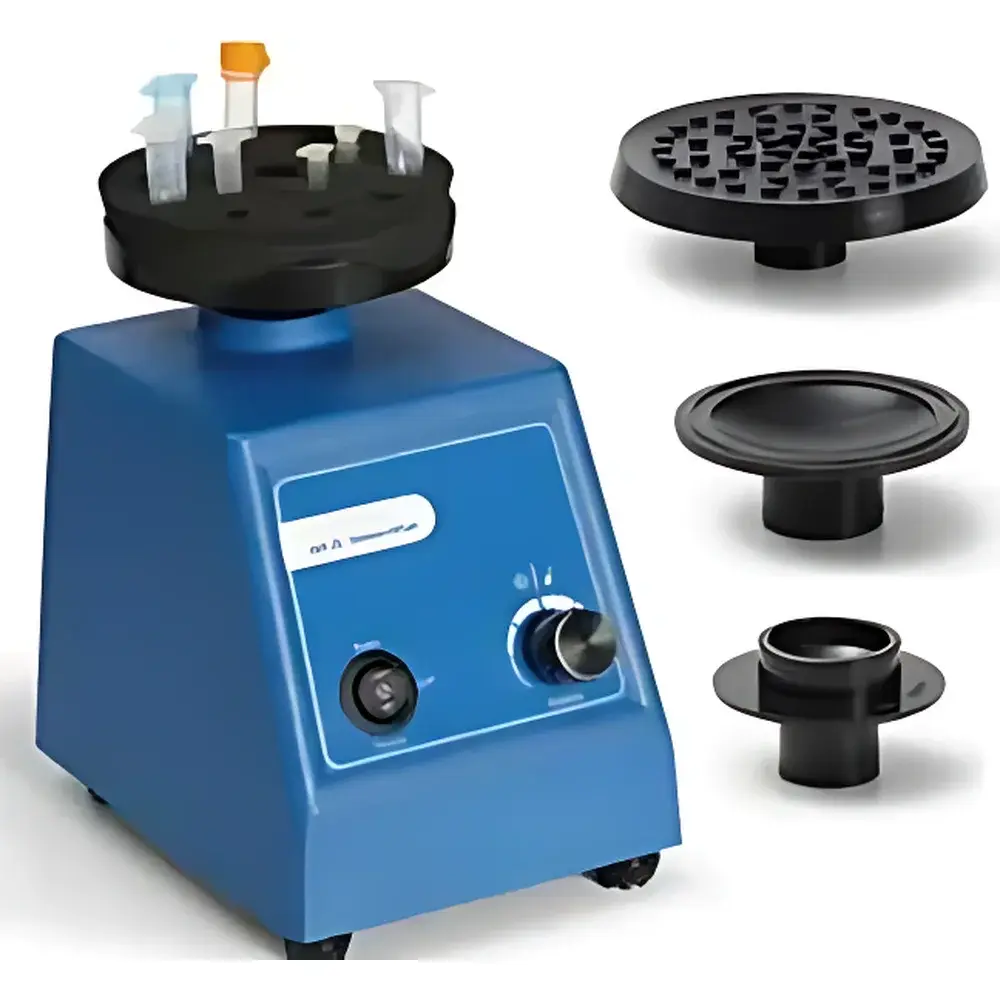
ZiQi XH-D Vortex Mixer
| Brand | ZiQi |
|---|---|
| Origin | Shanghai, China |
| Manufacturer Type | Direct Manufacturer |
| Country of Origin | China |
| Model | XH-D |
| Speed Range | 1000–2800 rpm |
| Operating Modes | Continuous, Touch-Activated (Pulse), and Adjustable Speed |
| Motion Type | Circular Orbital Oscillation |
| Housing Material | Anodized Aluminum Alloy |
| Speed Display | Analog Dial Gauge |
| Dimensions (W×D×H) | 170 × 120 × 170 mm |
| Input Voltage | 220 V ±10%, 50 Hz |
| Standard Platforms | Silicone Rubber Cup Holder, Plastic Cup Holder, Multi-Well Plate Adapter, Non-Slip Rubber Mat |
Overview
The ZiQi XH-D Vortex Mixer is a compact, benchtop orbital shaker engineered for reproducible and controllable mixing of small-volume liquid and suspension samples in life science and analytical laboratories. It operates on the principle of circular orbital oscillation—generating consistent, off-center rotational motion that induces vortex formation in tubes and vessels placed on its platform. Unlike linear shakers or rocking platforms, this design ensures rapid homogenization of viscous, low-volume, or heterogeneous mixtures—including aqueous solutions, cell suspensions, reagent dilutions, and powdered solids suspended in buffer—without requiring magnetic stir bars or external agitation accessories. Its mechanical architecture prioritizes stability and minimal vibration transmission to adjacent instrumentation, making it suitable for shared lab benches where precision-sensitive devices (e.g., balances, spectrophotometers) are in proximity.
Key Features
- Three operational modes: continuous rotation, momentary pulse activation via tactile switch, and continuously variable speed control—enabling precise adaptation to sample viscosity, container geometry, and mixing endpoint requirements.
- Four interchangeable platform inserts included as standard: silicone rubber cup holder (for 10–15 mm diameter test tubes), rigid plastic cup holder (optimized for conical centrifuge tubes), multi-well plate adapter (compatible with 96-well microplates), and non-slip rubber mat (for beakers, flasks, and irregularly shaped vessels).
- High-torque, brushless AC motor sourced from an ISO-certified OEM supplier—engineered for thermal stability, extended service life (>10,000 hr MTBF), and acoustic performance below 45 dB(A) at 2500 rpm.
- Anodized aluminum housing provides structural rigidity, corrosion resistance, and passive heat dissipation—critical for uninterrupted operation during extended protocols such as enzyme incubation or antibody labeling workflows.
- Robust base mass (approx. 2.3 kg) minimizes lateral displacement and resonance across the full speed range, ensuring consistent mixing force delivery regardless of load distribution or platform configuration.
Sample Compatibility & Compliance
The XH-D accommodates standard laboratory consumables including polypropylene and glass test tubes (10–18 mm OD), Eppendorf-style microcentrifuge tubes (0.2–2.0 mL), 15 mL and 50 mL conical tubes, 96-well PCR plates, and low-form beakers up to 100 mL volume. Its orbital amplitude (±3 mm) and acceleration profile (up to 12 g at 2800 rpm) are calibrated to meet common method requirements in molecular biology (e.g., DNA extraction lysis steps per QIAamp protocols), clinical diagnostics (sample homogenization prior to ELISA or hematology analysis), and quality control testing (USP dissolution auxiliary mixing). While not certified to IEC 61000-6-3 (EMC) or ISO 13485 for medical device manufacturing, the unit complies with general electrical safety standards applicable to Class I laboratory equipment under GB 4793.1–2007 (Chinese national adoption of IEC 61010-1).
Software & Data Management
As a manually operated analog instrument, the XH-D does not incorporate digital firmware, connectivity interfaces (e.g., USB, Bluetooth), or data logging capabilities. Speed selection and mode activation are performed exclusively via front-panel mechanical controls: a rotary dial for fine-grained rpm adjustment (calibrated scale: 0–3000 rpm) and a dual-position toggle switch (Continuous/Pulse) with integrated tactile feedback. This architecture eliminates software validation dependencies, simplifies qualification under GLP and GMP environments, and supports audit-ready documentation through manual logbook entries or integration into electronic lab notebook (ELN) workflows using standardized SOPs referencing defined speed/time parameters.
Applications
- Routine resuspension of pelleted cells, bacterial cultures, or lyophilized reagents prior to downstream processing.
- Homogenization of immiscible phases in extraction protocols (e.g., phenol-chloroform separation, organic-aqueous partitioning).
- Pre-analytical preparation of clinical specimens—including whole blood, serum, plasma, and urine—for automated analyzers or point-of-care testing platforms.
- Mixing of viscous polymer solutions (e.g., agarose, methylcellulose) used in 3D cell culture scaffolds or electrophoresis gel casting.
- Accelerated dissolution of solid-phase catalysts or nanoparticles in reaction screening assays within synthetic chemistry and materials science labs.
FAQ
Is the XH-D compatible with 1.5 mL microcentrifuge tubes?
Yes—the silicone rubber cup holder is dimensionally optimized for 1.5 mL and 2.0 mL Eppendorf-style tubes, providing secure grip without tube deformation.
Can the unit operate continuously for more than 30 minutes?
Yes; the motor and thermal management system support indefinite continuous operation at any speed within the 1000–2800 rpm range, provided ambient temperature remains ≤35°C and ventilation is unobstructed.
Does the analog speed dial provide repeatable settings between users?
The calibrated dial features 10 marked increments (0–3000 rpm), enabling procedural consistency when referenced against validated SOPs—though absolute repeatability requires periodic verification using an external tachometer.
Are replacement platform inserts available separately?
Yes; all four standard platforms (silicone cup holder, plastic cup holder, multi-well adapter, rubber mat) are orderable as individual spare parts with traceable part numbers compliant with ISO 9001 documentation practices.
What maintenance is required for long-term reliability?
No scheduled lubrication or calibration is needed; routine cleaning with 70% ethanol and visual inspection of platform inserts for wear or deformation is sufficient for >5 years of typical academic or industrial use.



