
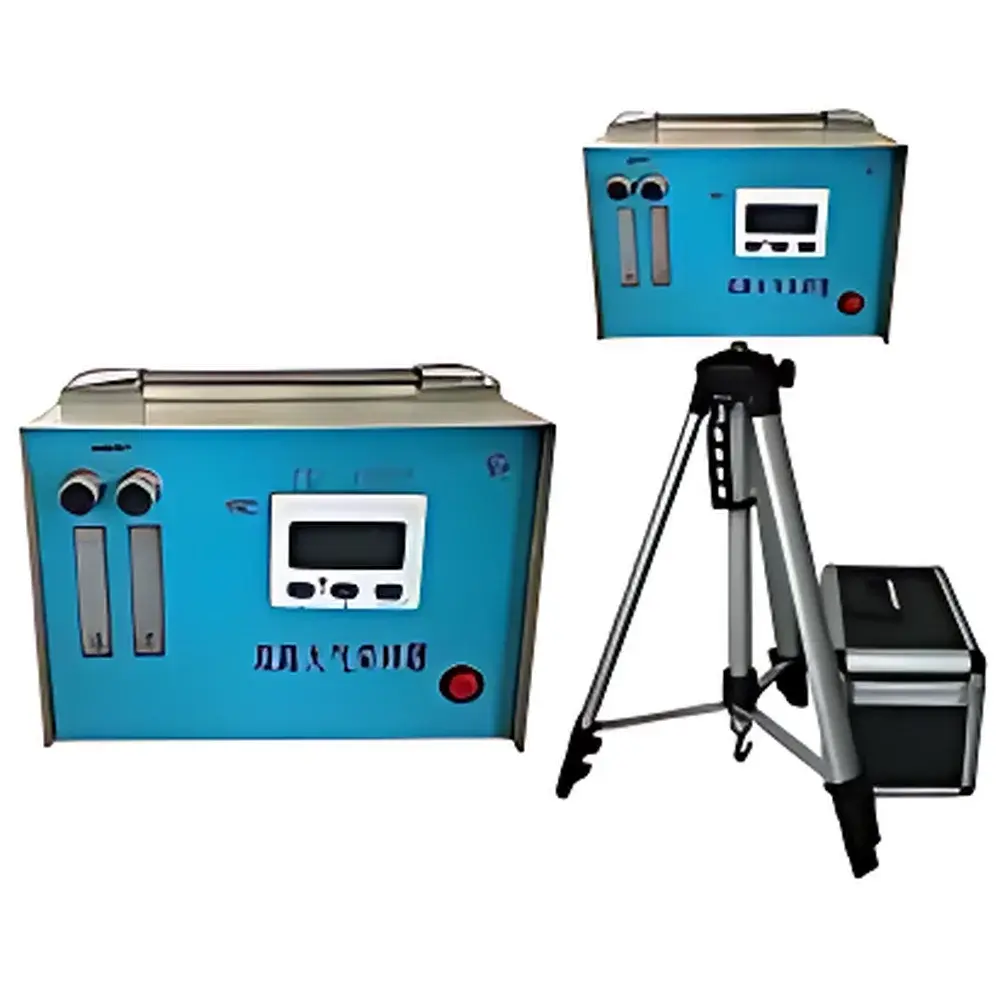
TQ-1000 Dual-Channel Ambient Air Sampler
| Origin | Jiangsu, China |
|---|---|
| Manufacturer Type | Authorized Distributor |
| Origin Category | Domestic (China) |
| Model | TQ-1000 |
| Pricing | Upon Request |
| Sampling Flow Ranges | 0.1–1.5 L/min, 0.1–2.0 L/min, or 0.1–3.0 L/min (user-selectable) |
| Flow Accuracy | ≤ ±5% |
| Timing Accuracy | ≤ ±1% |
| Maximum Negative Pressure | ≥25 kPa |
| Power Supply | 10 V DC (rechargeable Ni-Cd battery) / 220 V AC, 50 Hz |
| Operating Temperature | −10 °C to +45 °C |
| Relative Humidity | ≤85% RH |
| Weight | ~2.0 kg |
Overview
The TQ-1000 Dual-Channel Ambient Air Sampler is a field-deployable, microprocessor-controlled sampling instrument engineered for simultaneous, independent collection of two parallel air samples—critical for method validation, quality assurance, and regulatory compliance in occupational hygiene and environmental monitoring. It operates on the principle of constant-flow volumetric sampling using two isolated diaphragm vacuum pumps, each driven by its own dedicated motor and flow control circuit. This dual-pump architecture eliminates cross-channel interference and ensures metrological independence between sample trains—a requirement aligned with ISO 16000-1, NIOSH Method 0500, and OSHA ID-121 protocols for airborne contaminant assessment. The instrument integrates a high-energy nickel-cadmium (Ni-Cd) rechargeable battery system, enabling uninterrupted operation under variable field conditions without reliance on mains power. Its robust mechanical design, sealed electronics housing, and wide operating temperature range support deployment in industrial facilities, urban ambient networks, and remote monitoring sites.
Key Features
- Dual independent sampling channels with separate pump assemblies, flow sensors, and timing circuits—ensuring true parallel sampling per ASTM D5467 and EN 13670-1 requirements.
- Microcontroller-based timing system with programmable countdown from 1 minute to 99 hours 59 minutes; timing accuracy maintained at ≤ ±1% across full range.
- Three user-selectable flow ranges (0.1–1.5 L/min, 0.1–2.0 L/min, 0.1–3.0 L/min) calibrated against traceable primary standards; flow stability verified under load up to 25 kPa negative pressure.
- Hybrid power architecture: operates seamlessly on 10 V DC (internal Ni-Cd battery) or 220 V AC/50 Hz input; battery provides ≥8 hours cumulative runtime after full 14–16 hour charge cycle.
- Integrated voltage monitoring display indicating real-time battery status during sampling and charging; low-voltage alert triggers at ≤8 V to prevent deep discharge and extend battery service life.
- Ruggedized aluminum alloy chassis with IP54-rated enclosure; compliant with IEC 60529 for dust and splash resistance during outdoor or facility-based use.
Sample Compatibility & Compliance
The TQ-1000 is compatible with standard glass absorption bottles (e.g., impingers, bubblers), sorbent tubes (e.g., charcoal, silica gel, Tenax), and filter cassettes used for gaseous and particulate-phase analytes including VOCs, aldehydes, sulfur dioxide, nitrogen oxides, ozone, and metal fumes. It meets functional performance criteria outlined in ISO 16000-2 (indoor air sampling), EPA Compendium Method TO-17 (sorbent tube sampling), and Chinese HJ/T 375-2007 (ambient air sampler technical specifications). All electronic components conform to EMC Directive 2014/30/EU and Low Voltage Directive 2014/35/EU. Battery charging circuitry complies with IEC 62133 for secondary cells and batteries containing alkaline electrolyte.
Software & Data Management
The TQ-1000 operates as a standalone hardware platform without embedded software or wireless connectivity. All operational parameters—including start time, duration, and channel activation—are set via tactile membrane keypad and displayed on a dual-digit LED screen. No firmware updates or driver installation are required. Sample metadata (start time, duration, flow setting) must be manually recorded in laboratory notebooks or electronic lab notebooks (ELNs) to satisfy GLP and ISO/IEC 17025 documentation requirements. Audit trails are maintained externally through logbooks, calibration certificates, and scheduled maintenance records per manufacturer-recommended intervals (every 6 months or 200 operating hours).
Applications
- Occupational exposure assessment in manufacturing, chemical processing, and mining sectors per OEL monitoring strategies.
- Ambient air quality surveillance networks for regulatory reporting under national air quality standards (e.g., China’s GB 3095-2012).
- Method validation studies requiring paired-sample collection to assess analytical precision and recovery.
- Indoor air quality investigations in schools, offices, and healthcare facilities for formaldehyde, benzene, and total volatile organic compounds (TVOC).
- Field calibration verification of continuous emission monitoring systems (CEMS) using reference-grade grab sampling.
- Emergency response scenarios where rapid, parallel sampling supports triage-level hazard characterization.
FAQ
What types of sampling media are compatible with the TQ-1000?
The instrument supports standard 10–25 mm diameter sorbent tubes, 25–50 mL impingers, and 37 mm or 47 mm filter cassettes—provided backpressure remains within the specified ≥25 kPa limit.
Is the TQ-1000 suitable for use in explosive atmospheres?
No. The TQ-1000 is not intrinsically safe or ATEX-certified. For hazardous locations, refer to explosion-proof variants offered by the original equipment manufacturer (Yinhe Technology Co., Ltd.).
How often should the internal Ni-Cd battery be recharged if stored long-term?
If unused for more than three months, perform a maintenance charge to maintain cell integrity and avoid voltage depression; store at 15–25 °C with ~40% state-of-charge.
Does the TQ-1000 meet FDA 21 CFR Part 11 requirements?
No. As a non-networked, non-auditable hardware device with no electronic signature capability or data export function, it does not fall within the scope of Part 11—but raw sampling records generated alongside its use may be included in Part 11-compliant workflows when documented in validated ELN systems.
Can flow calibration be performed in-house?
Yes. Users may verify flow accuracy using a NIST-traceable primary calibrator (e.g., bubble flowmeter or dry gas meter) at representative points across the selected range; recalibration is recommended annually or after pump servicing.







