
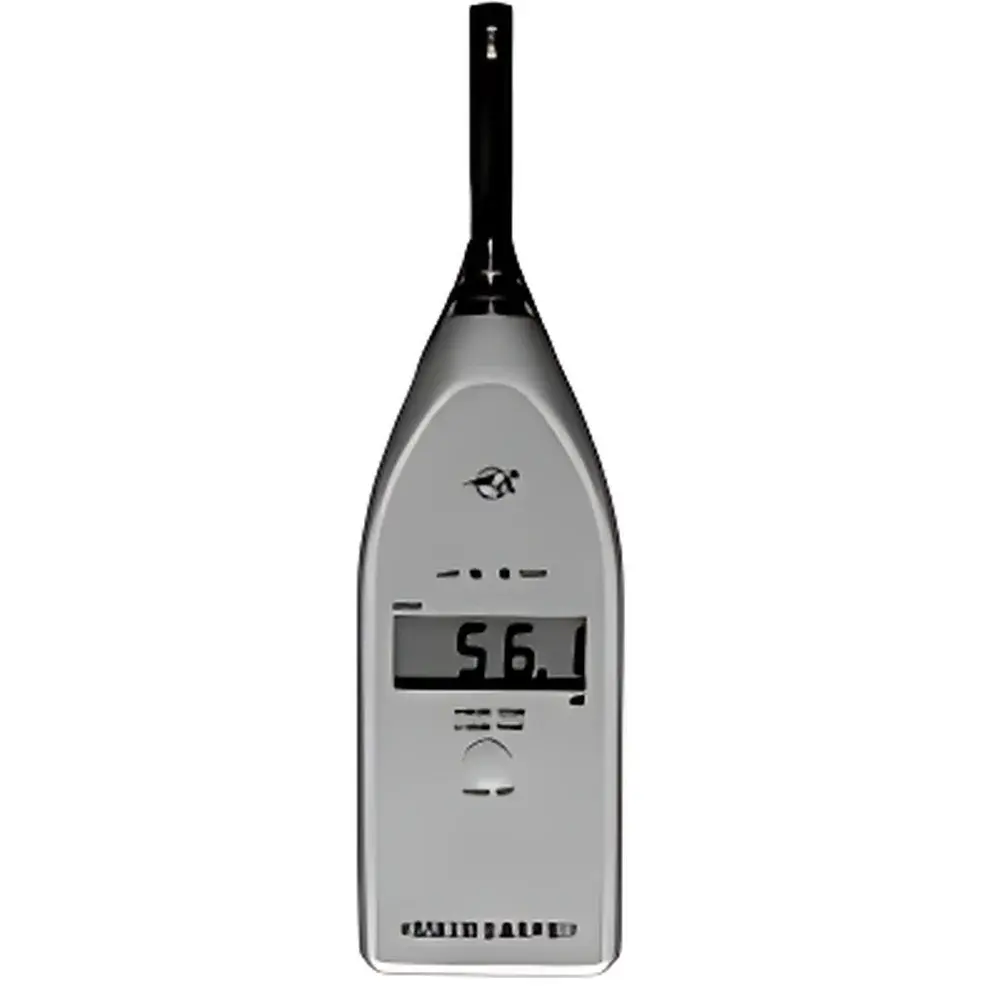
HS5633B Universal Sound Level Meter by Yinhé Technology
| [Origin | Jiangsu, China |
|---|---|
| Type | Class 2 SLM per IEC 61672-1:2013 & JJG 188–2002 |
| Frequency Weighting | A/C |
| Measurement Range | 35–130 dB (A), 40–130 dB (C) |
| Frequency Range | 20 Hz – 12.5 kHz |
| Display | 3.5-digit LCD, 0.1 dB resolution, ~1 update/s |
| Time Weighting | Fast (F), Max Hold |
| Range Selection | Low (35–100 dB), High (65–130 dB) |
| Power | 9 V alkaline battery (DC 7–9 V) |
| AC Output | ≤2 Vrms, 600 Ω |
| DC Output | 0.3–1.3 V (0.1 V/10 dB), 1 MΩ load |
| Dimensions | 246 × 70 × 30 mm |
| Mass | 260 g (incl. battery) |
| Calibration | Compatible with HS6020 (94 dB @ 1 kHz)] |
Overview
The HS5633B Universal Sound Level Meter is a portable, Class 2-compliant acoustic measurement instrument engineered for field-deployable noise assessment in compliance with international and national metrological standards. It operates on the principle of electret condenser microphone transduction coupled with analog signal conditioning and digital display processing, delivering real-time sound pressure level (SPL) readings referenced to 20 µPa (0 dB re 20 µPa). Designed for versatility across environmental, occupational, transportation, and building acoustics applications, the HS5633B implements standardized frequency weighting networks (A and C) and time-weighted response modes (Fast) as defined in IEC 61672-1:2013 and JJG 188–2002. Its compact form factor, low mass, and battery-powered operation make it suitable for handheld spot measurements, short-term noise surveys, and preliminary compliance screening where portability and operational simplicity are prioritized over extended logging or advanced spectral analysis.
Key Features
- Class 2 accuracy per IEC 61672-1:2013 and JJG 188–2002 — validated for routine environmental and industrial noise monitoring
- Dual-frequency weighting networks: A-weighting (for human hearing perception) and C-weighting (for peak-level and low-frequency energy assessment)
- Two manually selectable measurement ranges: Low (35–100 dB) and High (65–130 dB), each with dedicated over-range and under-range visual indicators
- Maximum hold function (HOLD) to capture and retain the highest instantaneous SPL value during a measurement period
- Fast (F) time weighting response (125 ms integration time) conforming to ANSI S1.4 and IEC 61672 requirements
- Backlit 3.5-digit liquid crystal display (50 × 20 mm) with 0.1 dB resolution and approximate 1 Hz update rate
- Integrated AC and DC analog outputs: AC output (≤2 Vrms, 600 Ω) supports connection to external recorders or analyzers; DC output (0.3–1.3 V, scaled at 0.1 V/10 dB, 1 MΩ load) enables direct interfacing with data acquisition systems
- Lightweight construction (260 g with battery) and ergonomic housing (246 × 70 × 30 mm) optimized for extended handheld use
- Single 9 V alkaline battery operation (DC 7–9 V supply range) providing stable performance under variable ambient temperatures
Sample Compatibility & Compliance
The HS5633B is intended for measuring airborne sound pressure levels generated by steady-state, fluctuating, or impulsive noise sources — including road traffic, construction equipment, HVAC systems, electrical transformers, and industrial machinery. It is not designed for octave-band or 1/3-octave spectral analysis, nor for impulse noise classification per ISO 1996-2. The instrument meets the performance criteria for Class 2 sound level meters specified in IEC 61672-1:2013 and the Chinese national verification regulation JJG 188–2002. While not inherently compliant with GLP or FDA 21 CFR Part 11 due to lack of audit-trail-capable firmware or user-accessible calibration lockout, its metrological traceability can be maintained through periodic verification using an accredited acoustic calibrator (e.g., HS6020, 94 dB @ 1 kHz). The device supports optional accessories including windscreen (standard), extension cable (5 m), and transport case — all contributing to measurement integrity in outdoor or non-ideal acoustic environments.
Software & Data Management
The HS5633B operates as a standalone analog-digital hybrid meter without embedded memory or USB/Bluetooth connectivity. Data recording requires external hardware: the DC output signal may be routed to a compatible DAQ system (e.g., National Instruments USB-6009 or equivalent) for time-synchronized logging, while the AC output supports connection to analog tape recorders or oscilloscopes for waveform capture. No proprietary software is supplied; users must implement third-party acquisition platforms (e.g., LabVIEW, MATLAB Data Acquisition Toolbox, or open-source tools such as Audacity with appropriate interface) to process and archive measurements. Calibration verification is performed manually using the HS6020 pistonphone calibrator prior to and following critical measurement sessions, with results documented externally per ISO/IEC 17025 or internal QA procedures.
Applications
- Environmental noise mapping for municipal planning and regulatory reporting (e.g., local ordinances referencing GB 3096–2008)
- Preliminary occupational noise exposure screening in manufacturing, warehousing, and maintenance facilities
- Transportation noise assessment near highways, railways, and airports (as part of baseline studies)
- Building acoustics verification — e.g., façade transmission loss estimation, room reverberation checks, and HVAC noise diagnostics
- Educational laboratory use for physics and environmental science curricula requiring hands-on SPL measurement fundamentals
- Pre-compliance checks prior to formal testing with Class 1 instrumentation or certified laboratories
FAQ
Does the HS5633B support data logging or internal storage?
No. The instrument provides real-time analog and digital display only. Continuous data capture requires external DAQ hardware connected via its DC or AC output ports.
Is the HS5633B suitable for measuring impulsive or impact noise?
It provides Fast (F) time weighting only and lacks Impulse (I) or Peak (Peak) detection modes. Therefore, it does not comply with ISO 1996-2 requirements for impulsive noise assessment.
Can the HS5633B be calibrated traceably to national standards?
Yes — when used with an accredited calibrator (e.g., HS6020 verified to ISO 17025), and when calibration records are maintained per organizational QA protocols.
What is the operating temperature range?
The manufacturer specifies functional operation between 0 °C and +40 °C, with relative humidity up to 90 % RH (non-condensing), consistent with Class 2 environmental limits in IEC 61672-1.
Does the HS5633B meet EU CE or UKCA marking requirements?
As supplied, the device carries no CE or UKCA marking. Compliance with the EU Measuring Instruments Directive (MID) or UK Measuring Instruments Regulations would require additional conformity assessment and technical documentation not provided by default.







