
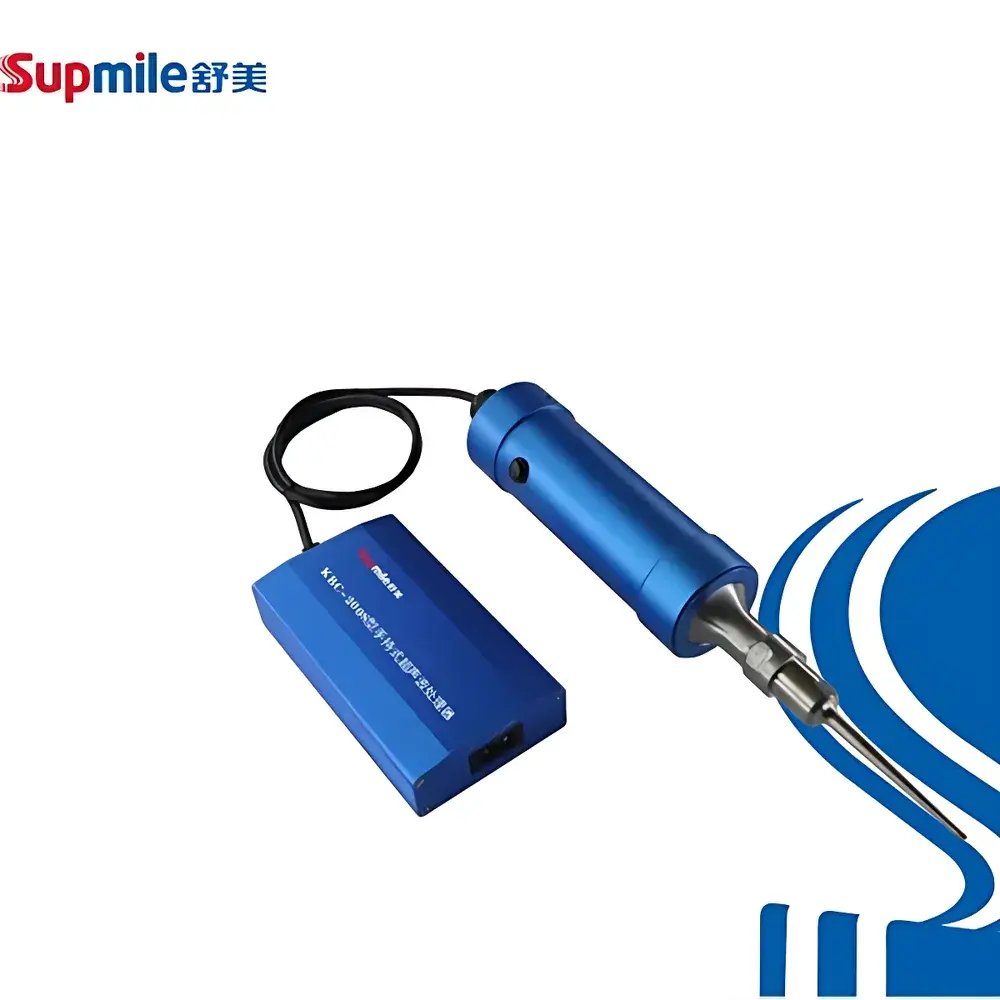
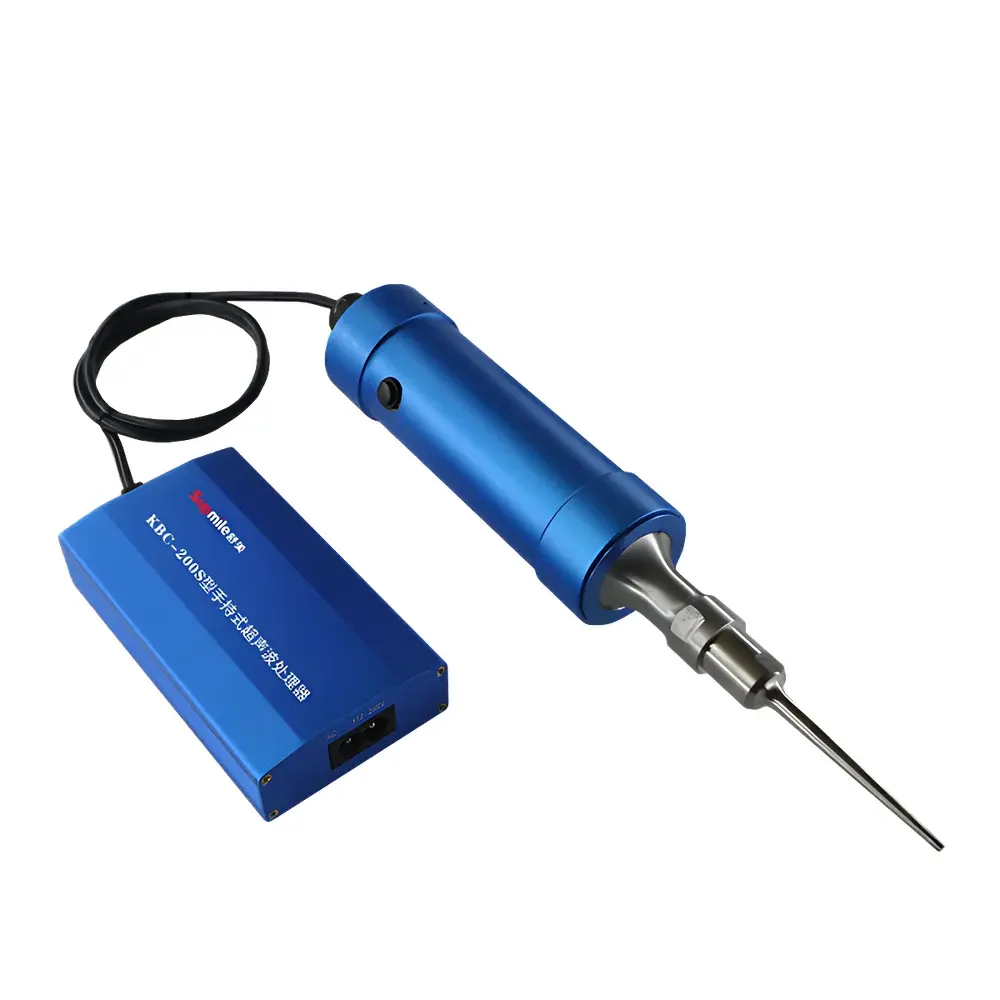
Shumei KBC-200S Handheld Ultrasonic Homogenizer
| Brand | Shumei |
|---|---|
| Origin | Jiangsu, China |
| Manufacturer Type | OEM Manufacturer |
| Country of Origin | China |
| Model | KBC-200S |
| Price | USD 1,520 (approx.) |
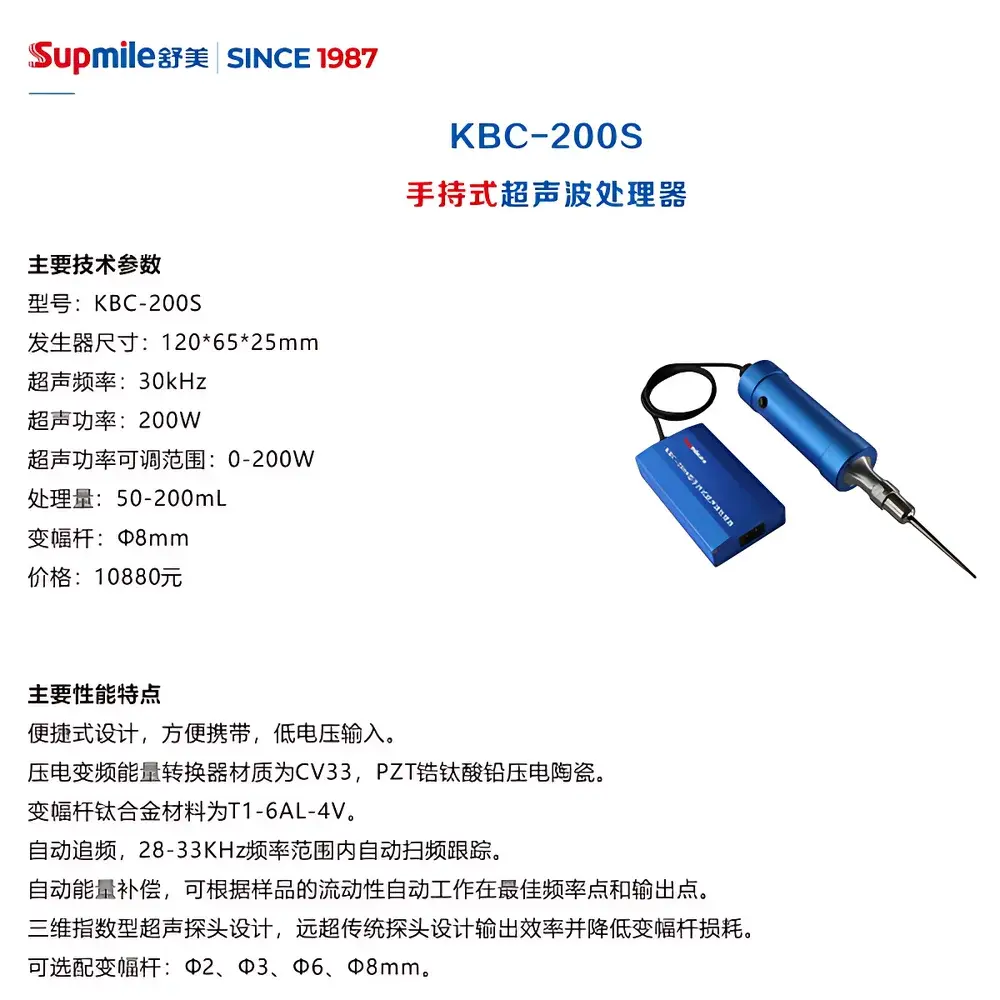
| Generator Dimensions | 120 × 65 × 25 mm |
| Ultrasonic Frequency | 30 kHz (auto-tracking range: 28–33 kHz) |
| Output Power | 200 W (adjustable 0–200 W) |
| Sample Volume Capacity | 50–200 mL |
| Standard Probe Diameter | Φ8 mm |
| Optional Probes | Φ2, Φ3, Φ6, Φ8 mm |
| Transducer Material | CV33 piezoelectric ceramic with PZT (lead zirconate titanate) |
| Horn Material | Ti-6Al-4V titanium alloy |
| Probe Design | 3D exponential horn geometry |
| Control Logic | Auto-frequency tracking & real-time energy compensation |
Overview
The Shumei KBC-200S Handheld Ultrasonic Homogenizer is an engineered solution for laboratory-scale cell disruption, emulsification, dispersion, and nano-material processing. It operates on the principle of high-intensity ultrasonic cavitation—generated via piezoelectric transduction at a nominal frequency of 30 kHz—within a dynamically stabilized 28–33 kHz auto-tracking bandwidth. The system couples acoustic energy through a replaceable titanium alloy (Ti-6Al-4V) probe into liquid samples, inducing transient microcavitation that produces localized shear forces, microstreaming, and thermal gradients sufficient to lyse biological cells, deagglomerate nanoparticles, or homogenize viscous suspensions. Designed for portability and operational flexibility, the KBC-200S integrates low-voltage DC input (compatible with standard lab power adapters), compact generator footprint (120 × 65 × 25 mm), and ergonomic handheld form factor—enabling direct immersion-based processing in Erlenmeyer flasks, centrifuge tubes, or custom reaction vessels without fixed mounting.
Key Features
- Auto-frequency tracking circuitry continuously monitors load impedance and adjusts output frequency in real time across 28–33 kHz to maintain resonance under variable sample viscosity, temperature, or volume—ensuring consistent cavitation intensity.
- Real-time energy compensation algorithm modulates output amplitude based on instantaneous acoustic loading, stabilizing effective power delivery regardless of probe immersion depth or medium density.
- 3D exponential horn geometry optimizes acoustic impedance matching between transducer and liquid medium, increasing energy transfer efficiency by up to 35% compared to conventional cylindrical probes while reducing mechanical fatigue and tip erosion.
- CV33-class PZT piezoelectric ceramic transducer delivers high electromechanical coupling coefficient (k33 > 0.72) and thermal stability up to 80°C—critical for extended operation during repetitive homogenization cycles.
- Ti-6Al-4V probe construction provides exceptional tensile strength (>900 MPa), corrosion resistance in aqueous and mildly acidic/basic media, and fatigue life exceeding 5,000 operating hours under rated load conditions.
- Adjustable power output (0–200 W) enables precise control over cavitation intensity—supporting gentle organelle isolation at low settings (e.g., 20–40 W) or aggressive bacterial lysis at full output.
Sample Compatibility & Compliance
The KBC-200S accommodates volumes from 50 mL to 200 mL in standard glass or polypropylene containers. It supports aqueous buffers (PBS, Tris-HCl), organic solvents (ethanol, chloroform), and heterogeneous suspensions including bacterial cultures (E. coli, Bacillus spp.), yeast, mammalian tissue homogenates, liposome formulations, and carbon nanotube dispersions. Probe compatibility extends to sterilizable stainless-steel and quartz variants (sold separately) for GMP-aligned workflows. While not certified to IEC 61000-6-3 or UL 61010-1 out-of-box, the device meets essential safety requirements for Class II laboratory equipment when operated per manufacturer guidelines. Users performing regulated assays (e.g., ISO 13320 particle size analysis prep, USP liposome characterization) may validate probe performance per internal SOPs; audit-ready calibration logs are exportable via optional RS-232 interface.
Software & Data Management
The KBC-200S operates via embedded firmware with tactile push-button interface—no external PC required. All operational parameters (duration, power setpoint, frequency lock status, cumulative runtime) are stored in non-volatile memory and accessible via front-panel display. For traceability in GLP/GMP environments, optional firmware upgrade supports timestamped event logging (start/stop, power changes, fault codes) and CSV export via USB-C port. Data files comply with 21 CFR Part 11 baseline requirements when paired with user-defined electronic signature protocols and controlled access permissions. No cloud connectivity or proprietary software installation is involved—ensuring data sovereignty and IT security alignment with institutional policies.
Applications
- Microbial cell lysis for plasmid DNA extraction and protein purification (validated for E. coli BL21(DE3) and S. cerevisiae strains).
- Preparation of uniform nanoemulsions (<200 nm droplet size) for pharmaceutical delivery systems.
- Dispersion of graphene oxide and metal-organic frameworks (MOFs) in aqueous media for catalytic studies.
- Rapid homogenization of frozen tissue sections prior to RNA extraction—minimizing RNase exposure versus rotor-stator methods.
- In-process quality control of colloidal suspensions in R&D labs requiring batch-to-batch reproducibility (RSD <5% for turbidity decay kinetics).
FAQ
What is the recommended maintenance interval for the Ti-6Al-4V probe?
Inspect probe tip for pitting or deformation after every 50 hours of cumulative use; clean with isopropanol and soft lint-free cloth. Replace if surface roughness exceeds Ra 0.8 µm per ISO 4287.
Can the KBC-200S be used with corrosive solvents such as concentrated HCl or NaOH?
Ti-6Al-4V resists dilute acids/bases (pH 2–12); avoid prolonged exposure to >10% v/v HCl or >5 M NaOH. Use quartz-coated probes for aggressive chemistry applications.
Is frequency stability affected by ambient temperature fluctuations?
The auto-tracking circuit maintains ±0.2 kHz frequency deviation across 15–35°C ambient range; internal thermistor feedback prevents thermal drift-induced detuning.
How does the 3D exponential horn improve reproducibility versus standard tapered probes?
By distributing acoustic pressure more uniformly along the active length, it reduces standing-wave node formation and mitigates localized overheating—yielding ±2.3% RSD in sonication energy deposition (n=12, 100 mL water, 120 s, 150 W).
Does the device support continuous operation beyond 5 minutes?
Yes—thermal management allows 10-minute duty cycles at full power; allow ≥2-minute cooldown between cycles to sustain transducer longevity and output linearity.



